Results by title
8 books match the query 'Violent crimes'
Crime and Justice, Volume 24
Youth ViolenceEdited by Michael Tonry and Mark H. Moore
University of Chicago Press Journals, 1998
Featuring articles by leading American and European scholars from many fields, Youth Violence provides a reliable, up-to-date, authoritative and comprehensive overview of policy issues and research developments concerning crime and violence among the young.
Exceptional Violence
Embodied Citizenship in Transnational JamaicaDeborah A. Thomas
Duke University Press, 2011
Refiguring Race and Risk
Counternarratives of Care in the US Security StateRoberta Wolfson
The Ohio State University Press, 2024
Savage Portrayals
Race, Media and the Central Park Jogger StoryNatalie Byfield
Temple University Press, 2014

The Civilization of Crime
Violence in Town and Country since the Middle AgesEdited by Eric A. Johnson and Eric H. Monkkonen
University of Illinois Press, 1996
of Western culture, has crime itself become more "civilized"?
This book exposes as myths the beliefs that society has become more violent
than it has been in the past and that violence is more likely to occur
in cities than in rural areas.
The product of years of study
by scholars from North America and Europe, The Civilization of Crime
shows that, however violent some large cities may be now, both rural and
urban communities in Sweden, Holland, England, and other countries were
far more violent during the late Middle Ages than any cities are today.
Contributors show that the
dramatic change is due, in part, to the fact that violence was often tolerated
or even accepted as a form of dispute settlement in village-dominated
premodern society. Interpersonal violence declined in the seventeenth
and eighteenth centuries, as dispute resolution was taken over by courts
and other state institutions and the church became increasingly intolerant
of it.
The book also challenges a
number of other historical-sociological theories, among them that contemporary
organized crime is new, and addresses continuing debate about the meaning
and usefulness of crime statistics.
CONTRIBUTORS: Esther Cohen,
Herman Diederiks, Florike Egmond, Eric A. Johnson, Michele Mancino, Eric
H. Monkkonen, Eva Österberg, James A. Sharpe, Pieter Spierenburg,
Jan Sundin, Barbara Weinberger
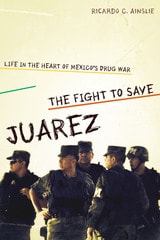
The Fight to Save Juárez
Life in the Heart of Mexico's Drug WarBy Ricardo C. Ainslie
University of Texas Press, 2013
The city of Juárez is ground zero for the drug war that is raging across Mexico and has claimed close to 60,000 lives since 2007. Almost a quarter of the federal forces that former President Felipe Calderón deployed in the war were sent to Juárez, and nearly 20 percent of the country’s drug-related executions have taken place in the city, a city that can be as unforgiving as the hardest places on earth. It is here that the Mexican government came to turn the tide. Whatever happens in Juárez will have lasting repercussions for both Mexico and the United States.
Ricardo Ainslie went to Juárez to try to understand what was taking place behind the headlines of cartel executions and other acts of horrific brutality. In The Fight to Save Juárez, he takes us into the heart of Mexico’s bloodiest city through the lives of four people who experienced the drug war from very different perspectives—Mayor José Reyes Ferriz, a mid-level cartel player’s mistress, a human rights activist, and a photojournalist. Ainslie also interviewed top Mexican government strategists, including members of Calderón’s security cabinet, as well as individuals within U.S. law enforcement. The dual perspective of life on the ground in the drug war and the “big picture” views of officials who are responsible for the war’s strategy, creates a powerful, intimate portrait of an embattled city, its people, and the efforts to rescue Juárez from the abyss.
Violent Criminal Acts and Actors Revisited
Lonnie Athens
University of Illinois Press, 1997
as "the most far-reaching, provocative, and profound analysis of violent conduct" available in criminological literature. In Violent Criminal Acts and Actors Revisited, Athens returns to his pioneering work and finds that his premises are just as relevant and original as in their earlier version--and that they have been curiously, and to society's detriment, overlooked.
Rather than finding the causes of criminal behavior in external forces
or personality disorders, as conventional wisdom often does, Athens renews his fundamental argument that a violent situation comes into being when defined by an individual as a situation that calls for violence--that an actor responds to the circumstance as he or she defines it. Based on the author's many firsthand interviews with offenders and on his personal experience, Violent Criminal Acts and Actors Revisited augments Athens’s call to reexamine the source and locus of violent criminal behavior.
Why We Harm
Presser, Lois
Rutgers University Press, 2013
2014 Choice Outstanding Academic Title
Criminologists are primarily concerned with the analysis of actions that violate existing laws. But a growing number have begun analyzing crimes as actions that inflict harm, regardless of the applicability of legal sanctions. Even as they question standard definitions of crime as law-breaking, scholars of crime have few theoretical frameworks with which to understand the etiology of harmful action.
In Why We Harm, Lois Presser scrutinizes accounts of acts as diverse as genocide, environmental degradation, war, torture, terrorism, homicide, rape, and meat-eating in order to develop an original theoretical framework with which to consider harmful actions and their causes. In doing so, this timely book presents a general theory of harm, revealing the commonalities between actions that impose suffering and cause destruction.
Harm is built on stories in which the targets of harm are reduced to one-dimensional characters—sometimes a dangerous foe, sometimes much more benign, but still a projection of our own concerns and interests. In our stories of harm, we are licensed to do the harmful deed and, at the same time, are powerless to act differently. Chapter by chapter, Presser examines statements made by perpetrators of a wide variety of harmful actions. Appearing vastly different from one another at first glance, Presser identifies the logics they share that motivate, legitimize, and sustain them. From that point, she maps out strategies for reducing harm.