Results by title
6 books match the query 'Virginia Woolf'

Afterwords
Letters on the Death of Virginia WoolfOldfield, Sybil
Rutgers University Press, 2005
On 28 March, 1941, at the height of Hitler's victories during the Second World War, Virginia Woolf filled her pockets with stones and drowned herself in the River Ouse near her home in Sussex. At the time of her death some voices in the press attacked her for showing cowardice in the face of the enemy and for setting a bad example to the general population. Woolf's suicide has been the subject of controversy for the media, for literary scholars, and for her biographers ever since.
Just when it may seem that nothing else could be said about Virginia Woolf and the ambiguous details of her suicide, Afterwords provides an entirely fresh perspective. It makes available to a wide readership for the first time letters sent to Leonard Woolf and Vanessa Bell (Virginia Woolf's sister) in the aftermath of the event. This unique volume brings together over two hundred letters from T. S. Eliot, H. G. Wells, May Sarton, Vita Sackville-West, Edith Sitwell, E. M. Forster, Radclyffe Hall, and many others, including political figures and religious leaders. In addition, informative annotations reveal the identities of many unexpected condolence-letter writers from among the general public.
In her introduction, editor Sybil Oldfield confronts the contemporary controversy over Woolf's suicide note, arguing that no one who knew Woolf or her work believed that she had deserted Britain. The ensuing collection of letters supports Oldfield's assertion. In elegant prose that rises to the stature of the occasion, these writers share remembrances of Virginia Woolf in life, comment on the quality of her work and her antifascist values, and reveal previously unknown facets of her capacity for friendship.
A richly deserved tribute to the life of an extraordinary woman as well as a testimony to the human capacity for sympathy, Afterwords is essential reading for anyone interested in the life, death, and enduring impact of Virginia Woolf.
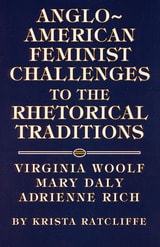
Anglo-American Feminist Challenges to the Rhetorical Traditions
Virginia Woolf, Mary Daly, Adrienne RichKrista Ratcliffe
Southern Illinois University Press, 1996
Although women and men have different relationships to language and to each other, traditional theories of rhetoric do not foreground such gender differences. Krista Ratcliffe argues that because feminists generally have not conceptualized their language theories from the perspective of rhetoric and composition studies, rhetoric and composition scholars must construct feminist theories of rhetoric by employing a variety of interwoven strategies: recovering lost or marginalized texts; rereading traditional rhetoric texts; extrapolating rhetorical theories from such nonrhetoric texts as letters, diaries, essays, cookbooks, and other sources; and constructing their own theories of rhetoric.
Focusing on the third option, Ratcliffe explores ways in which the rhetorical theories of Virginia Woolf, Mary Daly, and Adrienne Rich may be extrapolated from their Anglo-American feminist texts through examination of the interrelationship between what these authors write and how they write. In other words, she extrapolates feminist theories of rhetoric from interwoven claims and textual strategies. By inviting Woolf, Daly, and Rich into the rhetorical traditions and by modeling the extrapolation strategy/methodology on their writings, Ratcliffe shows how feminist texts about women, language, and culture may be reread from the vantage point of rhetoric to construct feminist theories of rhetoric. She also outlines the pedagogical implications of these three feminist theories of rhetoric, thus contributing to ongoing discussions of feminist pedagogies.
Traditional rhetorical theories are gender-blind, ignoring the reality that women and men occupy different cultural spaces and that these spaces are further complicated by race and class, Ratcliffe explains. Arguing that issues such as who can talk, where one can talk, and how one can talk emerge in daily life but are often disregarded in rhetorical theories, Ratcliffe rereads Roland Barthes’ "The Old Rhetoric" to show the limitations of classical rhetorical theories for women and feminists. Discovering spaces for feminist theories of rhetoric in the rhetorical traditions, Ratcliffe invites readers not only to question how women have been located as a part of— and apart from—these traditions but also to explore the implications for rhetorical history, theory, and pedagogy.

Possible Worlds
Jorge Luis Borges's (Pseudo-) Translations of Virginia Woolf and Franz KafkaRebecca DeWald
University of London Press, 2020
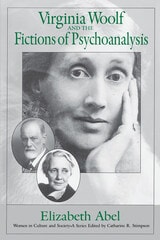
Virginia Woolf and the Fictions of Psychoanalysis
Elizabeth Abel
University of Chicago Press, 1989
"Virginia Woolf and the Fictions of Psychoanalysis brings Woolf's extraordinary craftsmanship back into view; the book combines powerful claims about sexual politics and intellectual history with the sort of meticulous, imaginative close reading that leaves us, simply, seeing much more in Woolf's words than we did before. It is the most exciting book on Woolf to come along in some time."—Lisa Ruddick, Modern Philology
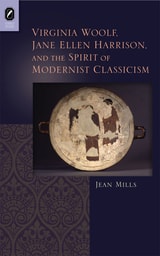
Virginia Woolf, Jane Ellen Harrison, and the Spirit of Modernist Classicism
Jean Mills
The Ohio State University Press, 2014
To an extent, Virginia Woolf, Jane Ellen Harrison, and the Spirit of Modernist Classicism participates in an act of classical recovery. It is an effort to revive and reclaim Harrison’s work and to illustrate the degree to which her cultural, political, and scholastic example informed one of the major modernist voices of the twentieth century.
Women Who Make a Fuss
The Unfaithful Daughters of Virginia WoolfIsabelle Stengers
University of Minnesota Press, 2014
Virginia Woolf, to whom university admittance had been forbidden, watched the universities open their doors. Though she was happy that her sisters could study in university libraries, she cautioned women against joining the procession of educated men and being co-opted into protecting a “civilization” with values alien to women. Now, as Woolf’s disloyal (unfaithful) daughters, who have professional positions in Belgian universities, Isabelle Stengers and Vinciane Despret, along with a collective of women scholars in Belgium and France, question their academic careers and reexamine the place of women and their role in thinking, both inside and outside the university. They urge women to heed Woolf’s cry—Think We Must—and to always make a fuss about injustice, cruelty, and arrogance.