Results by title
4 books match the query 'Visual communication in art'
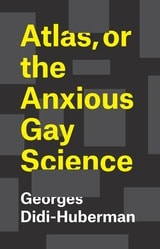
Atlas, or the Anxious Gay Science
Georges Didi-Huberman
University of Chicago Press, 2018
Aby Warburg’s Mnemosyne Atlas (1925–1929) is a prescient work of mixed media assemblage, made up of hundreds of images culled from antiquity to the Renaissance and arranged into startling juxtapositions. Warburg’s allusive atlas sought to illuminate the pains of his final years, after he had suffered a breakdown and been institutionalized. It continues to influence contemporary artists today, including Gerhard Richter and Mark Dion.
In this illustrated exploration of Warburg and his great work, Georges Didi-Huberman leaps from Mnemosyne Atlas into a set of musings on the relation between suffering and knowledge in Western thought, and on the creative results of associative thinking. Deploying writing that delights in dramatic jump cuts reminiscent of Warburg’s idiosyncratic juxtapositions, and drawing on a set of sources that ranges from ancient Babylon to Walter Benjamin, Atlas, or the Anxious Gay Science is rich in Didi-Huberman’s trademark combination of elan and insight.
In this illustrated exploration of Warburg and his great work, Georges Didi-Huberman leaps from Mnemosyne Atlas into a set of musings on the relation between suffering and knowledge in Western thought, and on the creative results of associative thinking. Deploying writing that delights in dramatic jump cuts reminiscent of Warburg’s idiosyncratic juxtapositions, and drawing on a set of sources that ranges from ancient Babylon to Walter Benjamin, Atlas, or the Anxious Gay Science is rich in Didi-Huberman’s trademark combination of elan and insight.
[more]
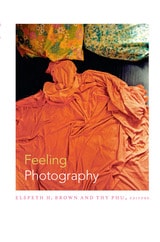
Feeling Photography
Elspeth H. Brown and Thy Phu, eds.
Duke University Press, 2014
This innovative collection demonstrates the profound effects of feeling on our experiences and understanding of photography. It includes essays on the tactile nature of photos, the relation of photography to sentiment and intimacy, and the ways that affect pervades the photographic archive. Concerns associated with the affective turn—intimacy, alterity, and ephemerality, as well as queerness, modernity, and loss—run through the essays. At the same time, the contributions are informed by developments in critical race theory, postcolonial studies, and feminist theory. As the contributors bring affect theory to bear on photography, some interpret the work of contemporary artists, such as Catherine Opie, Tammy Rae Carland, Christian Boltanski, Marcelo Brodsky, Zoe Leonard, and Rea Tajiri. Others look back, whether to the work of the American Pictorialist F. Holland Day or to the discontent masked by the smiles of black families posing for cartes de visite in a Kodak marketing campaign. With more than sixty photographs, including twenty in color, this collection changes how we see, think about, and feel photography, past and present.
Contributors. Elizabeth Abel, Elspeth H. Brown, Kimberly Juanita Brown, Lisa Cartwright, Lily Cho, Ann Cvetkovich, David L. Eng, Marianne Hirsch, Thy Phu, Christopher Pinney, Marlis Schweitzer, Dana Seitler, Tanya Sheehan, Shawn Michelle Smith, Leo Spitzer, Diana Taylor
Contributors. Elizabeth Abel, Elspeth H. Brown, Kimberly Juanita Brown, Lisa Cartwright, Lily Cho, Ann Cvetkovich, David L. Eng, Marianne Hirsch, Thy Phu, Christopher Pinney, Marlis Schweitzer, Dana Seitler, Tanya Sheehan, Shawn Michelle Smith, Leo Spitzer, Diana Taylor
[more]

Scrap Theory
Reproductive Injustice in the Black Feminist ImaginationMali D. Collins
The Ohio State University Press, 2025
Reproductive justice debates have often focused on the right to not have children, but rarely do they address the right to remember children lost to violence. Turning her attention to visual and written works by Black women documenting mother–child separation, Mali D. Collins invites us to deploy a theory of “scraps” to understand the ways that the lives of Black mothers and children are documentations of centuries of racialized and gendered torment. Focusing on creative works from the late twentieth century through the present, including the writings of Toni Cade Bambara, M. NourbeSe Philip, and Edwidge Danticat; the critical activism of Erica Garner; and visual/material art by Samaria Rice and Elizabeth Catlett, Collins argues that Black women’s creative work should be recognized as memory work that plays a crucial role in the cultural processing of racial and maternal trauma. By centering creative scraps—interstitial, fragmentary, or discarded elements—of maternal dispossession, Scrap Theory brings together theories of archival injustice and reproductive injustice to illuminate how the archival erasure of Black motherhood is an urgent concern for the movement for reproductive justice.
[more]

Seeing Witness
Visuality and the Ethics of TestimonyJane Blocker
University of Minnesota Press, 2009
Unearthing the meaning of witnessing in contemporary art and politics
The act of bearing witness can reveal much, but what about the figure of the witness itself? As contemporary culture is increasingly dominated by surveillance, the witness—whether artist, historian, scientist, government official, or ordinary citizen—has become empowered in realms from art to politics.
In Seeing Witness, Jane Blocker challenges the implicit authority of witnessing through the examination of a series of contemporary artworks, all of which make the act of witnessing visible, open to inspection and critique. Considering such artists as Marina Abramović, James Luna, Felix Gonzalez-Torres, Eduardo Kac, and Ann Hamilton, Blocker investigates the artists and spectators who look, the technologies they look with, and the forms of power and moral authority that permit their viewing. Going beyond particular traumatic or sensational events, Blocker contemplates the politics of witnessing and argues that the witness represents a morally unique—and even problematic—position of privilege. Separating Seeing Witness from previous literature on the subject, she finds that the visual is inherent in witnessing and asserts that contemporary art is integral to questioning and understanding how witnessing is mobilized in culture today.[more]