Results by title
12 books match the query 'Volume 16'

Adolescent Psychiatry, Volume 16
Developmental and Clinical StudiesEdited by Sherman C. Feinstein
University of Chicago Press, 1989
Crime and Justice, Volume 16
An Annual Review of ResearchEdited by Michael Tonry
University of Chicago Press Journals, 1992
Derrida's Gift, Volume 16
Elizabeth Weed and Ellen Rooney, eds.
Duke University Press, 0
In bringing together major feminist critics whose work has been touched by the writings of Derrida, this issue both pays tribute to and reflects upon Derrida’s ideas. Among the essayists included, Jane Gallop considers Derrida’s writings on Levinas; Judith Butler reads Derrida’s final interview in Le Monde in 2004; Elizabeth Grosz signals Derrida as a rare philosopher for whom sexual difference was crucial; Gayatri Chakravorty Spivak explores the figure of the mother’s child in Derrida, focusing on the critique of reproductive heteronormativity and the question of agency in feminism; and Joan Wallach Scott argues for the importance of critique in the academy. The issue also includes an edited transcription of a vibrant discussion between feminist theorists and Derrida called “Women in the Beehive: A Seminar with Jacques Derrida,” which took place at Brown University’s Pembroke Center for Teaching and Research on Women in 1984.
Contributors. Fran Bartkowski, Anne-Emmanuelle Berger, Susan Bernstein, Judith Butler, Pheng Cheah, Drucilla Cornell, Jane Gallop, Elizabeth Grosz, Peggy Kamuf, Christie McDonald, Joan Wallach Scott, Gayatri Chakravorty Spivak
Early Women Stars, Volume 16
Jennifer M. Bean and Diane Negra, eds.
Duke University Press, 0
Essays focus on figures across the wide international lexicon of stardom, including stunt star Pearl White, iconic French performer Musidora, imported European vamp Pola Negri, pixie heroine Colleen Moore, and Chinese star Xuan Jinglin. Other articles revisit figures, such as Mary Pickford and Greta Garbo, whose stardom appears to be self-evident but proves more complex than previous accounts have suggested. In this collection, early female stars function as a medium through which authors reconceptualize feminist film history and historiography.
Contributors. Jennifer M. Bean, Vicki Callahan, Lucy Fischer, Amelie Hastie, Diane Negra, Gaylyn Studlar, Zhen Zhang
Handbook of Middle American Indians, Volume 16
Sources Cited and Artifacts IllustratedRobert Wauchope, series editor; Margaret A.L. Harrison, volume editor
University of Texas Press, 1976
The publication of Volume 16 of this distinguished series brings to a close one of the largest research and documentation projects ever undertaken on the Middle American Indians.
Since the publication of Volume 1 in 1964, the Handbook of Middle American Indians has provided the most complete information on every aspect of indigenous culture, including natural environment, archaeology, linguistics, social anthropology, physical anthropology, ethnology, and ethnohistory.
Culminating this massive project is Volume 16, divided into two parts. Part I, Sources Cited, by Margaret A. L. Harrison, is a listing in alphabetical order of all the bibliographical entries cited in Volumes 1-11. (Volumes 12-15, comprising the Guide to Ethnohistorical Sources, have not been included, because they stand apart in subject matter and contain or constitute independent bibliographical material.) Part II, Location of Artifacts Illustrated, by Marjorie S. Zengel, details the location (at the time of original publication) of the owner of each pre-Columbian American artifact illustrated in Volumes 1-11 of the Handbook, as well as the size and the catalog, accession, and/or inventory number that the owner assigns to the object. The two parts of Volume 16 provide a convenient and useful reference to material found in the earlier volumes.
The Handbook of Middle American Indians was assembled and edited at the Middle American Research Institute of Tulane University with the assistance of grants from the National Science Foundation and under the sponsorship of the National Research Council Committee on Latin American Anthropology.

Intellectual Politics in Post-Tiananmen China, Volume 16
Xudong Zhang
Duke University Press, 0
Creating a platform for further theoretical discussion about the ongoing struggle to bring about a new social system, the contributors grapple with the internal crisis or disorientation of the Chinese intellectual world as a distorted, but telling picture of the complexity of contemporary Chinese economics, politics, society, and culture. Essays offer a critical examination of the current state of Chinese intellectual discourse; a challenge to mainstream liberalism in China today and its commitment to democracy; a summary of reconsiderations of property rights, economic democracy, political participation, and the meaning of socialism in the age of flexible production; a reflection on the handover of Hong Kong in the context of a general discussion of Western colonialism in China; and an analysis of the rise of consumer nationalism and mass culture in China since the early 1990s. Intellectual Politics in Post-Tiananmen China sheds light on the evasive nature of Chinese society, and the contributors engage the Chinese problematic not only as a crisis but also as an ongoing historical dynamic.
Contributors. Rey Chow, Zhiyuan Cui, Wang Hui, Gan Yang, Xudong Zhang
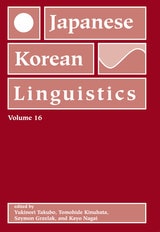
Japanese/Korean Linguistics, Volume 16
Edited by Yukinori Takubo, Tomohide Kinuhata, Szymon Grzelak, and Kayo Nagai
CSLI, 2009
The annual Japanese/Korean Linguistics Conference provides a forum for presenting research that will broaden the understanding of these two languages, especially through comparative study. The sixteenth Japanese/Korean Linguistics Conference, held in October of 2006 at Kyoto University, was the first in the history of the conference to be held outside of the United States. The thirty-six papers in this volume encompass a variety of areas, such as phonetics; phonology; morphology; syntax; semantics; pragmatics; discourse analysis; and the geographical and historical factors that influence the development of languages, sociolinguistics, and psycholinguistics.
Johannesburg
The Elusive Metropolis, Volume 16Sarah Nuttall and Achille Mbembe, eds.
Duke University Press, 0
Contributors to this issue—a mix of scholars, urban planners, and artists, many of whom hail from South Africa—reveal Johannesburg to be a polycentric and international city that has developed its own cosmopolitan culture. In a detailed study of three streets in the modern precinct of Melrose Arch, one essay shows how the thoroughly commodified and marketed Johannesburg cityscape has shaped the cultural sensitivities, aesthetics, and urban subjectivities of its inhabitants, at times even overriding the historical memory of apartheid. Another essay, focusing on the emergence of a new urban culture, examines how the city itself becomes a crucial site for the remixing and reassembling of racial identities. By tracking the movement of people with AIDS to various locations in the city to seek relief and treatment, another essay reveals an urban geography very different from what is seen from the highways. Finally, through interviews and commentaries, journalists, artists, and architects of Johannesburg offer reflections on the geography and shifting culture of the city and its townships, on the complicated relationship between Johannesburg and other African cities, and on the search for an architectural style that adequately expresses the complexity of this cosmopolitan city.
Contributors. Lindsay Bremner, Nsizwa Dlamini, Mark Gevisser, Grace Khunou, Frédéric Le Marcis, John Matshikiza, Achille Mbembe, Sarah Nuttall, Rodney Place, AbdouMaliq Simone, Michael Watts
Ocean Yearbook, Volume 16
Edited by Elisabeth Mann Borgese, Aldo Chircop, and Moira L. McConnell
University of Chicago Press, 2002
Selected Documents and Proceedings include:
Report of the International Ocean Institute 1999 - 2000
Oceans and the Law of the Sea Report of the Secretary General, 2000
UN Convention on the Law of the Sea Report
The Hamburg Declaration on the Ocean
The Fiji Declaration on Islands in the New Millennium
The Appendix includes a Directory of Oceans-related Institutions
Since its inception in 1978, the Ocean Yearbook has proven an invaluable research tool to marine biologists, oceanographers, ocean development specialists, students of international law, as well as analysts of foreign policy and international security.
Osiris, Volume 16
Science in Theistic Contexts: Cognitive DimensionsEdited by John Hedley Brooke, Margaret J. Osler, and Jitse M. van der Meer
University of Chicago Press, 2001
Reflecting the fecundity of contemporary scholarship, the current volume should be of extraordinary interest to historians of science, scientists, as well as anyone intrigued by the many ways in which relations between religion and science have been constructed.
Contributors include:
Peter Barker,
John Hedley Brooke,
Geoffrey Cantor,
Margaret G. Cook,
Michael J. Crowe,
Thomas Dixon,
Noah J. Efron,
Richard England,
Martin Fichman,
Maurice A. Finocchiaro,
Menachem Fish,
Bernard R. Goldstein,
Bernard Lightman,
Margaret J. Osler
F. Jamil Ragep,
Phillip R. Sloan,
Stephen Snobelen,
Jitse M. van der Meer,
Stephen J. Wykstra,
The Collected Letters of Thomas and Jane Welsh Carlyle
January–July 1843, Volume 16Clyde de L. Ryals and Kenneth J. Fielding
Duke University Press, 0
The Talmud of the Land of Israel, Volume 16
Rosh HashanahJacob Neusner, General Editor
University of Chicago Press, 1988