Results by title
4 books match the query 'Volume VII'

The Collected Works of William Howard Taft, Volume VII
Taft Papers on League of NationsFrank X. Gerrity
Ohio University Press, 2003
Eager to turn the congressional election of 1918 into a confirmation of his foreign policy, President Woodrow Wilson was criticized for abandoning the spirit of the popular slogan “Politics adjourned!”
His predecessor, William Howard Taft, found Wilson difficult to deal with and took issue with his version of the League of Nations, which Taft felt was inferior to the model proposed by the League to Enforce Peace. Rather than join the massive Republican opposition to the Treaty of Versailles, however, Taft instead supported Wilson’s controversial decision to travel to Paris as the head of the American peace delegation, and he defended the critical tenth article in the covenant, which detractors saw as a surrender of American sovereignty. He also counseled Wilson to insert a clause concerning the Monroe Doctrine that would pacify the Senate’s group of “reservationists,” whose votes were essential to approval of the treaty.
Volume VII in The Collected Works of William Howard Taft consists of the Taft Papers on League of Nations originally published in 1920. This is a collection ofTaft’s speeches, newspaper articles, and complementary documents that reflect his consistent support for a league of nations and, eventually, for the Covenant of the League of Nations emanating from the Paris Peace Conference.
Although the failure of the treaty and its League of Nations can probably be laid at the feet of an obstinate Wilson and a wily Henry Cabot Lodge, William Howard Taft can be credited with rising above partisanship to emerge as the League’s most consistent supporter.
As in the rest of the Collected Works, Taft Papers on League of Nations provides a window on the machinations surrounding some of the most significant decisions of the era.
The Complete Works of Robert Browning, Volume VII
With Variant Readings and AnnotationsRobert Browning
Ohio University Press, 1985
The first complete edition of the works of Robert Browning with variant readings and annotations contains: 1. The entire contents of the first editions of Browning’s work; 2. All prefaces and dedications which Browning wrote for his own works and for those of Elizabeth Barrett Browning and others; 3. The two prose essays: The Essay on Chatterton and The Essay on Shelley; 4. The front matter and tables of contents of each of the collected editions (1849, 1863, 1865, 1868, 1888–1889) which Browning himself saw through the press; 5 Poems by Browning published during his lifetime but not collected by him; 9. Poems not published during Browning’s lifetime which have come to light since his death; 7. John Forster’s Thomas Wentworth, Earl of Strafford to which Browning contributed significantly, though to what precise extent has not been determined.
The edition provides a full apparatus, including variant readings and annotations.
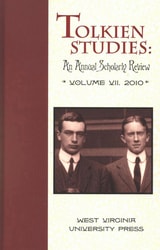
Tolkien Studies
An Annual Scholarly Review, Volume VIIMichael D.C. Drout
West Virginia University Press, 2010
Walt Whitman
The Correspondence, Volume VIITed Genoways
University of Iowa Press, 2005
Now, more than forty years after the inaugural volume’s original publication, Ted Genoways brings scholars the latest volume in Walt Whitman: The Correspondence. Incorporating all of the letters Miller had collected before his death in 2001 and combining them with more than a hundred previously unknown letters he himself gathered, Genoways’s volume is a perfect accompaniment to Miller’s original work.
Among the more than one hundred fifty letters collected in this volume are numerous correspondences concerning Whitman’s Civil War years, including a letter sending John Hay, the personal secretary to Abraham Lincoln, a manuscript copy of “O Captain, My Captain!” Additional letters address various aspects of the production of Leaves of Grass, the most notable being an extensive correspondence surrounding the Deathbed Edition, gathered by Whitman’s friend Horace Traubel, and reproduced here for the first time. Most significantly, this volume at last incorporates Whitman’s early letters to Abraham Paul Leech, first published by Arthur Golden in American Literature in 1986. The revelations contained in these letters must be considered among the most important discoveries about Whitman’s life made during the last half of the twentieth century.
Regardless of whether their significance is great or small, immediate or long-term, each new piece of Whitman’s correspondence returns us to a particular moment in his life and suggests the limitless directions that remain for Whitman scholarship.