Results by title
18 books match the query 'Volunteer Work'
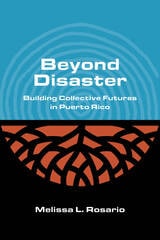
Beyond Disaster
Building Collective Futures in Puerto RicoMelissa L. Rosario
Northwestern University Press, 2025
An alternative view of Puerto Rico’s past, present, and future
How do we map the pathways to liberation where we have been taught to see only trauma, suffering, and lack? Melissa L. Rosario offers an alternative view of Puerto Rico, America’s oldest colony, removing readers from the framework of crisis to consider the deeper legacies of its current impasse. Beyond Disaster: Building Collective Futures in Puerto Rico is an intimate portrait, weaving insights from the author’s own life, research, and organizing work as a scholar in the diaspora who rematriated. Rosario bridges the genres of social history and memoir to unsettle the meaning of resistance and freedom, underscoring the deep wounds of colonialism while still uplifting the profound possibilities of embodied alternatives.
Beyond Disaster critiques the framework of debt and crisis by examining the psychological, emotional, and spiritual effects of colonialism. Rosario highlights key examples of organizing efforts to defend land and education against total enclosure, protecting life amid loss. This book offers a series of microhistories, vignettes, and prose poetry to foreground the daily practices necessary to anchor the ecological and political landscapes of our collective future.
Citizen Power
A Citizen Leadership Manual Introducing the Art of No-Blame Problem SolvingHarry S. Pozycki
Rutgers University Press, 2020
Citizen Power
A Citizen Leadership Manual, New Jersey EditionHarry S. Pozycki
Rutgers University Press, 2021
Citizen Power portal (https://thecitizenscampaign.org/register/).
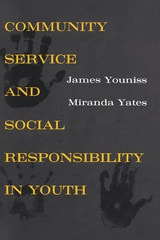
Community Service and Social Responsibility in Youth
James Youniss and Miranda Yates
University of Chicago Press, 1997
Using a case study from a predominantly Black, urban high school in Washington, D.C., Youniss and Yates build on the insights of Erik Erikson on the social and historical nature of identity development. They show that service at a soup kitchen as part of a course on social justice gives youth the opportunity to reflect on their status in society, on how society is organized, on how government should use its power, and on moral principles related to homelessness and poverty. Developing a sense of social responsibility and a civic commitment, youth come to see themselves as active agents in society.
The most authoritative work to date on the subject, this book challenges negative stereotypes of contemporary adolescents and illustrates how youth, when given the opportunity, can use their talents for social good. It will interest readers concerned with the development of today's youth and tomorrow's society.
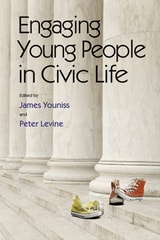
Engaging Young People in Civic Life
James Youniss
Vanderbilt University Press, 2009
The thirteen original essays are based on research in schools and in settings beyond the schoolyard where civic life is experienced. One focus is on programs for those schools in poor communities that tend to overlook civic education. Another chapter reports on how two city governments—Hampton, Virginia, and San Francisco—have invited youth to participate on boards and in agencies. A cluster of chapters focuses on the civic education programs in Canada and Western Europe, where, as in the United States, immigration and income inequality raise challenges to civic life.
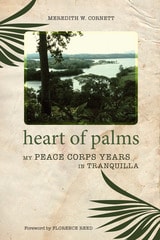
Heart of Palms
My Peace Corps Years in TranquillaMeredith W. Cornett
University of Alabama Press, 2014
A memoir of service, culture and transformation in a rural Panamanian village by a young American woman trained as a community forester for the Peace Corp.
In the storied fifty-year history of the US Peace Corps, Heart of Palms is the first Peace Corps memoir set in Panama, the slender isthmus that connects two continents and two oceans. In her memoir, Meredith Cornett transports readers to the remote village of Tranquilla, where dugout canoes are the mainstay of daily transportation, life and nature are permeated by witchcraft, and a restful night’s sleep may be disturbed by a raiding phalanx of army ants.
Cornett is sent to help counter the rapid deforestation that is destroying the ecosystem and livelihoods of the Panama Canal watershed region. Her first chapters chronicle her arrival and struggles not only with the social issues of language, loneliness, and insecurity, but also with the tragicomic basics of mastering open-fire cookery and intrusions by insects and poisonous snakes. As she grows to understand the region and its people, her keen eye discerns the overwhelming scope of her task. Unable to plant trees faster than they are lost, she writes with moving clarity about her sense of powerlessness.
Combating deforestation leads Cornett into an equally fierce battle against her own feelings of fear and isolation. Her journey to Panama becomes a parallel journey into herself. In this way, Heart of Palms is much more than a record of her Peace Corps service; it is also a moving environmental coming-of-age story and nuanced meditation on one village’s relationship to nature. When she returns home two years later, Cornett brings with her both skills and experience and a remarkable, newfound sense of confidence and mission.
Writing with rueful, self-deprecating humor, Cornett lets us ride along with her on a wave of naïve optimism, a wave that breaks not only on fear and intimidation, but also on tedium and isolation. Heart of Palms offers a bracing alternative to the romantic idealism common to Peace Corps memoirs and will be valued as a welcome addition to writing about the Peace Corps and environmental service.

Heaven's Kitchen
Living Religion at God's Love We DeliverCourtney Bender
University of Chicago Press, 2003
New Advances in the Study of Civic Voluntarism
Resources, Engagement, and RecruitmentCasey Klofstad
Temple University Press, 2016
Individuals who are civically active have three things in common: they have the capacity to do so, they want to, and they have been asked to participate. New Advances in the Study of Civic Voluntarism is dedicated to examining the continued influence of these factors—resources, engagement, and recruitment—on civic participation in the twenty-first century.
The contributors to this volume examine recent social, political, technological, and intellectual changes to provide the newest research in the field. Topics range from race and religion to youth in the digital age, to illustrate the continued importance of understanding the role of the everyday citizen in a democratic society.
Contributors include:Molly Andolina, Allison P. Anoll, Leticia Bode, Henry E. Brady, Traci Burch, Barry C. Burden, Andrea Louise Campbell, David E. Campbell, Sara Chatfield, Stephanie Edgerly, Zoltán Fazekas, Lisa García Bedoll, Peter K. Hatemi, John Henderson, Krista Jenkins, Yanna Krupnikov, Adam Seth Levine, Melissa R. Michelson, S. Karthick Ramakrishnan, Dinorah Sánchez Loza, Kay Lehman Schlozman, Dhavan Shah, Sono Shah, Kjerstin Thorson, Sidney Verba, Logan Vidal, Emily Vraga, Chris Wells, JungHwan Yang, and the editor.
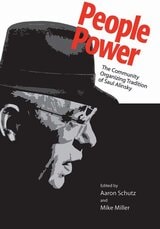
People Power
The Community Organizing Tradition of Saul AlinskyAaron Schutz
Vanderbilt University Press, 2015
--Fred Ross, Cesar Chavez, Dolores Huerta, and the Community Service Organization and National Farm Workers Association
--Nicholas von Hoffman and the Woodlawn Organization
--Tom Gaudette and the Northwest Community Organization
--Ed Chambers, Richard Harmon, and the Industrial Areas Foundation
--Shel Trapp, Gale Cincotta, and National People's Action
--Heather Booth, Midwest Academy, and Citizen Action
--Wade Rathke and ACORN
Weaving classic texts with interviews and their own context-setting commentaries, the editors of People Power provide the first comprehensive history of Alinsky-based organizing in the tumultuous period from 1955 to 1980, when the key organizing groups in the United States took form. Many of these selections--previously available only on untranscribed audiotapes or in difficult-to-read mimeograph or Xerox formats--appear in print here for the first time.
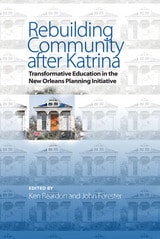
Rebuilding Community after Katrina
Transformative Education in the New Orleans Planning InitiativeKen Reardon
Temple University Press, 2015
Rebuilding Community after Katrina chronicles the innovative and ambitious partnership between Cornell University’s City and Regional Planning department and ACORN Housing, an affiliate of what was the nation’s largest low-income community organization. These unlikely allies came together to begin to rebuild devastated neighborhoods in New Orleans after Hurricane Katrina.
The editors and contributors to this volume allow participants’ voices to show how this partnership integrated careful, technical analysis with aggressive community outreach and organizing. With essays by activists, organizers, community members, and academics on the ground, Rebuilding Community after Katrina presents insights on the challenges involved in changing the way politicians and analysts imagined the future of New Orleans’ Ninth Ward.
What emerges from this complex drama are lessons about community planning, organizational relationships, and team building across multi-cultural lines. The accounts presented in Rebuilding Community after Katrina raise important and sensitive questions about the appropriate roles of outsiders in community-based planning processes.
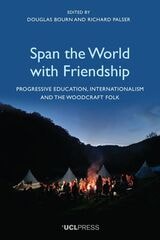
Span the World with Friendship
Edited by Douglas Bourn and Richard Palser
University College London, 2025
For nearly a century, the Woodcraft Folk has championed radical social change through education, but its contributions remain largely overlooked in histories of progressive youth movements. Span the World with Friendship is the first major academic study of this pioneering organization, tracing its role in fostering internationalism, cooperative learning, and environmental activism long before these became mainstream concerns. The Woodcraft Folk’s impact is inspected through diverse disciplinary perspectives, including political theory, anthropology, and youth work studies. Through a review of multiple archival sources—letters, meeting records, and oral testimonies—contributors bring a critical lens to a movement often narrated uncritically.
Beginning with a biography of founder Leslie Paul, the book looks into the Folk’s relationship with the labor movement, its engagement with eugenics debates, and its use of folk traditions as tools for social cohesion. Concluding with an exploration of its transition into a youth-led movement, this volume positions the Woodcraft Folk within broader discussions on education for global justice and activism, ensuring its legacy is finally given the academic attention it deserves.
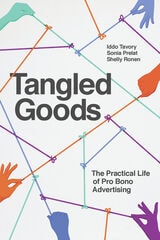
Tangled Goods
The Practical Life of Pro Bono AdvertisingIddo Tavory, Sonia Prelat and Shelly Ronen
University of Chicago Press, 2022
The advertising industry may seem like one of the most craven manifestations of capitalism, turning consumption into a virtue. In Tangled Goods, authors Iddo Tavory, Sonia Prelat, and Shelly Ronen consider an important dimension of the advertising industry that appears to depart from the industry’s consumerist foundations: pro bono ad campaigns. Why is an industry known for biting cynicism and cutthroat competition also an industry in which people dedicate time and effort to “doing good”?
Interviewing over seventy advertising professionals and managers, the authors trace the complicated meanings of the good in these pro bono projects. Doing something altruistic, they show, often helps employees feel more at ease working for big pharma or corporate banks. Often these projects afford them greater creative leeway than they normally have, as well as the potential for greater recognition. While the authors uncover different motivations behind pro bono work, they are more interested in considering how various notions of the good shift, with different motivations and benefits rising to the surface at different moments. This book sheds new light on how goodness and prestige interact with personal and altruistic motivations to produce value for individuals and institutions and produces a novel theory of the relationship among goods: one of the most fraught questions in sociological theory.
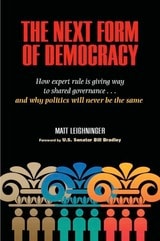
The Next Form of Democracy
How Expert Rule Is Giving Way to Shared Governance—and Why Politics Will Never Be the SameMatt Leighninger
Vanderbilt University Press, 2006
The stories of civic experiments in this book can show us the realpolitik of deliberative democracy, and illustrate how the evolution of democracy is already reshaping politics.
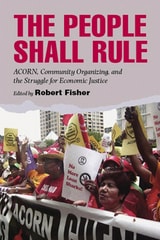
The People Shall Rule
ACORN, Community Organizing, and the Struggle for Economic JusticeRobert Fisher
Vanderbilt University Press, 2009
The twelve chapters in this volume present the perspectives of insiders like founder Wade Rathke and leading outside practitioners and academics. The result is a thorough detailing of ACORN's founding and its changing strategies, including vivid accounts and analyses of its campaigns on the living wage, voter turnout, predatory lending, redlining, school reform, and community redevelopment, as well as a critical perspective on ACORN's place in the community organizing landscape.
The Unheard Voices
Community Organizations and Service LearningRandy Stoecker
Temple University Press, 2009
Service learning has become an institutionalized practice in higher education. Students are sent out to disadvantaged communities to paint, tutor, feed, and help organize communities. But while the students gain from their experiences, the contributors to The Unheard Voices ask, "Does the community?"
This volume explores the impact of service learning on a community, and considers the unequal relationship between the community and the academy. Using eye-opening interviews with community-organization staff members, The Unheard Voices challenges assumptions about the effectiveness of service learning. Chapters offer strong critiques of service learning practices from the lack of adequate training and supervision, to problems of communication and issues of diversity. The book's conclusion offers ways to improve service learning so that future endeavors can be better at meeting the needs of the communities and the students who work in them.
The War on the Social Factory
The Struggle for Community Safety in the Silicon ValleyAnnie Paradise
Northwestern University Press, 2024
A collective ethnography of grassroots mobilizations for community safety across the Silicon Valley
This is a narrative of struggle and solidarity and a collective toolkit for grassroots opposition to militarization, policing, and ongoing conditions of war in the current conjuncture of racial patriarchal capitalism. Grassroots researcher Annie Paradise presents here a collective ethnography of the mothers and community matriarchs whose children have been murdered by police across the San Francisco Bay Area as they develop and practice autonomous, creative forms of resistance.
The War on the Social Factory: The Struggle for Community Safety in the Silicon Valley maps local families’ struggles to reclaim their households and their communities—to create a social infrastructure of care, justice, and safety outside state- and market-determined modes of “security.” Practices such as sustained vigil, testimony, and the production and circulation of insurgent knowledges are shown here to be part of interconnected justice efforts to demilitarize and decarcerate communities in the face of the multiple forms of violence enacted under late racial patriarchal capitalism. Paradise examines the expanding carceral processes of enclosure, criminalization, dispossession, expropriation, and disposability that mark the neoliberal "security” regime across the Silicon Valley and offers counter-counterinsurgent strategies and practices of co-generative, dynamic resistance.
This Book is Free and Yours to Keep
Notes from the Appalachian Prison Book ProjectConnie Banta
West Virginia University Press, 2024
This Book Is Free and Yours to Keep presents a captivating collection of letters and artwork by people in prison that highlights the crucial work done by the Appalachian Prison Book Project (APBP), a nonprofit that provides books to incarcerated people in West Virginia, Virginia, Tennessee, Kentucky, Ohio, and Maryland. Through the words of people directly impacted by the criminal punishment system, the collection provides uncommon insight into reading practices and everyday life in prisons and jails while being an inspiration for prison book projects, prison reform, and abolition.
Simultaneously communicating the vital importance of access to books and education, and conveying the power of community, the letters sent to APBP by incarcerated people spark conversations about race, poverty, and incarceration and shed light on the movement for accountability for state violence. This Book Is Free and Yours to Keep elucidates the violence and neglect perpetuated by carceral systems and offers a way forward based on solidarity and collaboration.
We Make Change
Community Organizers Talk About What They Do--and WhyKristin Layng Szakos
Vanderbilt University Press, 2007