Results by title
10 books match the query 'Wachtel, Andrew'
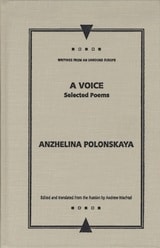
A Voice
Selected PoemsAnzhelina Polonskaya
Northwestern University Press, 2004
Drawn from her most recent Russian collections, A Voice: Selected Poems explores the poet's ongoing fascinations—desolate places, long journeys, a synesthesia of sensory stimulation, and the presence of death. Also on display is her Chekhovian gift for unexpected closure. This is a promising English-language debut from a poet already gaining international attention.
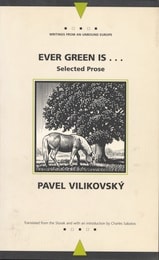
Ever Green Is...
Selected ProsePavel Vilikovsky
Northwestern University Press, 2002
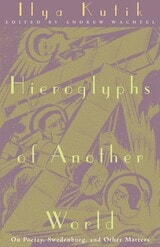
Hieroglyphs of Another World
On Poetry, Swedenborg, and Other MattersIlya Kutik
Northwestern University Press, 2000
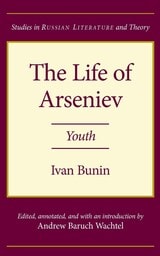
The Life of Arseniev
YouthIvan Bunin
Northwestern University Press, 1994
In ways similar to Nabokov's Speak, Memory, Bunin's novel powerfully evokes the atmosphere of Russia in the decades before the Revolution and illuminates those Russian literary and cultural traditions eradicated in the Soviet era. This first full English-language edition updates earlier translations, taking as its source the version Bunin revised in 1952, and including an introduction and annotations by Andrew Baruch Wachtel.
The Loss
A Novella and Two Short StoriesVladimir Makanin
Northwestern University Press, 1998
In his celebrated short story "The Prisoner of the Caucasus," two Russian soldiers take a Chechen prisoner during the war, and as events unfold, Makanin reveals the casual brutality of the war but also the secret truths of the character's lives. In the novella The Loss, Pekalov, a drunkard and dreamer obsessed with the idea of building a tunnel under the Ural River, disappears in a ditch while working and is made a saint by the people of his village. "Klyucharyov and Alimushkin" tells the story of what happens when one man becomes remarkably lucky while the other loses all his luck.
The Prophecy and Other Stories
Drago Jancar
Northwestern University Press, 2009
These newly collected short stories reveal a master at the top of his game. Drago Jancar possesses an acute understanding of the human psyche, enabling his stories to resonate beyond their particular milieu. This collection features seven pieces, drawn from four different collections, that together present the struggle of individuals against powerful forces. The characters try to make sense of a world of shifting borders and changing names that make the idea of a "homeland"—either literal or figurative—a dream rather than a reality.
The Second Book
Muharem Bazdulj
Northwestern University Press, 2005
Muharem Bazdulj has broken from the pack of new Eastern European writers influenced by innovators such as Danilo Kiš, Milan Kundera, and Jorge Luis Borges. Employing a light touch, a daring anti-nationalist tone, and the kind of ambition that inspires nothing less than a rewriting of Bosnian and Yugoslavian history, Bazdulj weaves the imagined realities of history into fiction and fiction into history. To quote one critic, for Bazdulj history "is the sum of interpretations while imagination is the sum of facts."
Third Wave
The New Russian PoetryKent Johnson and Stephen M. Ashby, Editors. Introduction by Alexei Parshchikov and Andrew Wachtel. Afterword by Mikhail Epstein
University of Michigan Press, 1992
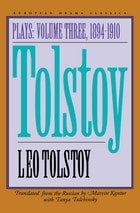
Tolstoy
Plays: Volume III: 1894-1910Leo Tolstoy
Northwestern University Press, 1998
Now noted Slavic philologist Marvin Kantor and Tatiana Tulchinsky have prepared the first complete English translation of the great writer's plays. This volume contains plays written during the years 1894 to 1910, including:
Peter the Breadman
And the Light Shineth in Darkness
The Living Corpse
The Wisdom of Children
The Traveler and the Peasant
The Cause of It All
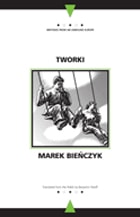
Tworki
Marek Bienczyk
Northwestern University Press, 2008
In Tworki, a village just southwest of Warsaw, there is a psychiatric hospital and in that hospital, the patients and their caretakers are hidden from the war just outside their iron gates. Our hero, Jurek, answers an ad in the paper for a job there and finds himself keeping the books alongside a knockout strawberry blonde named Sonia. They and their group of friends—vital young people like Marcel, an initial rival for Jurek; Olek, Sonia’s chosen love; and Janka, with whom Jurek becomes involved—do their jobs, picnic on the weekends, and dance in the gardens on the grounds of the hospital. Jurek speaks often of, and even in, verse, whether he is talking to his friends or in letters to a distant and admiring cousin. He and his friends live lives that defy the discord and destruction of the war in Europe, striving to rediscover or save whatever beauty they can. Much of this beauty is embodied by Sonia, who is beloved of all the friends and patients at the asylum. But the revitalizing spring they all hope will come for Poland is not to arrive this year. Despite the relative safety of their odd surroundings, the world and the war soon come for the friends. Olek’s absences are longer and unexplained. Marcel is not what he seems, and he and his wife mysteriously disappear, she says, to the gas. And the perfection that Sonia embodies cannot ultimately be kept, by the friends, by the nation, or even by Sonia herself.