Results by title
2 books match the query 'Wachterhauser, Brice R.'
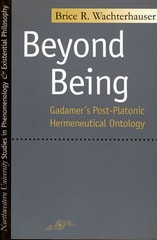
Beyond Being
Gadamer's Post-Platonic Hermeneutic OntologyBrice R. Wachterhauser
Northwestern University Press, 1999
Hans Georg-Gadamer is best known in the English-speaking world for his major work on philosophical hermeneutics, Truth and Method; he has also written extensively on the subject of Plato. Most commentators on Gadamer's work therefore view Gadamer either as a historian of philosophy or as a philosopher in his own right, critically engaged in the philosophical issues of our time.
In Beyond Being, Brice R. Wachterhauser contends that this perceived bifurcation in Gadamer's work oversimplifies and distorts important parts of Gadamer's thought. Wachterhauser argues that only by viewing Gadamer's contribution to philosophy as an integrated whole and by reading Gadamer's hermeneutical studies in light of his Plato studies are we able to avoid certain key misunderstandings of Gadamer, as well as to comprehend more clearly the radical implications of Gadamer's thought.
In Beyond Being, Brice R. Wachterhauser contends that this perceived bifurcation in Gadamer's work oversimplifies and distorts important parts of Gadamer's thought. Wachterhauser argues that only by viewing Gadamer's contribution to philosophy as an integrated whole and by reading Gadamer's hermeneutical studies in light of his Plato studies are we able to avoid certain key misunderstandings of Gadamer, as well as to comprehend more clearly the radical implications of Gadamer's thought.
[more]
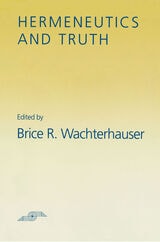
Hermeneutics and Truth
Brice R. Wachterhauser
Northwestern University Press, 1994
The claim that all human thought involves "interpretation," that all human thought is in some way relative to a contingent context of cognitive, theoretical, practical, and aesthetic considerations, has become widely accepted, but what we understand by "truth" and how we should best pursue it are questions raised with renewed force once a hermeneutical starting point has been embraced. Brice R. Wachterhauser's collection Hermeneutics and Truth is an attempt to contribute to this conversation.
No thinkers have wrestled with the issue of truth and interpretation in more illuminating ways for the Continental tradition of philosophy than Heidegger and Gadamer. Hermeneutics and Truth is a dual focus on Heidegger and Gadamer, but it concentrates primarily on Gadamer's efforts to think through the issue of truth for hermeneutics and only secondarily on Heidegger's thought on this issue.
No thinkers have wrestled with the issue of truth and interpretation in more illuminating ways for the Continental tradition of philosophy than Heidegger and Gadamer. Hermeneutics and Truth is a dual focus on Heidegger and Gadamer, but it concentrates primarily on Gadamer's efforts to think through the issue of truth for hermeneutics and only secondarily on Heidegger's thought on this issue.
[more]