Results by title

6 books match the query 'Waiting for'

cover of Waiting For The Revolution To End: Syrian Displacement, Time and Subjectivity

Waiting For The Revolution To End

Syrian Displacement, Time and Subjectivity

Charlotte Al-Khalili

University College London, 2023

An exploration of the Syrian revolution through the experiences of citizens in exile.

Based on more than three years of embedded fieldwork with Syrians displaced in the border city of Gaziantep (southern Turkey), this book places the Syrian revolution and its tragic aftermath under ethnographic scrutiny. It charts the evolution from peaceful uprising (2011) to armed confrontation (2012), descent into fully fledged conflict (2013) and finally to proxy war (2015), to propose an understanding of revolution beyond success and failure.

While the Assad regime remains in place, the Syrian revolution (al-thawra) still holds a transformational power that can be located on intimate and world-making scales. Charlotte Al-Khalili traces the unintended consequences of revolution to reveal the reshaping of Syrian life-worlds and exiles’ evolving theorizations, experiences, and imaginations of al-thawra. She describes the in-between spatio-temporal realm inhabited by Syrians displaced to Turkey as they await the revolution’s outcomes and maps the revolution’s multidimensional and multi-scalar effects on their everyday life. By following the chronology of events inside Syria and Syrians’ geography of displacement, Waiting for the Revolution to End makes the relation between revolution and displacement its centerpiece, both as an ethnographic object and an analytical device.
 
[more]
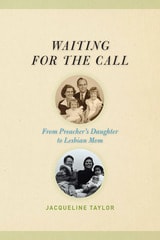
cover of Waiting for the Call: From Preacher's Daughter to Lesbian Mom

Waiting for the Call

From Preacher's Daughter to Lesbian Mom

Jacqueline Taylor

University of Michigan Press, 2007

“Well-written, absorbing, and a great pleasure to read . . . will appeal to Christians struggling to square their traditional beliefs with acceptance of homosexuality as well as to all those interested in adoption, lesbian marriage, and the changing shape of America’s families.”

—Elizabeth C. Fine, Virginia Tech University

Waiting for the Call takes readers from the foothills of the Appalachians—where Jacqueline Taylor was brought up in a strict evangelical household—to contemporary Chicago, where she and her lesbian partner are raising a family. In a voice by turns comic and loving, Taylor recounts the amazing journey that took her in profoundly different directions from those she or her parents could have ever envisioned.

Taylor’s father was a Southern Baptist preacher, and she struggled to deal with his strictures as well as her mother’s manic-depressive episodes. After leaving for college, Taylor finds herself questioning her faith and identity, questions that continue to mount when—after two divorces, a doctoral degree, and her first kiss with a woman—she discovers her own lesbianism and begins a most untraditional family that grows to include two adopted children from Peru.

Even as she celebrates and cherishes this new family, Taylor insists on the possibility of maintaining a loving connection to her religious roots. While she and her partner search for the best way to explain adoption to their children and answer the inevitable question, “Which one is your mom?” they also seek out a church that will unite their love of family and their faith. Told in the great storytelling tradition of the American South, full of deep feeling and wry humor, Waiting for the Call engagingly demonstrates how one woman bridged the gulf between faith and sexual identity without abandoning her principles.
[more]
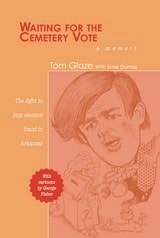
cover of Waiting for the Cemetery Vote: The Fight to Stop Election Fraud in Arkansas

Waiting for the Cemetery Vote

The Fight to Stop Election Fraud in Arkansas

Tom Glaze

University of Arkansas Press, 2011
Waiting for the Cemetery Vote begins with an overview chapter of Arkansas election fraud since the nineteenth century and then moves on to more specific examples of fraudulent activities over a dozen or so years that coincide with the onset of the modern progressive era in Arkansas. Author Tom Glaze, who was a trial lawyer battling election fraud during this time, is the ideal chronicler for this topic, bringing a memoirist's intimate insight together with a wealth of historical knowledge. Glaze describes the manipulation of absentee ballots and poll-tax receipts; votes cast by the dead, children, and animals; forgeries of ballots from nursing homes; and threats to body or livelihood made to anyone who would dare question these activities or monitor elections. Deceptive practices used to control election results were disturbingly brazen in the gubernatorial elections in the 1960s and were especially egregious in Conway and Searcy Counties in the 1970s and in special elections for the state senate in Faulkner, Conway, and Van Buren Counties. A clean-election movement began in the early 1970s, led not by party or political leaders but by individual citizens. These vigilant and courageous Arkansans undertook to do what their public institutions persistently failed to: insure that elections for public office were honest and that the will of the people was scrupulously obliged. Prominent and colorful among these groups was a small band of women in Conway County who dubbed themselves the "Snoop Sisters" and took on the long-established corrupt machine of Sheriff Marlin Hawkins. Written with longtime Arkansas political writer Ernie Dumas and illustrated with cartoons from the inimitable George Fisher, Waiting for the Cemetery Vote will be an entertaining and informative read for any Arkansas history and politics buffs.
[more]
cover of Waiting for the Cool Moon: Anti-imperialist Struggles in the Heart of Japan's Empire

Waiting for the Cool Moon

Anti-imperialist Struggles in the Heart of Japan's Empire

Wendy Matsumura

Duke University Press, 2024
In Waiting for the Cool Moon Wendy Matsumura interrogates the erasure of colonial violence at the heart of Japanese nation-state formation. She critiques Japan studies’ role in this effacement and contends that the field must engage with anti-Blackness and anti-Indigeneity as the grounds on which to understand imperialism, colonialism, fascism, and other forces that shape national consciousness. Drawing on Black radical thinkers’ critique of the erasure of the Middle Passage in universalizing theories of modernity’s imbrication with fascism, Matsumura traces the consequences of the Japanese empire’s categorization of people as human and less-than-human as manifested in the 1920s and 1930s, and the struggles of racialized and colonized people against imperialist violence. She treats the archives safeguarded by racialized, colonized women throughout the empire as traces of these struggles, including the work they performed to keep certain stories out of view. Matsumura demonstrates that tracing colonial sensibility and struggle is central to grappling with their enduring consequences for the present.
[more]
cover of Waiting for the Dawn: Mircea Eliade in Perspective

Waiting for the Dawn

Mircea Eliade in Perspective

Davíd Carrasco

University Press of Colorado, 1991
First published in 1991, Waiting for the Dawn is the result of a year-long interdisciplinary study of Mircea Eliade’s scholarly, literary, and autobiographical works which took place at the University of Colorado in 1982. With a preface by Davíd Carrasco that takes into account recent developments in Eliade scholarship, this important work is back in print after renewed interest in Eliade thanks to Francis Ford Coppola’s screen adaptation Youth without Youth (2007).
[more]
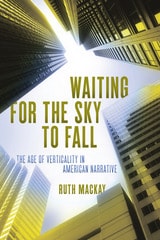
cover of Waiting for the Sky to Fall: The Age of Verticality in American Narrative

Waiting for the Sky to Fall

The Age of Verticality in American Narrative

Ruth Mackay

The Ohio State University Press, 2016

Waiting for the Sky to Fall: The Age of Verticality in American Narrative by Ruth Mackay traces the figures of flight, grievous falls, and collapsing towers, all of which haunt American narratives before and after 9/11. Mackay examines how these events prefigure 9/11, exploring the narrative residue left by the “end” of horizontal space—when settlers reached America’s Pacific Coast, leaving nowhere westward on the continent to go. She then continues into the aftermath of the fall of the Twin Towers. This period of time marks an era of verticality: an age that offers a transformed concept of the limits of space, entwined with a sense of anxiety and trepidation.

With this study, Mackay asks: In what oblique ways has verticality leaked into American narrative? Why do metaphors of up and down recur across the twentieth century? With close readings of Jonathan Safran Foer’s Extremely Loud and Incredibly Close, Winsor McCay’s comic strip Little Nemo in Slumberland, Upton Sinclair’s Oil! and its film rendering There Will Be Blood, Allen Ginsberg’s poetic dissections of the nuclear bomb, and Leslie Marmon Silko’s imagining of flight in Almanac of the Dead, this interdisciplinary study culminates with a discussion of Philippe Petit’s tightrope walk between the Twin Towers. Waiting for the Sky to Fall examines how vertical representation cleaves to, and often transforms the associations of, specific events that are physically and visually disorienting, disquieting, or even traumatic.
 
[more]