Results by title
22 books match the query 'Wall'
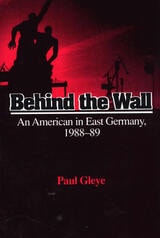
Behind the Wall
An American in East Germany, 1988-89Paul Gleye
Southern Illinois University Press, 1991
Standing in long lines in the shops, coaxing clean laundry from an outdated washing machine, traveling despite unpredictable train schedules, and being without hot water, fruit, and vegetables through the gray winter months failed to dull Paul Gleye’s perceptions during the year he lived in Weimar, East Germany. Day by day Gleye documented his varied observations and experiences, unaware that they would prove a unique record of what would soon be an extinct society.
Gleye was in East Germany as a Fulbright lecturer. Living beyond the capital city of East Berlin and traveling and conversing freely, Gleye gained access to people and places that had been almost completely closed to Americans and other Westerners for decades.
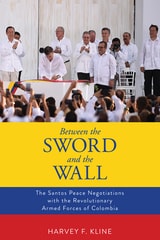
Between the Sword and the Wall
The Santos Peace Negotiations with the Revolutionary Armed Forces of ColombiaHarvey F. Kline
University of Alabama Press, 2020
Chronicles the peace process negotiations between Colombian president Juan Manuel Santos and the Marxist Revolutionary Armed Forces of Colombia
In Between the Sword and the Wall: The Santos Peace Negotiations with the Revolutionary Armed Forces of Colombia, Harvey Kline, a noted expert on contemporary Colombian politics, brings to a close his multivolume chronicle of the incessant violence that has devastated Colombia’s population, politics, and military for decades. This, his newest work on the subject, recounts and analyzes the negotiations between Colombian president Juan Manuel Santos and the Marxist Revolutionary Armed Forces of Colombia (FARC), which ended with a peace agreement in 2016.
The FARC insurgency began in 1964, and every Colombian president after 1980 unsuccessfully tried to negotiate a peace agreement with the group. Kline analyzes how the Santos administration was ultimately able to negotiate peace with the FARC. The agreement failed to receive the approval of the Colombian people in an October 2016 plebiscite, but a renegotiated version was later approved by the congress in the same year. Afterward, more than 7,000 rebels turned over their weapons to the UN mission in Colombia. The former combatants were then to be judged by a special court empowered to punish but not imprison those who had violated human rights. Throughout the book, Kline emphasizes the dual nature of the Santos negotiations, first with the FARC and second with the democratic opposition to the agreement led by former president Álvaro Uribe Vélez.
Kline provides readers with a well-researched analysis based on a variety of resources, including media articles and primary documents from the government, international organizations, and the FARC. He also conducted extensive interviews with twenty-eight government officials and Colombian experts from all ideological persuasions.
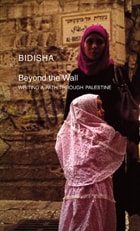
Beyond the Wall
Writing a Path through PalestineBidisha
Seagull Books, 2012
Beyond the Wall
Writing a Path through PalestineBidisha
Seagull Books, 2025
Their voices come from Bethlehem and Hebron. You can hear them from Jerusalem to Nazareth, and witness their protests in Gaza and Ramallah. From the refugee camps in the West Bank, you can hear the voices of the Palestinian people call out to demand self-determination and a better quality of life. But outside of Israel and the occupied territories, these individual voices are rarely heard—until now.
In Beyond the Wall: Writing a Path through Palestine, internationally renowned feminist critic and writer Bidisha collects the testimonies of an occupied people—ordinary citizens, activists, and children—alongside those of international aid workers and foreign visitors for a revelatory look at a population on the margins.
Called “beautifully belligerent, [and] fiercely intelligent” by The Independent and a “dazzlingly creative writer” by the London Times, Bidisha amplifies the voices of the Palestinian people in this book and lends them her own considerable strength.
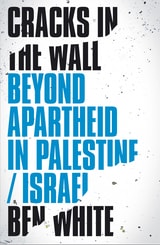
Cracks in the Wall
Beyond Apartheid in Palestine/IsraelBen White
Pluto Press, 2018
But while the situation on the ground is bleak, Ben White argues that there are widening cracks in Israel's traditional pillars of support. Opposition to Israeli policies and even critiques of Zionism are growing in Jewish communities, as well as amongst Western progressives. The election of Donald Trump has served as a catalyst for these processes, including the transformation of Israel from a partisan issue into one that divides the US establishment. Meanwhile, the Palestinian-led boycott campaign is gathering momentum, prompting a desperate backlash by Israel and its allies.
With sharp analysis, Ben White says now is the time to plot a course that avoids the mistakes of the past - a way forward beyond apartheid in Palestine. The solution is not partition and ethnic separation, but equality and self-determination - for all.
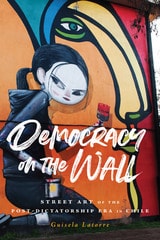
Democracy on the Wall
Street Art of the Post-Dictatorship Era in ChileGuisela Latorre
The Ohio State University Press, 2019
Exploring the resurgence and impact of the muralist brigades, women graffiti artists, the phenomenon of “open-sky museums,” and the transnational impact on the development of Chilean street art, Latorre argues that mural and graffiti artists are enacting a “visual democracy,” a form of artistic praxis that seeks to create alternative images to those produced by institutions of power. Keenly aware of Latin America’s colonial legacy and deeply flawed democratic processes, and distrustful of hegemonic discourses promoted by government and corporate media, the artists in Democracy on the Wall utilize graffiti and muralism as an alternative means of public communication, one that does not serve capitalist or nationalist interests. Latorre posits that through these urban interventions that combine creativity with social action, Chilean street artists formulate visions of what a true democracy looks like.
Education Behind the Wall
Why and How We Teach College in PrisonEdited by Mneesha Gellman
Brandeis University Press, 2022
An edited volume reflecting on different aspects of teaching in prison and different points of view.
This book seeks to address some of the major issues faced by faculty who are teaching college classes for incarcerated students. Composed of a series of case studies meant to showcase the strengths and challenges of teaching a range of different disciplines in prison, this volume brings together scholars who articulate some of the best practices for teaching their expertise inside alongside honest reflections on the reality of educational implementation in a constrained environment. The book not only provides essential guidance for faculty interested in developing their own courses to teach in prisons, but also places the work of higher education in prisons in philosophical context with regards to racial, economic, social, and gender-based issues. Rather than solely a how-to handbook, this volume also helps readers think through the trade-offs that happen when teaching inside, and about how to ensure the full integrity of college access for incarcerated students.
Heaven Has a Wall
Religion, Borders, and the Global United StatesElizabeth Shakman Hurd
University of Chicago Press, 2025
Our national conversation about the border has taken a religious turn. When televangelists declare, “Heaven has a wall,” activists shout back, “Jesus was a refugee.” For Elizabeth Shakman Hurd, the standoff makes explicit a longstanding truth: borders are religious as well as political objects.
In this book, Hurd argues that Americans share a bipartisan border religion, complete with an array of beliefs and practices, including a reverence for national security, a liturgy for immigration, and an eschatological foreign policy. Through an analysis of the many ways the United States creates, enforces, and ignores borders at home and abroad, Hurd offers a bold new perspective on the ties that bind American religion, politics, and public life.
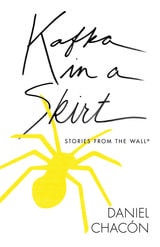
Kafka in a Skirt
Stories from the WallDaniel Chacón
University of Arizona Press, 2019
Set in El Paso and other Latinx-dominant urban spaces, Kafka in a Skirt is an immersive look into the myriad lives of the characters who inhabit these culturally diverse areas. Chacón masterfully weaves elements of the surreal and fantastic through a shining tapestry of fiction, creating moments of touching realism in contrast with scenes that are fascinatingly unfamiliar. Occasionally teasing the ghosts of Jorge Luis Borges and the Argentine poet Alejandra Pizarnik, this collection disregards boundaries and transports readers into a world merely parallel to our own. Kafka in a Skirt unravels the intricacies of culture, sexuality, love, and loneliness in a collection that shows the personal implications of barriers while remaining hopeful and bright.
LAST ONE OVER THE WALL
The Massachusetts Experiment in Closing Reform SchoolsJerome G. Miller
The Ohio State University Press, 1998
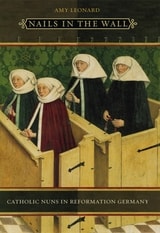
Nails in the Wall
Catholic Nuns in Reformation GermanyAmy Leonard
University of Chicago Press, 2005
Focusing primarily on a group of Dominican nuns in Strasbourg, Germany, Amy Leonard's Nails in the Wall outlines the century-long battle between these nuns and the Protestant city council. With savvy strategies that employed charm, wealth, and political and social connections, the nuns were able to sustain their Catholic practices. Leonard's in-depth archival research uncovers letters about and records of the nuns' struggle to maintain their religious beliefs and way of life in the face of Protestant reforms. She tells the story of how they worked privately to keep Catholicism alive-continuing to pray in Latin, smuggling in priests to celebrate Mass, and secretly professing scores of novices to ensure the continued survival of their convents. This fascinating and heartening study shows that, far from passively allowing the Protestants to dismantle their belief system, the women of the Strasbourg convents were active participants in the battle over their vocation and independence.

Run For The Wall
Remembering Vietnam on a Motorcycle PilgrimageMichalowski, Raymond J
Rutgers University Press, 2001
Every May, for more than a decade, an ever-increasing number of motorcyclists have made the “Run for the Wall,” a cross-country journey from Southern California to the “Wall,” the Vietnam war memorial in Washington, D.C. While the journey’s avowed purpose is political — to increase public awareness about those who remain either prisoners of war or missing in action in Southeast Asia — it also serves as a healing pilgrimage for its participants and as a “welcome-home” ritual many veterans feel they never received.
Run for the Wall is a highly readable ethnographic account of this remarkable American ritual. The authors, themselves motorcyclists as well as Run participants, demonstrate that the event is a form of secular pilgrimage. Here key concepts in American culture— “freedom,” and “brotherhood,” for example—are constructed and deployed in a variety of rituals and symbols to enable participants to come to terms with the consequences of the Vietnam war. While the focus is the journey itself, the book also explores other themes related to American culture and history, including the nature of community, the Vietnam war, and the creation of American secular ritual.
In moving, first-hand accounts, the book tells how participation in the POW-MIA social movement helps individuals find personal and collective meaning in America’s longest and most divisive conflict. Above all, this is a story of a uniquely American form of political action, ritual, pilgrimage, and the social construction of memory.
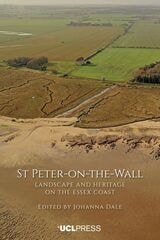
St Peter-On-The-Wall
Landscape and Heritage on the Essex CoastEdited by Johanna Dale
University College London, 2023
The Chapel of St Peter-on-the-Wall, built on the ruins of a Roman fort, dates from the mid-seventh century and is one of the oldest largely intact churches in England. It stands in splendid isolation on the shoreline at the mouth of the Blackwater Estuary in Essex, where the land meets and interpenetrates with the sea and the sky. This book brings together contributors from across the arts, humanities, and social sciences to uncover the premodern contexts and modern resonances of this medieval building and its landscape setting. In analyzing the significance of the chapel and surrounding landscape over more than a thousand years, this collection additionally contributes to wider debates about the relationship between space and place, and particularly the interfaces between both medieval and modern cultures and also heritage and the natural environment.
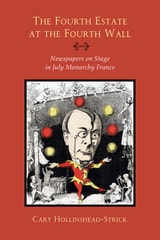
The Fourth Estate at the Fourth Wall
Newspapers on Stage in July Monarchy FranceCary Hollinshead-Strick
Northwestern University Press, 2019
July Monarchy plays, which provided affordable entertainment to a broad section of the public, constitute a large, nearly untapped reservoir of commentary on the arrival of the forty-franc press. Vaudevilles and comedies ask whether journalism that benefits from advertisement can be unbiased. Dramas explore whether threatening to spread false news is an acceptable way for journalists to exercise their influence. Hollinshead-Strick uses both plays and novels to show that despite their claims to enlighten their readers, newspapers were often accused of obscuring public access to information. Balzac’s interventions in this media sphere reveal his utopian views on print technology. Nerval’s and Pyat’s demonstrate the nefarious impact that corrupt theater critics could have on authors and on the public alike.
Scholars of press and media studies, French literature, theater, and nineteenth-century literature more generally will find this book a valuable introduction to a cross-genre debate about press publicity that remains surprisingly resonant today.
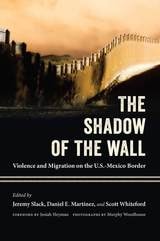
The Shadow of the Wall
Violence and Migration on the U.S.-Mexico BorderEdited by Jeremy Slack, Daniel E. Martínez, and Scott Whiteford; Foreword by Josiah Heyman; Photographs by Murphy Woodhouse
University of Arizona Press, 2018
The authors analyze data from the Migrant Border Crossing Study (MBCS), a mixed-methods, binational research project that offers socially relevant, rigorous social science about migration, immigration enforcement, and violence on the border. Using information gathered from more than 1,600 post-deportation surveys, this volume examines the different faces of violence and migration along the Arizona-Sonora border and shows that deportees are highly connected to the United States and will stop at nothing to return to their families. The Shadow of the Wall underscores the unintended social consequences of increased border enforcement, immigrant criminalization, and deportation along the U.S.-Mexico border.
Contributors
Howard Campbell
Josiah Heyman
Alison Elizabeth Lee
Daniel E. Martínez
Ricardo Martínez-Schuldt
Emily Peiffer
Jeremy Slack
Prescott L. Vandervoet
Matthew Ward
Scott Whiteford
Murphy Woodhouse

The Wall and the Garden
Selected Massachusetts Election Sermons, 1670-1775A.W. Plumstead, Editor
University of Minnesota Press, 1968
The Wall and the Garden was first published in 1968. Minnesota Archive Editions uses digital technology to make long-unavailable books once again accessible, and are published unaltered from the original University of Minnesota Press editions.
The election day sermon in colonial New England was an annual, formal address by a minister of the gospel to the newly assembled legislature of the colony. The tradition began in the Massachusetts Bay colony in 1634, and it continued, in Boston, for 250 years. In this volume, Professor Plumstead presents a collection of nine of the Massachusetts election sermons, chosen from among the surviving Massachusetts sermons which were printed between 1661 and 1775. They are not chosen as representative but, rather, as the best, judged on a basis of literary excellence and ideas and points of style relevant to later developments in American literature and history. There are changes in style and theme in the 105 years between the first and the last selection, and, in his brief introduction to each of the sermons, the editor discusses these changes and the sermon's relationship to the tradition as a whole.
In a general introduction, Professor Plumstead provides background information about the history and significance of the election sermons. As he makes clear, the election sermon tradition offers a vantage point for seeing both continuity and change in colonial intellectual history. The sermons in this collection will complement colonial studies by bringing the reader close to the spirit of the times.
The title of the volume, The Wall and the Garden, derives from the frequent use by colonial preachers of the metaphors of the garden and the wall to describe the colonies and their spiritual enemies.
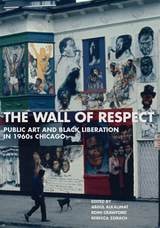
The Wall of Respect
Public Art and Black Liberation in 1960s ChicagoEdited by Abdul Alkalimat, Romi Crawford, and Rebecca Zorach
Northwestern University Press, 2017
The Wall of Respect received national critical acclaim when it was unveiled on the side of a building at Forty-Third and Langley in Chicago’s Bronzeville neighborhood. Painters and photographers worked side by side on the mural's seven themed sections, which featured portraits of Black heroes and sheroes, among them John Coltrane, Nina Simone, Billie Holiday, Malcolm X, Muhammad Ali, and W. E. B. Du Bois. The Wall became a platform for music, poetry, and political rallies. Over time it changed, reflecting painful controversies among the artists as well as broader shifts in the Civil Rights and Black Liberation Movements.
At the intersection of African American culture, politics, and Chicago art history, The Wall of Respect offers, in one keepsake-quality work, an unsurpassed collection of images and essays that illuminate a powerful monument that continues to fascinate artists, scholars, and readers in Chicago and across the United States.
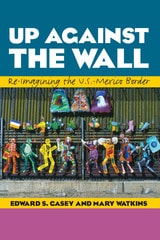
Up Against the Wall
Re-Imagining the U.S.-Mexico BorderBy Edward S. Casey and Mary Watkins
University of Texas Press, 2014
Using the U.S. wall at the border with Mexico as a focal point, two experts examine the global surge of economic and environmental refugees, presenting a new vision of the relationships between citizen and migrant in an era of “Juan Crow,” which systematically creates a perpetual undercaste.
Winner, National Association for Ethnic Studies (NAES) Outstanding Book Award, 2017
As increasing global economic disparities, violence, and climate change provoke a rising tide of forced migration, many countries and local communities are responding by building walls—literal and metaphorical—between citizens and newcomers. Up Against the Wall: Re-imagining the U.S.-Mexico Border examines the temptation to construct such walls through a penetrating analysis of the U.S. wall at the U.S.-Mexico border, as well as investigating the walling out of Mexicans in local communities. Calling into question the building of a wall against a friendly neighboring nation, Up Against the Wall offers an analysis of the differences between borders and boundaries. This analysis opens the way to envisioning alternatives to the stark and policed divisions that are imposed by walls of all kinds. Tracing the consequences of imperialism and colonization as citizens grapple with new migrant neighbors, the book paints compelling examples from key locales affected by the wall—Nogales, Arizona vs. Nogales, Sonora; Tijuana/San Diego; and the lower Rio Grande Valley of Texas. An extended case study of Santa Barbara describes the creation of an internal colony in the aftermath of the U.S. conquest of Mexican land, a history that is relevant to many U.S. cities and towns.
Ranging from human rights issues in the wake of massive global migration to the role of national restorative shame in the United States for the treatment of Mexicans since 1848, the authors delve into the broad repercussions of the unjust and often tragic consequences of excluding others through walled structures along with the withholding of citizenship and full societal inclusion. Through the lens of a detailed examination of forced migration from Mexico to the United States, this transdisciplinary text, drawing on philosophy, psychology, and political theory, opens up multiple insights into how nations and communities can coexist with more justice and more compassion.
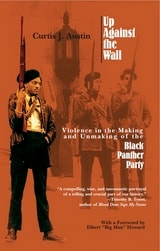
Up Against the Wall
Violence in the Making and Unmaking of the Black Panther PartyCurtis J. Austin
University of Arkansas Press, 2008
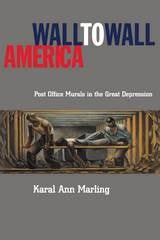
Wall To Wall America
Post Office Murals in the Great DepressionKaral Ann Marling
University of Minnesota Press, 2000
A revealing cultural history of this American art form.
In her intriguing and heavily illustrated look at post office murals of the 1930s, Karal Ann Marling examines these unique government-sponsored works of art not only as paintings but as part of American cultural history. Depicting scenes from the farm, the frontier, and the factories, these murals were commissioned by the Treasury Department during the administration of Franklin D. Roosevelt. Placed in the building where everyone in town had reason to stop, the thousand-odd paintings discussed here were truly intended to hold appeal for everyone. This spirited and often irreverent discussion offers a close look at the murals and what they represented to small-town America during the Great Depression.
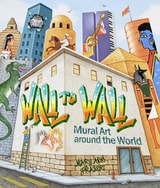
Wall to Wall
Mural Art around the WorldMary Ann Fraser
J. Paul Getty Trust, The, 2024
People have been drawing on walls since ancient times. They do it to create beauty, to tell a story, to make a statement, or just to say, “I was here.” You can find wall art in a remote cave in Patagonia and a desert castle in Jordan, a kingly palace in the Republic of Benin and the National Palace of Mexico, a miles-long flood channel in Los Angeles and a sky-high rooftop in Norway.
In Wall to Wall, award-winning author, illustrator, and muralist Mary Ann Fraser takes readers on a worldwide journey through time, stopping to see amazing mural art along the way. Stunning color illustrations and fascinating photographs illuminate both famous and little-known examples, and lighthearted text tells engaging stories about the people who inspired or created them. A glossary, selected bibliography, and section about the preservation of murals conclude the book. No reader will ever again pass by a mural—whether in a historic building, a museum, or out on the street—without stopping to take a closer look.
Ages ten to fourteen
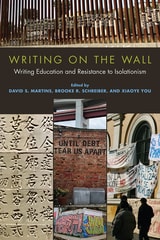
Writing on the Wall
Writing Education and Resistance to Isolationismedited by David S. Martins, Brooke R. Schreiber & Xiaoye You
Utah State University Press, 2022
The collection extends existing scholarship and research about the ways racist and colonial rhetorics impact writing education; the impact of translingual, transnational, and cosmopolitan ideologies on student learning and student writing; and the role international educational partnerships play in pushing back against isolationist ideologies. Established and early-career scholars who work in a broad range of institutional contexts highlight the historical connections among monolingualism, racism, and white nationalism and introduce community- and classroom-based practices that writing teachers use to resist isolationist beliefs and tendencies.
“Writing on the wall” serves as a metaphor for the creative, direct action writing education can provide and invokes border spaces as sites of identity expression, belonging, and resistance. The book connects transnational writing education with the fight for racial justice in the US and around the world and will be of significance to secondary and postsecondary writing teachers and graduate students in English, linguistics, composition, and literacy studies.
Contributors: Olga Aksakalova, Sara P. Alvarez, Brody Bluemel, Tuli Chatterji, Keith Gilyard, Joleen Hanson, Florianne Jimenez Perzan, Rebecca Lorimer Leonard, Layli Maria Miron, Tony D. Scott, Kate Vieira, Amy J. Wan