Results by title
5 books match the query 'Wallace, Alfred Russel'
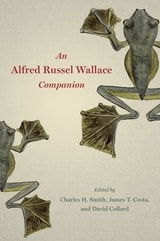
An Alfred Russel Wallace Companion
Edited by Charles H. Smith, James T. Costa, and David A. Collard
University of Chicago Press, 2019
Wallace declared his eight years of exploration in southeast Asia to be “the central and controlling incident” of his life. As 2019 marks one hundred and fifty years since the publication of The Malay Archipelago, Wallace’s canonical work chronicling his epic voyage, this collaborative book gathers an interdisciplinary array of writers to celebrate Wallace’s remarkable life and diverse scholarly accomplishments. Wallace left school at the age of fourteen and was largely self-taught, a voracious curiosity and appetite for learning sustaining him throughout his long life. After years as a surveyor and builder, in 1848 he left Britain to become a professional natural history collector in the Amazon, where he spent four years. Then, in 1854, he departed for the Malay Archipelago. It was on this voyage that he constructed a theory of natural selection similar to the one Charles Darwin was developing, and the two copublished papers on the subject in 1858, some sixteen months before the release of Darwin’s On the Origin of Species.
But as the contributors to the Companion show, this much-discussed parallel evolution in thought was only one epoch in an extraordinary intellectual life. When Wallace returned to Britain in 1862, he commenced a career of writing on a huge range of subjects extending from evolutionary studies and biogeography to spiritualism and socialism. An Alfred Russel Wallace Companion provides something of a necessary reexamination of the full breadth of Wallace’s thought—an attempt to describe not only the history and present state of our understanding of his work, but also its implications for the future.
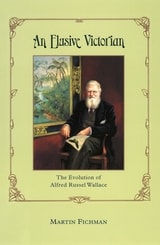
An Elusive Victorian
The Evolution of Alfred Russel WallaceMartin Fichman
University of Chicago Press, 2003
Fichman examines not only Wallace's scientific work as an evolutionary theorist and field naturalist but also his philosophical concerns, his involvement with theism, and his commitment to land nationalization and other sociopolitical reforms such as women's rights. As Fichman shows, Wallace worked throughout his life to integrate these humanistic and scientific interests. His goal: the development of an evolutionary cosmology, a unified vision of humanity's place in nature and society that he hoped would ensure the dignity of all individuals.
To reveal the many aspects of this compelling figure, Fichman not only reexamines Wallace's published works, but also probes the contents of his lesser known writings, unpublished correspondence, and copious annotations in books from his personal library. Rather than consider Wallace's science as distinct from his sociopolitical commitments, An Elusive Victorian assumes a mutually beneficial relationship between the two, one which shaped Wallace into one of the most memorable characters of his time. Fully situating Wallace's wide-ranging work in its historical and cultural context, Fichman's innovative and insightful account will interest historians of science, religion, and Victorian culture as well as biologists.
Island Life
Or, the Phenomena and Causes of Insular Faunas and Floras, Including a Revision and Attempted Solution of the Problem of Geological ClimatesAlfred Russel Wallace
University of Chicago Press, 2013
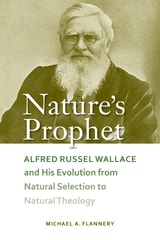
Nature's Prophet
Alfred Russel Wallace and His Evolution from Natural Selection to Natural TheologyMichael A. Flannery
University of Alabama Press, 2018
An astute study of Alfred Russel Wallace’s path to natural theology.
A spiritualist, libertarian socialist, women’s rights advocate, and critic of Victorian social convention, Alfred Russel Wallace was in every sense a rebel who challenged the emergent scientific certainties of Victorian England by arguing for a natural world imbued with purpose and spiritual significance. Nature’s Prophet: Alfred Russel Wallace and His Evolution from Natural Selection to Natural Theology is a critical reassessment of Wallace’s path to natural theology and counters the dismissive narrative that Wallace’s theistic and sociopolitical positions are not to be taken seriously in the history and philosophy of science.
Author Michael A. Flannery provides a cogent and lucid account of a crucial—and often underappreciated—element of Wallace’s evolutionary worldview. As co-discoverer, with Charles Darwin, of the theory of natural selection, Wallace willingly took a backseat to the well-bred, better known scientist. Whereas Darwin held fast to his first published scientific explanations for the development of life on earth, Wallace continued to modify his thinking, refining his argument toward a more controversial metaphysical view which placed him within the highly charged intersection of biology and religion.
Despite considerable research into the naturalist’s life and work, Wallace’s own evolution from natural selection to natural theology has been largely unexplored; yet, as Flannery persuasively shows, it is readily demonstrated in his writings from 1843 until his death in 1913. Nature’s Prophet provides a detailed investigation of Wallace’s ideas, showing how, although he independently discovered the mechanism of natural selection, he at the same time came to hold a very different view of evolution from Darwin.
Ultimately, Flannery shows, Wallace’s reconsideration of the argument for design yields a more nuanced version of creative and purposeful theistic evolution and represents one of the most innovative contributions of its kind in the Victorian and Edwardian eras, profoundly influencing a later generation of scientists and intellectuals.
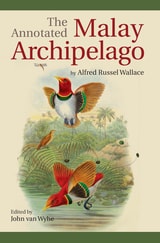
The Annotated Malay Archipelago
Alfred Russell Wallace
National University of Singapore Press, 2014
This edition explains, updates and corrects the original text with an historical introduction and hundreds of explanatory notes. Wallace left hundreds of people, places, publications and species unidentified. He referred to most species only with the scientific name current at the time. Whenever available, the common names for species have been provided, and scientific names updated. The content of the book has never been thoroughly analysed and compared against other contemporary sources. It turns out that the book contains many errors. This includes not just incorrect dates and place names but some of the most remarkable anecdotes; for example, the dramatic claim that tigers "kill on an average a Chinaman every day" in Singapore or that a Dutch Governor General committed suicide by leaping from a waterfall on Celebes.
By correcting the text of the Malay Archipelago against Wallace's letters and notebooks and other contemporary sources and by enriching it with modern identifications this edition reveals Wallace's work as never before.