Results by title
10 books match the query 'War crime trials'
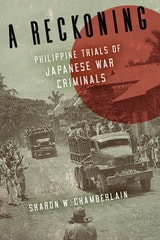
A Reckoning
Philippine Trials of Japanese War CriminalsSharon W. Chamberlain
University of Wisconsin Press, 2019
Chamberlain highlights the differing views of Filipinos and Japanese about the trials. The Philippine government aimed to show its commitment to impartial proceedings with just outcomes. In Japan, it appeared that defendants were selected arbitrarily, judges and prosecutors were biased, and lower-ranking soldiers were punished for crimes ordered by their superior officers. She analyzes the broader implications of this divergence as bilateral relations between the two nations evolved and contends that these competing narratives were reimagined in a way that, paradoxically, aided a path toward postwar reconciliation.
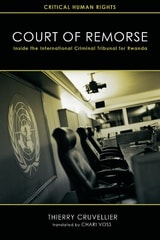
Court of Remorse
Inside the International Criminal Tribunal for RwandaThierry Cruvellier
University of Wisconsin Press, 2010
Fascinated by the Tribunal’s rich complexities, journalist Thierry Cruvellier came back day after day to watch the proceedings, spending more time there than any other outside observer. Gradually he gained the confidence of the victims, defendants, lawyers, and judges. Drawing on interviews with these protagonists and his close observations of their interactions, Cruvellier takes readers inside the courtroom to witness the motivations, mechanisms, and manipulations of justice as it unfolded on the stage of high-stakes, global politics. It is this ground-level view that makes his account so valuable—and so absorbing. A must-read for those who want to understand the dynamics of international criminal tribunals, Court of Remorse reveals both the possibilities and the challenges of prosecuting human rights violations.
Best Books for General Audiences, selected by the American Association for School Libraries and the Public Library Association
Best Books for High Schools, selected by the American Association for School Libraries
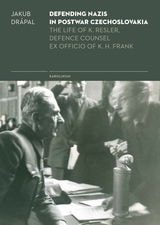
Defending Nazis in Postwar Czechoslovakia
Life of K. Resler, Defense Councel Ex Officio of K. H. FrankJakub Drápal
Karolinum Press, 2018
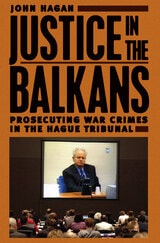
Justice in the Balkans
Prosecuting War Crimes in the Hague TribunalJohn Hagan
University of Chicago Press, 2003
Creating an institution that transcends national borders is a challenge fraught with political and organizational difficulties, yet, as Hagan describes here, the Hague tribunal has increasingly met these difficulties head-on and overcome them. The chief reason for its success, he argues, is the people who have shaped it, particularly its charismatic chief prosecutor, Louise Arbour. With drama and immediacy, Justice in the Balkans re-creates how Arbour worked with others to turn the tribunal's fortunes around, reversing its initial failure to arrest and convict significant figures and advancing the tribunal's agenda to the point at which Arbour and her colleagues, including her successor, Carla Del Ponte (nicknamed the Bulldog), were able to indict Milosevic himself. Leading readers through the investigations and criminal proceedings of the tribunal, Hagan offers the most original account of the foundation and maturity of the institution.
Justice in the Balkans brilliantly shows how an international social movement for human rights in the Balkans was transformed into a pathbreaking legal institution and a new transnational legal field. The Hague tribunal becomes, in Hagan's work, a stellar example of how individuals working with collective purpose can make a profound difference.
"The Hague tribunal reaches into only one house of horrors among many; but, within the wisely precise remit given to it, it has beamed the light of justice into the darkness of man's inhumanity, to woman as well as to man."—The Times (London)
Rhetorical Vectors of Memory in National and International Holocaust Trials
Marouf A. Hasian Jr.
Michigan State University Press, 2006
During the past several decades, the twentieth century Holocaust has become a defining event in many histories. This newfound respect for the Judeocide has been cathartic for both individuals and communities, in that it provides evidence that audiences around the world are rethinking the significance of the World War II narratives of bystanders, perpetrators, and victims. Given the complexities of these issues, scholars who are interested in studying Holocaust memory make choices about the questions on which they focus, the artifacts they select for analysis, and the perspectives they want to present.
Hasian reviews how national and international courts have used Holocaust trials as forums for debates about individuated justice, historical record keeping, and pedagogical memory work. He concludes that the trials involving Auschwitz, Demjanjuk, Eichmann, Finta, Nuremberg, Irving, Kastner, Keegstra, Sawoniuk, and Zündel are highly problematic. The author provides a rhetorical analysis of holocaust trials as a way of looking into the question of what role court proceedings play in the creation of Holocaust collective memories.
Sacred Men
Law, Torture, and Retribution in GuamKeith L. Camacho
Duke University Press, 2019
Testimony
Found Poems from the Special Court for Sierra LeoneShanee Stepakoff
Bucknell University Press, 2021
Sierra Leone’s devastating civil war barely caught the attention of Western media, but it raged on for over a decade, bringing misery to millions of people in West Africa from 1991 to 2002. The atrocities committed in this war and the accounts of its survivors were duly recorded by international organizations, but they run the risk of being consigned to dusty historical archives.
Derived from public testimonies at a UN-backed war crimes tribunal in Freetown, this remarkable poetry collection aims to breathe new life into the records of Sierra Leone’s civil war, delicately extracting heartbreaking human stories from the morass of legal jargon. By rendering selected trial transcripts in poetic form, Shanee Stepakoff finds a novel way to communicate not only the suffering of Sierra Leone’s people, but also their courage, dignity, and resilience. Her use of innovative literary techniques helps to ensure that the voices of survivors are not forgotten, but rather heard across the world.
This volume also includes an introduction that explores how the genre of “found poetry” can serve as a uniquely powerful means through which writers may bear witness to atrocity. This book’s unforgettable excavation and shaping of survivor testimonies opens new possibilities for speaking about the unspeakable.
The Japanese On Trial
Allied War Crimes Operations in the East, 1945–1951By Philip R. Piccigallo
University of Texas Press, 1979
This comprehensive treatment of post–World War II Allied war crimes trials in the Far East is a significant contribution to a neglected subject. While the Nuremberg and, to a lesser degree, Tokyo tribunals have received considerable attention, this is the first full-length assessment of the entire Far East operation, which involved some 5,700 accused and 2,200 trials.
After discussing the Tokyo trial, Piccigallo systematically examines the operations of each Allied nation, documenting procedure and machinery as well as the details of actual trials (including hitherto unpublished photographs) and ending with a statistical summary of cases.
This study allows a completely new assessment of the Far East proceedings: with a few exceptions, the trials were carefully and fairly conducted, the efforts of defense counsel and the elaborate review procedures being especially noteworthy. Piccigallo’s approach to this emotion-filled subject is straightforward and evenhanded throughout. He concludes with a discussion of the broader implications of such war crimes trials, a matter of interest to the general reader as well as to specialists in history, law, and international affairs.
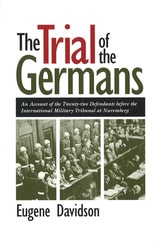
The Trial of the Germans
An Account of the Twenty-two Defendants before the International Military Tribunal at NurembergEugene Davidson
University of Missouri Press, 1997
The "definitive one-volume study of Nuremberg," The Trial of the Germans is now available in paperback. An astute observer of the Nuremberg trial, Eugene Davidson has struggled with the issues it raised: Was it a necessary response to the heinous crimes of the Third Reich? How were Germany and the Germans capable of such extraordinary evil? Was the trial just, given the claims that the defendants were simply serving their country, doing as they had been told to do? And if not just, was it nonetheless necessary as a warning to prevent future crimes against humanity? Davidson's approach to these and other large questions of justice is made through examination of each of the defendants in the trial. His reluctant, but firm, conclusion is: "In a world of mixed human affairs where a rough justice is done that is better than lynching or being shot out of hand, Nuremberg may be defended as a political event if not as a court." Some sentences may have seemed too severe, but none was harsher than the punishments meted out to innocent people by the regime these men served. "In a certain sense," says Davidson, "the trial succeeded in doing what judicial proceedings are supposed to do: it convinced even the guilty that the verdict against them was just."
Faulty as the trial was from the legal point of view, a catharsis of the pent-up emotions of millions of people had to be provided and a record of what had taken place duly preserved for whatever use later generations would make of it.
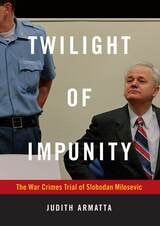
Twilight of Impunity
The War Crimes Trial of Slobodan MilosevicJudith Armatta
Duke University Press, 2010