Results by title
9 books match the query 'Warhol, Andy'
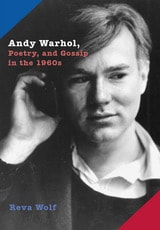
Andy Warhol, Poetry, and Gossip in the 1960s
Reva Wolf
University of Chicago Press, 1997
Wolf investigates the underground culture of poets, artists, and filmmakers who interacted with Warhol regularly. She claims that Warhol understood the literary imagination of his generation and that recognizing Warhol's literary activities is essential to understanding his art. Drawing on a wealth of unpublished material, including interviews, personal and public archives, tape recordings, documentary photographs, and works of art, Wolf offers dramatic evidence that Warhol's interactions with writers functioned like an extended conversation and details how this process impacted his work. This highly original and fascinating study gives us fresh insight into Warhol's art as practice and reformulates the myth that surrounds this popular American artist.
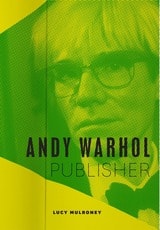
Andy Warhol, Publisher
Lucy Mulroney
University of Chicago Press, 2018
Journeying from the 1950s, when Warhol was starting to make his way through the New York advertising world, through the height of his career in the 1960s, to the last years of his life in the 1980s, Andy Warhol, Publisher unearths fresh archival material that reveals Warhol’s publications as complex projects involving a tantalizing cast of collaborators, shifting technologies, and a wide array of fervent readers.
Lucy Mulroney shows that whether Warhol was creating children’s books, his infamous “boy book” for gay readers, writing works for established houses like Grove Press and Random House, helping found Interview magazine, or compiling a compendium of photography that he worked on to his death, he readily used the elements of publishing to further and disseminate his art. Warhol not only highlighted the impressive variety in our printed culture but also demonstrated how publishing can cement an artistic legacy.
Like Andy Warhol
Jonathan Flatley
University of Chicago Press, 2017
Jonathan Flatley’s Like Andy Warhol is a revelatory look at the artist’s likeness-producing practices, not only reflected in his famous Campbell’s soup cans and Marilyn Monroe silkscreens but across Warhol’s whole range of interests including movies, drag queens, boredom, and his sprawling collections. Flatley shows us that Warhol’s art is an illustration of the artist’s own talent for “liking.” He argues that there is in Warhol’s productions a utopian impulse, an attempt to imagine new, queer forms of emotional attachment and affiliation, and to transform the world into a place where these forms find a new home. Like Andy Warhol is not just the best full-length critical study of Warhol in print, it is also an instant classic of queer theory.
Opacity and the Closet
Queer Tactics in Foucault, Barthes, and WarholNicholas de Villiers
University of Minnesota Press, 2012
Opacity and the Closet interrogates the viability of the metaphor of “the closet” when applied to three important queer figures in postwar American and French culture: the philosopher Michel Foucault, the literary critic Roland Barthes, and the pop artist Andy Warhol. Nicholas de Villiers proposes a new approach to these cultural icons that accounts for the queerness of their works and public personas.
Rather than reading their self-presentations as “closeted,” de Villiers suggests that they invent and deploy productive strategies of “opacity” that resist the closet and the confessional discourse associated with it. Deconstructing binaries linked with the closet that have continued to influence both gay and straight receptions of these intellectual and pop celebrities, de Villiers illuminates the philosophical implications of this displacement for queer theory and introduces new ways to think about the space they make for queerness.
Using the works of Foucault, Barthes, and Warhol to engage each other while exploring their shared historical context, de Villiers also shows their queer appropriations of the interview, the autobiography, the diary, and the documentary—forms typically linked to truth telling and authenticity.
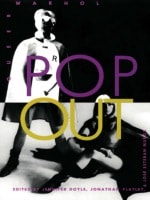
Pop Out
Queer WarholJennifer Doyle, Jonathan Flatley, and Jose Esteban Muñoz, eds.
Duke University Press, 1996
Written from the perspectives of art history, critical race theory, psychoanalysis, feminist theory, cinema studies, and social and literary theory, these essays consider Warhol in various contexts and within the history of the communities in which he figured. The homoerotic subjects, gay audiences, and queer contexts that fuel a certain fascination with Warhol are discussed, as well as Batman, Basquiat, and Valerie Solanas. Taken together, the essays in this collection depict Warhol’s career as a practical social reflection on a wide range of institutions and discourses, including those, from the art world to mass culture, that have almost succeeded in sanitizing his work and his image.
Contributors. Jennifer Doyle, Jonathan Flatley, Marcie Frank, David E. James, Mandy Merck, Michael Moon, José Esteban Muñoz, Eve Kosofsky Sedgwick, Brian Selsky, Sasha Torres, Simon Watney, Thomas Waugh
Sewn in the Sweatshops of Marx
Beuys, Warhol, Klein, DuchampThierry de Duve
University of Chicago Press, 2012
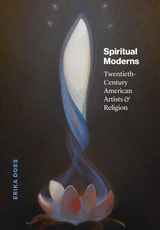
Spiritual Moderns
Twentieth-Century American Artists and ReligionErika Doss
University of Chicago Press, 2022
Andy Warhol is one of the best-known American artists of the twentieth century. He was also an observant Catholic who carried a rosary, went to mass regularly, kept a Bible by his bedside, and depicted religious subjects throughout his career. Warhol was a spiritual modern: a modern artist who appropriated religious images, beliefs, and practices to create a distinctive style of American art.
Spiritual Moderns centers on four American artists who were both modern and religious. Joseph Cornell, who showed with the Surrealists, was a member of the Church of Christ, Scientist. Mark Tobey created pioneering works of Abstract Expressionism and was a follower of the Bahá’í Faith. Agnes Pelton was a Symbolist painter who embraced metaphysical movements including New Thought, Theosophy, and Agni Yoga. And Warhol, a leading figure in Pop art, was a lifelong Catholic. Working with biographical materials, social history, affect theory, and the tools of art history, Doss traces the linked subjects of art and religion and proposes a revised interpretation of American modernism.
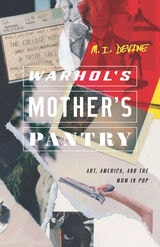
Warhol's Mother's Pantry
Art, America, and the Mom in PopM. I. Devine
The Ohio State University Press, 2020
“What are these fragments we’ve Jersey Shored against our ruin?” asks M. I. Devine, remixing T. S. Eliot, in this dizzying collection of essays that pays homage to the cultural forms that hold us steady. These fragments are stored in Warhol’s Mother’s Pantry, which takes us deep beneath the surfaces of pop to explore our shared quest for meaning today. Julia Warhola, an immigrant who arrived as the US was closing its borders a century ago, is the muse of reuse in these essays that cross boundaries—between now and then, high and low. She is the mom in pop who cut tin cans into flowers and taught Andy (and us) how to reshape and redeem our world. In essays as lyrical, witty, and experimental as the works they cover, Devine offers a new account of pop humanism. How we cut new things from the traditions we’re given, why we don’t stop believin’ (and carry on, wayward sons) when so much is stacked against us. Here are Leonard Cohen’s last songs and Molly Bloom’s last words; Vampire Weekend’s Rostam and Philip Larkin too; Stevie Smith, John Donne, and Kendrick Lamar; sonnets and selfies; early cinema and post–9/11 film, pop hooks, and pop art. In Devine’s hands, these literary and cultural artifacts are provocatively reassembled into an urgent and refreshing history that refuses to let its readers forget where pop came from and where it can go.
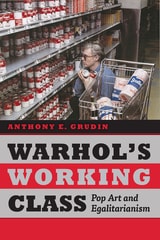
Warhol's Working Class
Pop Art and EgalitarianismAnthony E. Grudin
University of Chicago Press, 2017
Having propelled himself from an impoverished childhood in Pittsburgh to the heights of Madison Avenue, Warhol knew both sides of this equation: the intense appeal that popular culture held for working-class audiences and the ways in which the advertising industry hoped to harness this appeal in the face of growing middle-class skepticism regarding manipulative marketing. Warhol was fascinated by these promises of egalitarian individualism and mobility, which could be profound and deceptive, generative and paralyzing, charged with strange forms of desire. By tracing its intersections with various forms of popular culture, including film, music, and television, Grudin shows us how Warhol’s work disseminated these promises, while also providing a record of their intricate tensions and transformations.