Results by title

7 books match the query 'Weight Loss'
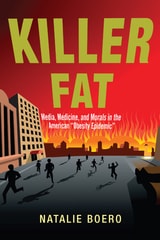
cover of Killer Fat: Media, Medicine, and Morals in the American "Obesity Epidemic”

Killer Fat

Media, Medicine, and Morals in the American "Obesity Epidemic”

Boero, Natalie

Rutgers University Press, 2013

In the past decade, obesity has emerged as a major public health concern in the United States  and abroad. At the federal, state, and local level, policy makers have begun drafting a range of policies to fight a war against fat, including body-mass index (BMI) report cards, “snack taxes,” and laws to control how fast food companies market to children. As an epidemic, obesity threatens to weaken the health, economy, and might of the most powerful nation in the world.

In Killer Fat, Natalie Boero examines how and why obesity emerged as a major public health concern and national obsession in recent years. Using primary sources and in-depth interviews, Boero enters the world of bariatric surgeries, Weight Watchers, and Overeaters Anonymous to show how common expectations of what bodies are supposed to look like help to determine what sorts of interventions and policies are considered urgent in containing this new kind of disease.

Boero argues that obesity, like the traditional epidemics of biological contagion and mass death, now incites panic, a doomsday scenario that must be confronted in a struggle for social stability. The “war” on obesity, she concludes, is a form of social control. Killer Fat ultimately offers an alternate framing of the nation’s obesity problem based on the insights of the “Health at Every Size” movement.

[more]
cover of Obesity Surgery: Stories Of Altered Lives

Obesity Surgery

Stories Of Altered Lives

Marta Meana

University of Nevada Press, 2008
Obesity is a major national health problem, and science has been developing a number of ways to address it. The most revolutionary is surgical intervention to alter the gastrointestinal system so that less food/nutrients can be consumed and/or absorbed. People who undergo this surgery usually experience drastic weight loss and dramatic health improvements. They also discover a new sense of self and face challenges often unimaginable when they were obese.
Using in-depth, first person accounts of 33 men and women who underwent weight-loss surgery, this book elaborates on the complexities of finally getting what you wished for— the good, the bad, and the totally unexpected.
We live in a culture fascinated by physical make-overs, but no one talks about their psychological consequences. Losing a lot of weight is perhaps the most extreme make-over of all. It leaves people emotionally changed, and these changes are the heart of this book.The fascinating narratives contain important lessons for individuals considering or having had the surgery and for those who try to help them. It is simply a story of how finally getting what you’ve always wished for can be much more complicated affair than you ever imagined.
[more]
cover of Obesity Surgery: Stories Of Altered Lives

Obesity Surgery

Stories Of Altered Lives

Marta Meana

University of Nevada Press, 2008
Obesity is a major national health problem, and science has been developing a number of ways to address it. The most revolutionary is surgical intervention to alter the gastrointestinal system so that less food/nutrients can be consumed and/or absorbed. People who undergo this surgery usually experience drastic weight loss and dramatic health improvements. They also discover a new sense of self and face challenges often unimaginable when they were obese.
Using in-depth, first person accounts of 33 men and women who underwent weight-loss surgery, this book elaborates on the complexities of finally getting what you wished for— the good, the bad, and the totally unexpected.
We live in a culture fascinated by physical make-overs, but no one talks about their psychological consequences. Losing a lot of weight is perhaps the most extreme make-over of all. It leaves people emotionally changed, and these changes are the heart of this book.The fascinating narratives contain important lessons for individuals considering or having had the surgery and for those who try to help them. It is simply a story of how finally getting what you’ve always wished for can be much more complicated affair than you ever imagined.
[more]
cover of Seeking the Straight and Narrow: Weight Loss and Sexual Reorientation in Evangelical America

Seeking the Straight and Narrow

Weight Loss and Sexual Reorientation in Evangelical America

Lynne Gerber

University of Chicago Press, 2011
Losing weight and changing your sexual orientation are both notoriously difficult to do successfully. Yet many faithful evangelical Christians believe that thinness and heterosexuality are godly ideals—and that God will provide reliable paths toward them for those who fall short. Seeking the Straight and Narrow is a fascinating account of the world of evangelical efforts to alter our strongest bodily desires.
 
Drawing on fieldwork at First Place, a popular Christian weight-loss program, and Exodus International, a network of ex-gay ministries, Lynne Gerber explores why some Christians feel that being fat or gay offends God, what exactly they do to lose weight or go straight, and how they make sense of the program’s results—or, frequently, their lack. Gerber notes the differences and striking parallels between the two programs, and, more broadly, she traces the ways that other social institutions have attempted to contain the excesses associated with fatness and homosexuality. Challenging narratives that place evangelicals in constant opposition to dominant American values, Gerber shows that these programs reflect the often overlooked connection between American cultural obsessions and Christian ones.
[more]
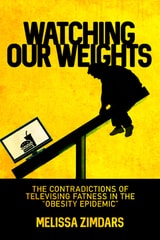
cover of Watching Our Weights: The Contradictions of Televising Fatness in the “Obesity Epidemic”

Watching Our Weights

The Contradictions of Televising Fatness in the “Obesity Epidemic”

Zimdars, Melissa

Rutgers University Press, 2019

Winner of the 2020 Gourmand Awards, Food Writing Section, USA​

Watching Our Weights explores the competing and contradictory fat representations on television that are related to weight-loss and health, medicalization and disease, and body positivity and fat acceptance. While television—especially reality television—is typically understood to promote individual self-discipline and expert interventions as necessary for transforming fat bodies into thin bodies, fat representations and narratives on television also create space for alternative as well as resistant discourses of the body. Melissa Zimdars thus examines the resistance inherent within TV representations and narratives of fatness as a global health issue, the inherent and overt resistance found across stories of medicalized fatness, and programs that actively avoid dieting narratives in favor of less oppressive ways of thinking about the fat body. Watching Our Weights weaves together analyses of media industry lore and decisions, communication and health policies, medical research, activist projects, popular culture, and media texts to establish both how television shapes our knowledge of fatness and how fatness helps us better understand contemporary television.  
[more]
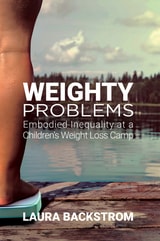
cover of Weighty Problems: Embodied Inequality at a Children’s Weight Loss Camp

Weighty Problems

Embodied Inequality at a Children’s Weight Loss Camp

Laura Backstrom

Rutgers University Press, 2019
Many parents, teachers, and doctors believe that childhood obesity is a social problem that needs to be solved. Yet, missing from debates over what caused the rise in childhood obesity and how to fix it are the children themselves. By investigating how contemporary cultural discourses of childhood obesity are experienced by children, Laura Backstrom illustrates how deeply fat stigma is internalized during the early socialization experiences of children. Weighty Problems details processes of embodied inequality: how the children came to recognize inequalities related to their body size, how they explained the causes of those differences, how they responded to micro-level injustices in their lives, and how their participation in a weight loss program impacted their developing self-image. The book finds that embodied inequality is constructed and negotiated through a number of interactional processes including resocialization, stigma management, social comparisons, and attribution.
[more]
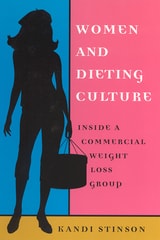
cover of Women and Dieting Culture: Inside a Commercial Weight Loss Group

Women and Dieting Culture

Inside a Commercial Weight Loss Group

Kandi Stinson

Rutgers University Press, 2001

American women invest millions of dollars, as well as much time and energy, in a quest for a body that meets our culture’s standard of beauty—slenderness. Since we define a woman’s sexual attractiveness as essential to her social worth, it is no wonder that “fat is a feminist issue.”

Commercial weight loss organizations have come under attack from feminist scholars for perpetuating the very social values that cause women to obsess about their weight. In Women and Dieting Culture, sociologist Kandi Stinson asks how these values are transmitted and how the women who join such organizations actually think about their bodies and weight loss. As part of her research, Stinson fully participated in a national, commercial weight-loss organization as a paying member. Her acute analysis and sensitive insider’s portrayal vividly illustrate the central roles dieting and body image play in women’s lives.

As she experiences the program and interviews other members, Stinson discovers that the women view the causes and cures of being overweight according to five distinct, though often overlapping, concepts: self-help, work, religion, addiction, and feminism. Drawing extensively on the dieters’ own words, Stinson explores each of these concepts and outlines how they form interrelated patterns which, when analyzed, yield an exciting new perspective on the transmission of cultural values.

Armed with fresh insights into how women feel about weight and their bodies, Stinson finally ponders the question: Can one be a feminist and still wish to lose weight?

[more]