Results by title
28 books match the query 'Welfare recipients'

A Poverty of Imagination
Bootstrap Capitalism, Sequel to Welfare ReformDavid Stoesz
University of Wisconsin Press, 2000
Welfare reform was supposed to end welfare as we know it. And it has. The welfare poor have been largely transformed into the working poor, but their poverty persists. This hard-hitting book takes a close look at where we’ve gone wrong—and where we might go next if we truly want to improve the lot of America’s underclass.
Tracing the roots of recent reforms to the early days of the war on poverty, A Poverty of Imagination describes a social welfare system grown increasingly inept, corrupt, and susceptible to conservative redesign. Investigating the causes of the ongoing failure of welfare assistance, Stoesz focuses on the economic barriers that impede movement out of poverty into the American mainstream. He explores such issues as the heterogeneity of welfare families, generational welfare, inadequate benefits, the negative effects of time limits on welfare recipients, a fringe banking industry that exploits low-income families, the limited capacity of low-wage markets, and the unavailability of credit.
Stoesz suggests that a form of "bootstrap capitalism" would allow individuals and families to participate more fully in American society and achieve upward economic mobility and stability. This proposal, emphasizing wage supplements, asset building, and community capitalism, sets the stage for the next act in poverty policy in the United States. With its valuable insights on the American welfare system and its positive agenda for change, this book makes a significant intervention in our ongoing struggle to come to terms with widespread poverty in the wealthiest nation on earth.
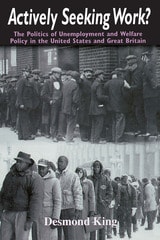
Actively Seeking Work?
The Politics of Unemployment and Welfare Policy in the United States and Great BritainDesmond King
University of Chicago Press, 1995
The goal of work-welfare policy in both countries has been to provide financial aid, training, and placement services for the unemployed. In order to muster support for these programs, however, work-welfare programs had to incorporate liberal requirements that they not interfere with private market forces, and that they prevent the "undeserving" from obtaining benefits. For King, the attempt to integrate these incompatible functions is the defining feature of British and American policies as well as the cause of their failure.
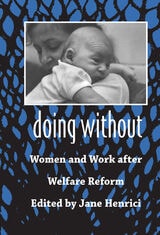
Doing Without
Women and Work after Welfare ReformEdited by Jane Henrici
University of Arizona Press, 2006
In Doing Without, Jane Henrici brings together nine contributions to tell the story of welfare reform from inside the lives of the women who live with it. Cases from Chicago and Boston are combined with a focus on San Antonio from one of the largest multi-city investigations on welfare reform ever undertaken. The contributors argue that the employment opportunities available to poorer women, particularly single mothers and ethnic minorities, are insufficient to lift their families out of poverty. Typically marked by variable hours, inadequate wages, and short-term assignments, both employment and training programs fail to provide stability or the kinds of benefits—such as health insurance, sick days, and childcare options—that are necessary to sustain both work and family life. The chapters also examine the challenges that the women who seek assistance, and those who work in public and private agencies to provide it, together must face as they navigate ever-changing requirements and regulations, decipher alterations in Medicaid, and apply for training and education. Contributors urge that the nation should repair the social safety net for women in transition and offer genuine access to jobs with wages that actually meet the cost of living.
Domestic Contradictions
Race and Gendered Citizenship from Reconstruction to Welfare ReformPriya Kandaswamy
Duke University Press, 2021
Finding Jobs
Work and Welfare ReformDavid Card
Russell Sage Foundation, 2000
Five Years After
The Long-Term Effects of Welfare-to-Work ProgramsDaniel Friedlander
Russell Sage Foundation, 1995
Free Labor
Workfare and the Contested Language of NeoliberalismJohn Krinsky
University of Chicago Press, 2008
At times the fight over workfare unfolded as an argument over who had the authority to define these terms, and in Free Labor, John Krinsky focuses on changes in the language and organization of the political coalitions on either side of the debate. Krinsky’s broadly interdisciplinary analysis draws from interviews, official documents, and media reports to pursue new directions in the study of the cultural and cognitive aspects of political activism. Free Labor will instigate a lively dialogue among students of culture, labor and social movements, welfare policy, and urban political economy.
From Welfare to Work
Judith M. Gueron
Russell Sage Foundation, 1991
How It Works
Recovering Citizens in Post-Welfare PhiladelphiaRobert P. Fairbanks II
University of Chicago Press, 2009
Of the some sixty thousand vacant properties in Philadelphia, half of them are abandoned row houses. Taken as a whole, these derelict homes symbolize the city’s plight in the wake of industrial decline. But a closer look reveals a remarkable new phenomenon—street-level entrepreneurs repurposing hundreds of these empty houses as facilities for recovering addicts and alcoholics. How It Works is a compelling study of this recovery house movement and its place in the new urban order wrought by welfare reform.
To find out what life is like in these recovery houses, Robert P. Fairbanks II goes inside one particular home in the Kensington neighborhood. Operating without a license and unregulated by any government office, the recovery house provides food, shelter, company, and a bracing self-help philosophy to addicts in an area saturated with drugs and devastated by poverty. From this starkly vivid close-up, Fairbanks widens his lens to reveal the intricate relationships the recovery houses have forged with public welfare, the formal drug treatment sector, criminal justice institutions, and the local government.
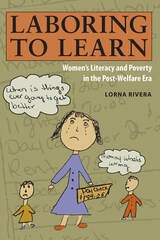
Laboring to Learn
Women's Literacy and Poverty in the Post-Welfare EraLorna Rivera
University of Illinois Press, 2007
The American adult education system has become an alternative for school dropouts, with some state welfare policies requiring teen mothers and women without high school diplomas to participate in adult education programs to receive aid. Currently, low-income women of color are more likely to be enrolled in the lowest levels of adult basic education. Very little has been published about women's experiences in these mandatory programs and whether the programs reproduce the conditions that forced women to drop out in the first place.
Lorna Rivera bridges the gap with this important study, the product of ten years' active ethnographic research with formerly homeless women who participated in adult literacy education classes before and after welfare reform. She draws on rich interviews with organizers and participants in the Adult Learners Program at Project Hope, a women's shelter and community development organization in Boston's Dudley neighborhood, one of the poorest in the city.
Analyzing the web of ideological contradictions regarding "work first" welfare reform policies, Rivera argues that poverty is produced and reproduced when women with low literacy skills are pushed into welfare-to-work programs and denied education. She examines how various discourses about individual choice and self-sufficiency shape the purposes of literacy, how low-income women express a sense of personal responsibility for being poor, and how neoliberal ideologies and practices compromise the goals of critical literacy programs. Throughout this study, the voices and experiences of formerly homeless women challenge cultural stereotypes about poor women, showing in personal and structural terms how social and economic forces shape and restrict opportunities for low-income women of color.
Living on the Edge in Suburbia
From Welfare to WorkfareTerese Lawinski
Vanderbilt University Press, 2010
In contrast to accounts of inner-city poor families, these suburban parents' stories reveal a broad array of precipitating circumstances leading to their downward economic slide and to welfare. They also provide insight into the bureaucratic machinations, rigid rules and mandates, disciplining techniques, and catch-22s that create an insecure environment for many families today. Many of these stories show that the need for welfare over time extends well beyond the federal government's five-year lifetime limit on welfare. Policies emphasizing work first also restrict access to education and further hinder parents' ability to gain a toehold in the economy.
In this tale of people and policies, the author shows how the interests of governments are often at variance with those of vulnerable families, and how some government actions place more pressure on lives replete with stress.
Making Ends Meet
How Single Mothers Survive Welfare and Low-Wage WorkKathryn Edin
Russell Sage Foundation, 1997
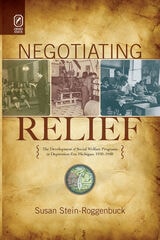
Negotiating Relief
The Development of Social Welfare Programs in Depression-Era Michigan, 1930–1940Susan Stein-Roggenbuck
The Ohio State University Press, 2008
Guided by fiscal localism and a firm belief in home rule, local officials fought to retain control of relief. Stein-Roggenbuck argues that while significant changes occurred in welfare policy as a result of the New Deal, many continuities remained. Among those was the responsibility of families to provide financial support. Often forgotten were those on general relief—individuals who did not fit the federal programs such as Aid to Dependent Children (ADC) and Old Age Assistance (OAA). General relief became a third track of welfare.
Drawing on newspaper records, county and city board minutes, social welfare agency records, federal records, and case file records, Negotiating Relief gives voice to the numerous groups involved in welfare debates, particularly the recipients of relief. This book adds to our understanding of the local implementation of welfare policy in both rural and urban areas.
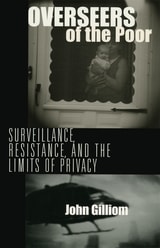
Overseers of the Poor
Surveillance, Resistance, and the Limits of PrivacyJohn Gilliom
University of Chicago Press, 2001
This powerful book lets us in on the conversations of low-income mothers from Appalachian Ohio as they talk about the welfare bureaucracy and its remarkably advanced surveillance system. In their struggle to care for their families, these women are monitored and assessed through a vast network of supercomputers, caseworkers, fraud control agents, and even grocers and neighbors.
In-depth interviews show that these women focus less on the right to privacy than on a critique of surveillance that lays bare the personal and political conflicts with which they live. And, while they have little interest in conventional forms of politics, we see widespread patterns of everyday resistance as they subvert the surveillance regime when they feel it prevents them from being good parents. Ultimately, Overseers of the Poor demonstrates the need to reconceive not just our understanding of the surveillance-privacy debate but also the broader realms of language, participation, and the politics of rights.
We all know that our lives are being watched more than ever before. As we struggle to understand and confront this new order, Gilliom argues, we need to spend less time talking about privacy rights, legislatures, and courts of law and more time talking about power, domination, and the ongoing struggles of everyday people.
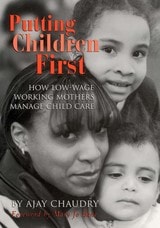
Putting Children First
How Low-Wage Working Mothers Manage Child CareAjay Chaudry
Russell Sage Foundation, 2004
Putting Faith in Partnerships
Welfare-to-Work in Four CitiesStephen V. Monsma
University of Michigan Press, 2004
In this groundbreaking study of a politically controversial topic---the debut offering in Alan Wolfe's Contemporary Political and Social Issues series---author Stephen Monsma avoids overheated rhetoric in favor of a careful, critical analysis of the hard evidence on whether public-private partnerships really work.
The book is based on in-depth studies of social service programs in Los Angeles, Chicago, Philadelphia, and Dallas. By examining public-private partnerships between government offices and nonprofit organizations, Monsma seeks to understand how these partnerships affect the balance between government's efforts to deal with social problems and the rights of individual citizens to control their own lives.
Putting Faith in Partnerships answers many previously unanswered questions in what may be the most controversial public policy debate today: about the feasibility and wisdom of government agencies forming partnerships with private organizations to provide essential public social services.
Stephen V. Monsma is Professor of Political Science at Pepperdine University. He has served as director of the Office of Quality Review in Michigan's Department of Social Services and is a widely recognized expert on the role of faith-based organizations in social service programs.
Race and the Politics of Welfare Reform
Sanford F. Schram, Joe Soss, and Richard C. Fording, Editors
University of Michigan Press, 2003
Reclaiming Class
Women, Poverty, And The Promiseedited by Vivyan C. Adair and Sandra L. Dahlberg
Temple University Press, 2003
Reformed American Dreams
Welfare Mothers, Higher Education, and ActivismSheila M. Katz
Rutgers University Press, 2019

Teen Mothers--Citizens or Dependents?
Ruth Horowitz
University of Chicago Press, 1994
"Rich vignettes reveal the complexities of teenage mothers' lives, particularly the disjuncture between classroom and street identities, 'inside' and 'outside.' . . . Original and illuminating as well as timely."—Sharon Thompson, Women's Review of Books
"Horowitz offers insights that should be considered in the debate over welfare reform. . . . Teen Mothers . . . places Horowitz's results in the context of major theories about the role of welfare in the U.S. and offers a microlevel critique of the implicit assumptions and probable consequences of each theory's approach to welfare reform."—Booklist
The White Welfare State
The Racialization of U.S. Welfare PolicyDeborah E. Ward
University of Michigan Press, 2005
"In The White Welfare State, Deborah Ward assembles a powerful array of documentary and statistical evidence to reveal the mechanisms, centrality, and deep historical continuity of racial exclusion in modern 'welfare' provision in the United States. Bringing unparalleled scrutiny to the provisions and implementation of state-level mothers' pensions, she argues persuasively that racialized patterns of welfare administration were firmly entrenched in this Progressive Era legislation, only to be adopted and reinforced in the New Deal welfare state. With rigorous and clear-eyed analysis, she pushes us to confront the singular role of race in welfare's development, from its early 20th-century origins to its official demise at century's end."
--Alice O'Connor, University of California at Santa Barbara
"This is a richly informative and arresting work. The White Welfare State will force a reevaluation of the role racism has played as a fundamental feature in even the most progressive features of the American welfare state. Written elegantly, this book will provoke a wide-ranging discussion among social scientists, historians, and students of public policy."
--Ira Katznelson, Ruggles Professor of Political Science and History, Columbia University
"This book offers an original and absorbing account of early policies that shaped the course of the American welfare state. It extends yet challenges extant interpretations and expands our understanding of the interconnections of race and class issues in the U.S., and American political development more broadly."
--Rodney Hero, University of Notre Dame

Unsocial Europe
Social Protection Or Flexploitation?Anne Gray
Pluto Press, 2004
Unwanted Claims
The Politics of Participation in the U.S. Welfare SystemJoe Soss
University of Michigan Press, 2002
Unwanted Claims is a work of political sociology that provides an illuminating account of political life in the U.S. welfare system that should be of interest to scholars, students, policy practitioners, and the general public. Written in a style that minimizes technical jargon, avoids complex statistical presentations, and makes extensive use of clients' own descriptions of their experiences, beliefs, and actions, it offers an accessible and humanizing portrait of welfare participation that challenges conventional wisdom and raises important questions about poverty, welfare, and democracy in America.
Joe Soss is Assistant Professor of Government, The American University.
WELFARE REFORM IN WEST VIRGINIA
ROBERT J. DILGER
West Virginia University Press, 2004
Welfare Reform and Political Theory
Lawrence M. Mead
Russell Sage Foundation, 2005
Work Requirements
Race, Disability, and the Print Culture of Social WelfareTodd Carmody
Duke University Press, 2022

Workfare or Fair Work
Women, Welfare, and Government Work ProgramsNancy E Rose
Rutgers University Press, 1995
Can the welfare system in the United States accord people dignity? That question is often left out of the current debates over welfare and workfare. In this provocative book, Nancy Rose argues that the United States has been successful in the past––notably during the New Deal and in the 1970s––at shaping programs that gave people “fair work.”
However, as Rose documents, those innovative job creation programs were voluntary and were mainly directed at putting men back to work. Women on welfare, and especially women of color, continue to be forced into a very different kind of program: mandatory, punitive, and demeaning. Such workfare programs are set up for failure. They rarely train women for jobs with futures, they ignore the needs of the women’s families, and they do not pay an honest wage. They perpetuate poverty rather than prevent it.
Rose uses the history of U.S. job creation programs to show alternatives to mandatory workfare. Any effort to redesign welfare in America needs to pay close attention to the lessons drawn from this perceptive analysis of the history of women, welfare, and work. This is an indispensable book for students, scholars, policymakers, politicians, and activists––for everyone who knows the system is broken and wants to fix it.
Workforce Intermediaries
For The 21St Centuryedited by Robert P. Giloth, Published in association with The American Assembly, Columbia University
Temple University Press, 2003