Results by title
4 books match the query 'White, Nancy Marie'
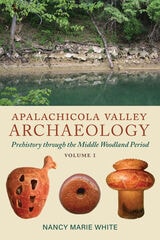
Apalachicola Valley Archaeology, Volume 1
Prehistory through the Middle Woodland PeriodNancy Marie White
University of Alabama Press, 2024
The definitive archaeological record and what is known or speculated about the ancient Apalachicola and lower Chattahoochee Valley region of northwest Florida, southeast Alabama, and southwest Georgia.
In this meticulously researched volume, Nancy Marie White provides a major holistic synthesis of the archaeological record and what is known or surmised about the peoples of the Apalachicola and lower Chattahoochee Valley region of northwest Florida, southeast Alabama, and southwest Georgia. White transforms a neglected research area into a lively saga that spans the time of the first human settlement, around 14,000 years ago, through the Middle Woodland period, ending about AD 700.
White reveals that Paleoindian habitation was more extensive than once surmised. Archaic sites were widespread, and those societies persisted when the Ice Age ended 10,000 years ago. Pottery appeared in the Late Archaic period (before 4000 BP), and Early Woodland–period burial mounds demonstrate a flowering of religious and ritual systems. Middle Woodland societies expanded this mortuary ceremony, and the complex pottery of the Swift Creek and the early Weeden Island ceramic series show an increased fascination with the ornate and unusual. Yet, basic Native American lifeways continued with gathering-fishing-hunting subsistence traditions similar to those of their ancestors.
This volume and its companion form the definitive work on the Apalachicola–lower Chattahoochee Valley region for both scholars and general readers interested in Native Americans of the Southeast.
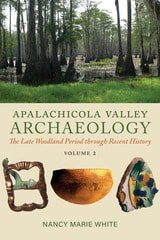
Apalachicola Valley Archaeology, Volume 2
The Late Woodland Period through Recent HistoryNancy Marie White
University of Alabama Press, 0
A comprehensive synthesis tracing 1,300 years of cultural transformation in the Apalachicola–lower Chattahoochee Valley, from Late Woodland societies to the modern era.
Apalachicola Valley Archaeology: The Late Woodland Period through Recent History, Volume 2, synthesizes the archaeology and history of the Native Americans, African Americans, and Euro-Americans of the Apalachicola–lower Chattahoochee Valley region of northwest Florida, southeast Alabama, and southwest Georgia from about 1300 years ago until the present. The region extends from Columbia, Alabama, to the Gulf of Mexico. It is culturally and environmentally distinct but little known archaeologically because it crosses historic political boundaries at the frontier.
Early chapters overview the environment and archaeology. Coverage then surveys time periods, from the Late Woodland to present. Topics include settlement, archaeological findings and material culture, subsistence and seasonality, history, sociopolitical systems, and peoples.
White’s prodigious work reveals that the prehistoric Late Woodland cultures who developed maize agriculture developed into Fort Walton chiefdoms. Post-invasion and Spanish and British colonization, these peoples were replaced by consolidated groups of Native American survivors and maroons moving around the region. These multiethnic societies with blended material cultures developed new identities, living at the edges of colonial territories. Creek societies, many becoming Seminoles, fought on all sides of European and American conflicts until most Indians were forcibly removed in the 1830s. Then the region became important for cotton, cattle, and timber, which were often produced by enslaved labor and transported by steamboat. Later expansion of agriculture and silviculture, as well as turpentine, tupelo honey, and other industries, left material evidence. The usefulness of the information to modern society is noted. Copious illustrations enhance the scientific analyses and the telling of the human stories.

Signs of Power
The Rise of Cultural Complexity in the SoutheastEdited by Jon L. Gibson and Philip J. Carr
University of Alabama Press, 2004
Traces the sources of power and large-scale organization of prehistoric peoples among Archaic societies.
By focusing on the first instances of mound building, pottery making, fancy polished stone and bone, as well as specialized chipped stone, artifacts, and their widespread exchange, this book explores the sources of power and organization among Archaic societies. It investigates the origins of these technologies and their effects on long-term (evolutionary) and short-term (historical) change.
The characteristics of first origins in social complexity belong to 5,000- to 6,000-year-old Archaic groups who inhabited the southeastern United States. In Signs of Power, regional specialists identify the conditions, causes, and consequences that define organization and social complexity in societies. Often termed "big mound power," these considerations include the role of demography, kinship, and ecology in sociocultural change; the meaning of geometry and design in sacred groupings; the degree of advancement in stone tool technologies; and differentials in shell ring sizes that reflect social inequality.
The Northwest Florida Expeditions of Clarence Bloomfield Moore
Clarence Bloomfield Moore
University of Alabama Press, 1999
A Dan Josselyn Memorial Publication
A foundational archaeological record of the Indigenous cultures, mound sites, and ancient landscapes of Northwest Florida and the Gulf Coast.
The Northwest Florida Expeditions of Clarence Bloomfield Moore, edited by David S. Brose and featuring scholarly contributions by Nancy Marie White, is an essential volume for understanding the archaeological heritage of Northwest Florida and the broader southeastern United States. This comprehensive collection brings together Moore's pioneering archaeological reports from expeditions conducted between 1901 and 1918, preserving some of the earliest documented investigations of prehistoric Native American sites in Florida, southern Alabama, and Georgia.
Traveling along rivers, coastal waterways, and estuaries, Moore examined earthen mounds, shell middens, burial sites, and village settlements, uncovering ceramics, tools, skeletal remains, and other artifacts that provided crucial insight into the Indigenous cultures that inhabited the region for thousands of years. Many of the sites he recorded have since been altered or lost, making his detailed observations an invaluable source for modern archaeological research.
The volume is enhanced by an extensive introduction from Brose and White, who place Moore's work within the context of contemporary archaeological theory and Southeastern cultural history while assessing the lasting significance of his discoveries. Combining the history of archaeology with modern interpretation, this book remains a foundational reference for scholars, students, and anyone interested in the Indigenous past of the Gulf Coast and Southeast.