Results by title
10 books match the query 'White people in literature'
Abandoning the Black Hero
Sympathy and Privacy in the Postwar African American White-Life NovelCharles, John C
Rutgers University Press, 2012
Abandoning the Black Hero is the first book to examine the postwar African American white-life novel—novels with white protagonists written by African Americans. These fascinating works have been understudied despite having been written by such defining figures in the tradition as Richard Wright, Zora Neale Hurston, James Baldwin, Ann Petry, and Chester Himes, as well as lesser known but formerly best-selling authors Willard Motley and Frank Yerby.
John C. Charles argues that these fictions have been overlooked because they deviate from two critical suppositions: that black literature is always about black life and that when it represents whiteness, it must attack white supremacy. The authors are, however, quite sympathetic in the treatment of their white protagonists, which Charles contends should be read not as a failure of racial pride but instead as a strategy for claiming creative freedom, expansive moral authority, and critical agency.
In an era when “Negro writers” were expected to protest, their sympathetic treatment of white suffering grants these authors a degree of racial privacy previously unavailable to them. White writers, after all, have the privilege of racial privacy because they are never pressured to write only about white life. Charles reveals that the freedom to abandon the “Negro problem” encouraged these authors to explore a range of new genres and themes, generating a strikingly diverse body of novels that significantly revise our understanding of mid-twentieth-century black writing.

Black and White Strangers
Race and American Literary RealismKenneth W. Warren
University of Chicago Press, 1993
Black, White, and in Color
Essays on American Literature and CultureHortense J. Spillers
University of Chicago Press, 2003
Black, White, and in Color offers a long-awaited collection of major essays by Hortense Spillers, one of the most influential and inspiring black critics of the past twenty years. Spanning her work from the early 1980s, in which she pioneered a broadly poststructuralist approach to African American literature, and extending through her turn to cultural studies in the 1990s, these essays display her passionate commitment to reading as a fundamentally political act-one pivotal to rewriting the humanist project.
Spillers is best known for her race-centered revision of psychoanalytic theory and for her subtle account of the relationships between race and gender. She has also given literary criticism some of its most powerful readings of individual authors, represented here in seminal essays on Ralph Ellison, Gwendolyn Brooks, and William Faulkner. Ultimately, the essays collected in Black, White, and in Color all share Spillers's signature style: heady, eclectic, and astonishingly productive of new ideas. Anyone interested in African American culture and literature will want to read them.

Broken Silences
Interviews with Black and White Women WritersEdited by Shirley M Jordan
Rutgers University Press, 1993
In these 20 interviews with women writers of fiction, Jordan, who teaches at Hampton University in Virginia, attempts to plumb the relations between black and white women in fiction and in life, and to explore the creative process. Although the book suffers from lengthy discussions of somewhat obscure work, the interviewees, most of whom have portrayed female characters of a race other than their own, offer intriguing, often conflicting observations about the primacy of race, gender or class. Kaye Gibbons ( Ellen Foster ) suggests that rural locations offer commonality to black and white Southern women; Marita Golden ( Long Distance Life ) observes that white writers emphasize female beauty while black writers focus on character. This book may be a useful supplement to literature courses.
From Library Journal
The message derived from the candid and articulate women interviewed here is, as Belva Plain states, "you learn as you live together." Editor Jordan (Hampton Univ., Virginia) has opened a dialog on writing and race relations by publishing these interviews with 20 significant contemporary black and white women writers, from Alice Childress and Joyce Carol Oates to Mildred Pitts Walker. The substance of these writers' thoughts is that the commonality of women's experience informs the genuine portrayal of a character as much as does the writer's understanding of her blackness or whiteness. This special book, so different from others that examine the writing process, is likely to stimulate dialog among women and to provoke serious study of many excellent women writers working today. Recommended for all collections supporting the study of literature, women's studies, and race relations.
Performing Whitely in the Postcolony
Afrikaners in South African Theatrical and Public LifeMegan Lewis
University of Iowa Press, 2016
Performing Whitely examines the multiple speech acts, political acts, and theatrical acts of the Afrikaner volk or nation in theatrical and public life, including pageants, museum sites, film, and popular music as well as theatrical productions. Lewis explores the diverse ways in which Afrikaners perform whitely, and the tactics they use, including nostalgia, melodrama, queering, abjection, and kitsch. She first investigates the way that apartheid’s architects leveraged whiteness in support of their nation-building efforts in the early twentieth century. In addition to re-enacting national pilgrimages of colonial-era migrations and building massive monuments at home, Afrikaner nationalists took their show to the United States, staging critical events of the Boer War at the 1904 St. Louis Exposition. A case study of the South African experience, Performing Whitely also offers parables for global whitenesses in the postcolonial era.
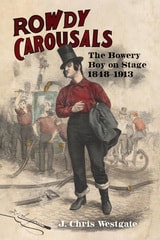
Rowdy Carousals
The Bowery Boy on Stage, 1848-1913J. Chris Westgate
University of Iowa Press, 2024
The book’s examination of working-class whiteness on stage, in the theatre, and in print culture invites theatre historians and critics to check the impulse to downplay or ignore questions about race and ethnicity in discussion of the Bowery Boy. J. Chris Westgate further explores links between the Bowery Boy’s rowdyism in the nineteenth century and the resurgence of white supremacy in the early twenty-first century.
The White Trash Menace and Hemispheric Fiction
Ramón E. Soto-Crespo
The Ohio State University Press, 2020
The Whiteness Between Us
Early Modern Playbooks of Racial TriangulationNoémie Ndiaye
University of Chicago Press, 2026
A theorization of the representational juxtapositions, frictions, and connections between Black people and other non-white people in early modern European theatre.
Over the course of the seventeenth century, European drama was an important tool for whiteness to imagine itself at the top of an aspirational structure of power relations. Indeed, that structure could only be aspirational at a time when Europeans were profoundly divided along easily racializable religious and ethnic lines, and when their sovereignty was threatened by the Ottoman empire. It was to strengthen this emerging consciousness of racial whiteness, Noémie Ndiaye argues, that European drama engaged in a form of racial triangulation, fitting Muslim, Jewish, Indigenous, Romani, and Asian characters into a spurious black/white racial binary.
Focusing on English, Spanish, and French drama from 1580 to 1715, The Whiteness Between Us shows how plays became a crucial tool to position not only black people but any non-white community in the new racial architecture that white supremacy sought to build. Ndiaye reveals the stage of this era as a space for wish fulfillment, enabling participants to imagine and work towards a whiter future.
The early modern playbooks of racial triangulation that Ndiaye brings to light can and have been reactivated for white supremacist purposes in our own day and age. Partly in response to the contemporary threat of white nationalism, scholars and students have sought to unearth the early modern roots of racial whiteness and white supremacy. Ndiaye’s book participates in this wave of interest, offering several innovations, including its capacious transnational claims.
Traces, Codes, and Clues
Reading Race in Crime FictionReddy, Maureen T
Rutgers University Press, 2002
Detective fiction featuring white women and people of color such as Barbara Neelys Blanche White and Walter Mosleys Easy Rawlinshas become tremendously popular. Although they are considered "light reading," mysteries also hold important cultural and social "clues." Much recent scholarly work has demonstrated that race is both a cultural fiction not a biological reality and a central organizing principle of experience. Popular writers are likely to reflect the conventions of their own historical situations.
In Traces, Codes, and Clues: Reading Race in Crime Fiction, Maureen T. Reddy explores the ways in which crime fiction manipulates cultural constructions such as race and gender to inscribe dominant cultural discourses. She notes that even those writers who appear to set out to revise outdated conventions repeatedly reproduce the genres most conservative elements. The greatest obstacle to transforming crime fiction, Reddy states, is the fact that the genre itself is deeply embedded in the discourse of white (and male) superiority. There is, therefore, an absolute necessity to break away from that discourse through reversal or other strategies in order to produce work that defies, and thus helps readers to defy, the dominant ideology of race.
Ugly White People
Writing Whiteness in Contemporary AmericaStephanie Li
University of Minnesota Press, 2023
Whiteness revealed: an analysis of the destructive complacency of white self-consciousness
White Americans are confronting their whiteness more than ever before, with political and social shifts ushering in a newfound racial awareness. And with white people increasingly seeing themselves as distinctly racialized (not simply as American or human), white writers are exposing a self-awareness of white racialized behavior—from staunch antiracism to virulent forms of xenophobic nationalism. Ugly White People explores representations of whiteness from twenty-first-century white American authors, revealing white recognition of the ugly forms whiteness can take.
Stephanie Li argues that much of the twenty-first century has been defined by this rising consciousness of whiteness because of the imminent shift to a “majority minority” population and the growing diversification of America’s political, social, and cultural institutions. The result is literature that more directly grapples with whiteness as its own construct rather than a wrongly assumed norm. Li contextualizes a series of literary novels as collectively influenced by changes in racial and political attitudes. Turning to works by Dave Eggers, Sarah Smarsh, J. D. Vance, Claire Messud, Ben Lerner, and others, she traces the responses to white consciousness that breed shared manifestations of ugliness. The tension between acknowledging whiteness as an identity built on domination and the failure to remedy inequalities that have proliferated from this founding injustice is often the source of the ugly whiteness portrayed through these narratives.
The questions posed in Ugly White People about the nature and future of whiteness are vital to understanding contemporary race relations in America. From the election of Trump and the rise of white nationalism to Karen memes and the war against critical race theory to the pervasive pattern of behavior among largely liberal-leaning whites, Li elucidates truths about whiteness that challenge any hope of national unity and, most devastatingly, the basic humanity of others.
Retail e-book files for this title are screen-reader friendly.