Results by title
11 books match the query 'Witnesses'

Accusatory Practices
Denunciation in Modern European History, 1789-1989Edited by Sheila Fitzpatrick and Robert Gellately
University of Chicago Press, 1997
"This is a fascinating and highly original exploration of a familiar, though poorly understood, phenomenon of modern societies in general and totalitarian systems in particular. From the French Revolution to the NKVD, Gestapo, and Stasi, denunciation is analyzed both as a function of political surveillance and as deeply rooted in the social practices of community and the workplace. The book represents a refreshing amalgam of deeply archival research and theoretical rigor."—Norman M. Naimark, Stanford University
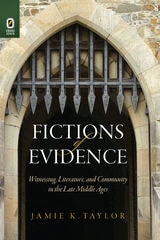
Fictions of Evidence
Witnessing, Literature, and Community in the Late Middle AgesJamie K. Taylor
The Ohio State University Press, 2013
Forensic Epidemiology
A Comprehensive Guide for Legal and Epidemiology ProfessionalsSana Loue
Southern Illinois University Press, 1999
Sana Loue explores the concepts of legal and epidemiological causation, the use of epidemiological data based on populations to determine causation in an individual case, and the use of epidemiological evidence in litigation, including the reliance on experts and expert witnesses.
Loue provides a guide for the attorney with little or no background in epidemiological theory and for the epidemiologist contemplating a new role as an expert witness. She assumes of her readers a working knowledge of the Federal Rules of Civil Procedure and the Federal Rules of Evidence.
Discussing the epidemiologist as expert witness, Loue covers the nature of that testimony, the purpose of the testimony, and the qualifications necessary to be regarded as an expert witness. She examines various legal theories of causation, primarily in the context of product liability and toxic tort, and addresses epidemiological principles and methods used in the process of causal inference.
Loue also focuses on legal mechanisms used to assess causation. Her concern here is with depositions and testimony and the preparation of epidemiology experts. She concludes her study by comparing the legal and epidemiological concepts of causation, using actual legal cases as examples.
Throughout the text, Loue incorporates excerpts from depositions, interrogatories, and trial testimony to provide concrete examples. She also sets up an appendix to provide nonattorney readers with an overview of the legal system. Ultimately, her goal is to foster a greater understanding between law and epidemiology.
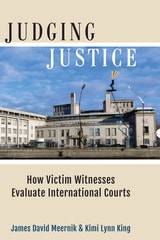
Judging Justice
How Victim Witnesses Evaluate International CourtsJames David Meernik and Kimi Lynn King
University of Michigan Press, 2019
In order to understand the meaning of justice, James David Meernik and Kimi Lynn King studied the perspective of witnesses who have testified before the International Criminal Tribunal for the Former Yugoslavia (ICTY). Using a unique survey, Meernik and King look at the identity of the victims and their perception of the fairness of ICTY. Because of the need to justify the practical and emotional difficulties involved in testifying before an international tribunal, witnesses look not just to the institution to judge its effectiveness, but also to their own contribution, by testifying effectively. The central elements of the theory Meernik and King develop—identity, fairness, and experience—transcend specific conflicts and specific countries and are of importance to people everywhere.
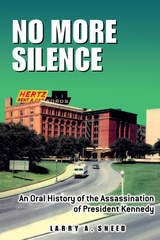
No More Silence
An Oral History of the Assassination of President KennedyLarry A. Sneed
University of North Texas Press, 2002
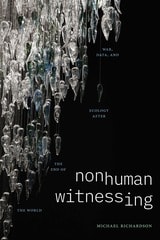
Nonhuman Witnessing
War, Data, and Ecology after the End of the WorldMichael Richardson
Duke University Press, 2024

Operation Defensive Shield
Witnesses to Israeli War CrimesEdited by Muna Hamzeh and Todd June
Pluto Press, 2003
On March 29, 2002 the Israeli army launched Operation Defensive Shield, the largest military offensive against Palestinian civilians since the 1948 Arab-Israeli War. During the operation, the military used the most advanced weaponry at its disposal: Merkava tanks, Apache attack helicopters and F-15 fighter jets. When the operation ended on April 21, Israel had destroyed the Palestinian economic and social infrastructure, leveled large swathes of residential area, killed 220 people, injured hundreds more and arrested thousands.
This book documents these events through a collection of electronic witness narratives written by Palestinians who were under attack and by Israeli and international peace activists who witnessed the results of these attacks. Deeply moving and courageous, these narratives offer a uniquely powerful and intimate account of the daily reality for Palestinians who endured Ariel Sharon's military strategy, and the death and destruction that strategy has caused throughout the Occupied Territories.
Most important, the witnesses' voices bring to life the aggressive nature of this strategy -- they belie the noble motives ascribed to Sharon and those in his government and military who designed and carried it out. The editors argue that Operation Defensive Shield is a prelude to Israel's ethnic cleansing of the Palestinians. They provide historical context, a chronology, and an analysis of the conflict that situates the horror of these days in their proper perspective.
Operation Defensive Shield: Witnesses to Israeli War Crimes is an essential record for those who want to understand what happened in the West Bank in the spring of 2002, and what it portends for the future of the region.
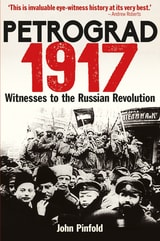
Petrograd, 1917
Witnesses to the Russian RevolutionJohn Pinfold
Bodleian Library Publishing, 2017
Assembling extracts from letters, journals, diaries, and memoirs from a remarkably diverse cast of both Russians and foreign nationals who were there when the revolution broke, Petrograd, 1917 is a strikingly close-up account of these world-shaking events. Each entry is supplemented with a short introductory note that sets it in context, and the book is rounded out with more than seventy illustrations, including photographs of the Romanovs and the violence in the streets as well as propaganda posters, postcards to loved ones, and more. In these pages, the drama and terror of those days comes to life once more, a century on.
The Man Who Sleeps in My Office
Jason Sommer
University of Chicago Press, 2004
Witnesses to Beatitude
Seven Romanian Greek Catholic Bishops Under CommunismFrancisca Băltăceanu
Catholic University of America Press, 2026
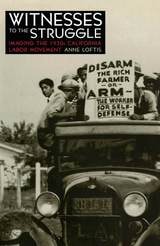
Witnesses to the Struggle
Imaging the 1930s California Labor MovementAnne Loftis
University of Nevada Press, 2014
In this groundbreaking interdisciplinary study, Loftis examines the artists who put a human face on the farmworkers’ plight in California during the Great Depression, focusing on writer John Steinbeck, photographer Dorothea Lange, sociologist and author Paul Taylor, and journalist Carey McWilliams. Loftis probes the interplay between journalism and art in the 1930s, when both academics and artists felt an urgent need to be relevant in the face of enormous misery. The power of their work grew out of their personal involvement in both the labor struggles and the hardships endured by workers and their families. Steinbeck, Lange, and the other artists and intellectuals in their circles created the public images of their times. Works such as The Grapes of Wrath or Lange’s Migrant Mother actually helped mold public opinion and form government policies. Even today these works remain icons in our shared perception of that era. Loftis helps us understand why this art still seems the truest representation of those desperate times, three-quarters of a century later.