Results by title
6 books match the query 'Women human rights workers'

Digging for Hope
A Feminist Ethnography in the Land of Mass GravesR. Aída Hernández Castillo
University of Arizona Press, 2026
Through physical and spiritual practices such as exhumation, mourning, and poetic remembrance, these women reclaim dignity for the dead and challenge a society that has normalized disappearance. At the heart of this book is a profound exploration of what Hernández Castillo calls a “pedagogy of love”—a political and ethical framework rooted in care, solidarity, and the refusal to forget. These women are not only searching for bodies; they are building emotional communities, crafting new languages of justice, and offering a reimagining of what it means to resist violence. Their practices, often overlooked by traditional scholarship, restore humanity and dignify the disappeared.
Digging for Hope is essential reading for anyone seeking to understand the gendered dimensions of violence and the grassroots movements that rise in response. With clarity and compassion, Hernández Castillo brings readers into the intimate spaces of grief and resistance, offering a model for feminist ethnography that is both rigorous and deeply humane.
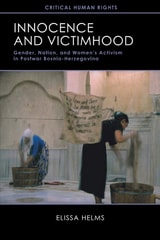
Innocence and Victimhood
Gender, Nation, and Women’s Activism in Postwar Bosnia-HerzegovinaElissa Helms
University of Wisconsin Press, 2013
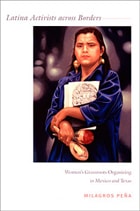
Latina Activists across Borders
Women's Grassroots Organizing in Mexico and TexasMilagros Peña
Duke University Press, 2007
Drawing on interviews with the leaders of more than two dozen women’s NGOs in Michoacán and El Paso/Ciudad Juárez, Peña examines the influence of the Roman Catholic Church and liberation theology on Latina activism, and she describes how activist affiliations increasingly cross ethnic, racial, and class lines. Women’s NGOs in Michoacán put an enormous amount of energy into preparations for the 1995 United Nations–sponsored World Conference on Women in Beijing, and they developed extensive activist networks as a result. As Peña demonstrates, activists in El Paso/Ciudad Juárez were less interested in the Beijing conference; they were intensely focused on issues related to immigration and to the murders and disappearances of scores of women in Ciudad Juárez. Ultimately, Peña’s study highlights the consciousness-raising work done by NGOs run by and for Mexican and Mexican American women: they encourage Latinas to connect their personal lives to the broader political, economic, social, and cultural issues affecting them.
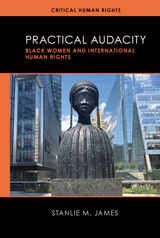
Practical Audacity
Black Women and International Human RightsStanlie James
University of Wisconsin Press, 2022
Stanlie M. James weaves narratives by and about these women throughout the history of the field, illustrating how they conceptualize, develop, and implement human rights. By centering the courage and innovative interventions of capable and visionary Black women, she places them rightfully alongside such figures as Thurgood Marshall and Charles Hamilton Houston. This volume fundamentally shifts the frame through which human rights struggles are understood, illuminating how those who witness and experience oppression have made some of the biggest contributions to building a better world.
Rigoberta Menchu Controversy
Arturo Arias
University of Minnesota Press, 2001
A balanced appraisal of the bitter debate surrounding the autobiography of Guatemala’s 1992 Nobel Peace Prize recipient.
Guatemalan indigenous rights activist Rigoberta Menchú first came to international prominence following the 1983 publication of her memoir, I, Rigoberta Menchú, which chronicled in compelling detail the violence and misery that she and her people suffered during her country’s brutal civil war. The book focused world attention on Guatemala and led to her being awarded the Nobel Peace Prize in 1992. In 1999, a book by David Stoll challenged the veracity of key details in Menchú’s account, generating a storm of controversy. Journalists and scholars squared off regarding whether Menchú had lied about her past and, if so, what that would mean about the larger truths revealed in her book.
In The Rigoberta Menchú Controversy, Arturo Arias has assembled a casebook that offers a balanced perspective. The first section of this volume collects the primary documents-newspaper articles, interviews, and official statements-in which the debate raged, many translated into English for the first time. In the second section, a distinguished group of international scholars assesses the political, historical, and cultural contexts of the debate and considers its implications for such issues as the “culture wars,” historical truth, and the politics of memory. Included is a new essay by David Stoll in which he responds to his critics.Contributors: Luis Aceituno; Juan Jesús Aznárez; John Beverley, U of Pittsburgh; Allen Carey-Webb, Western Michigan U; Margarita Carrera; Duncan Earle, U of Texas, El Paso; Carolina Escobar Sarti; Claudia Ferman, U of Richmond; Dina Fernández García; Eduardo Galeano; Dante Liano, U of Milan; W. George Lovell, Queen’s U, Canada; Christopher H. Lutz; Octavio Martí; Victor D. Montejo, UC Davis; Rosa Montero; Mario Roberto Morales, U of Northern Iowa; Jorge Palmieri; Daphne Patai, U of Massachusetts, Amherst; Mary Louise Pratt, Stanford U; Danilo Rodríguez; Ileana Rodríguez, Ohio State U; Larry Rohter; Jorge Skinner-Kleé; Elzbieta Sklodowska, Washington U; Carol A. Smith, UC Davis; Doris Sommer, Harvard U; David Stoll, Middlebury College; Manuel Vásquez Montalbán; and Kay B. Warren, Harvard U.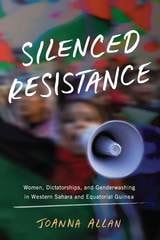
Silenced Resistance
Women, Dictatorships, and Genderwashing in Western Sahara and Equatorial GuineaJoanna Allan
University of Wisconsin Press, 2021