Results by title
16 books match the query 'Women in Christianity'
A Most Reliable Witness
Essays in Honor of Ross Shepard KraemerSusan Ashbrook Harvey
SBL Press, 2015
Celebrate a trailblazer in the areas of women and re
Celebrate a trailblazer in the areas of women and religion, Jews and Judaism, and earliest Christianity in the ancient Mediterranean
Ross Kraemer is Professor Emerita in the Department of Religious Studies at Brown University. This volume of essays, conceived and produced by students, colleagues, and friends bears witness to the breadth of her own scholarly interests. Contributors include Theodore A. Bergren, Debra Bucher, Lynn Cohick, Mary Rose D’Angelo, Nathaniel P. DesRosiers, Robert Doran, Jennifer Eyl, Paula Fredriksen, John G. Gager, Maxine Grossman, Kim Haines-Eitzen, Susan Ashbrook Harvey, Jordan Kraemer, Robert A. Kraft, Shira L. Lander, Amy-Jill Levine, Susan Marks, E. Ann Matter, Renee Levine Melammed, Susan Niditch, Elaine Pagels, Adele Reinhartz, Jordan Rosenblum, Sarah Schwarz, Karen B. Stern, Stanley K. Stowers, Daniel Ullucci, Arthur Urbano, Heidi Wendt, and Benjamin G. Wright.Features:
- Articles that examine both ancient and modern texts in cross-cultural and trans-historical perspective
- Twenty-eight original essays on ancient Judaism, Christianity, and women in the Greco-Roman world
Faith and Feminism in Nineteenth-Century Religious Communities
Michaela Sohn-Kronthaler
SBL Press, 2019
Explore a diversity of feminist readings of the Bible
This latest volume in the Bible and Women series is concerned with documenting, through word and image, both well-known and largely unknown women and their relationship to the Bible from the period of the late eighteenth century up to the beginning of the twentieth century. The essays in this collection illustrate the broad range of treatment of the Holy Scripture. Paul Chilcote, Marion Ann Taylor, Christiana de Groot, Elizabeth M. Davis, and Pamela S. Nadell offer perspectives on the Anglo-American sphere during this period. Marina Cacchi, Adriano Valerio, Inmaculada Blasco Herranz, and Alexei Klutschewski and Eva Maria Synek illuminate the areas of southern and eastern Europe. Angela Berlis, Ruth Albrecht, Doris Brodbeck, Ute Gause, and Michaela Sohn-Kronthaler examine women from the German-speaking world and their texts. Bernhard Schneider, Magda Motté, Katharina Büttner-Kirschner, and Elfriede Wiltschnigg treat the subject area of religious literature and art.
Features
- Insight into how women participated in academic exegesis and applied biblical figures as models for structuring their own lives
- Exploration of genres used by women, including letters, diaries, autobiographical records, stories, novels, songs, poems, and specialized exegetical treatises and commentaries on individual books of the Bible
- Detailed analyses of women’s interpretations ranging from those that sought to confirm traditions to those that challenged them
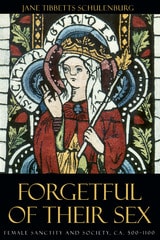
Forgetful of Their Sex
Female Sanctity and Society, ca. 500-1100Jane Tibbetts Schulenburg
University of Chicago Press, 1998
"A tremendous piece of scholarship. . . . This journey through more than 2,000 saints is anything but dull. Along the way, Schulenburg informs our ideas regarding the role of saints in the medieval psyche, gender-specific identification, and the heroics of virginity." —Library Journal
"[This book] will be a kind of 'roots' experience for some readers. They will hear the voices, haunted and haunting, of their distant ancestors and understand more about themselves." —Christian Science Monitor
"This fascinating book reaches far beyond the history of Christianity to recreate the 'herstory' of a whole gender." —Kate Saunders, The Independent
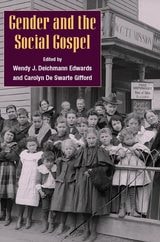
Gender and the Social Gospel
Edited by Wendy J. Deichmann Edwards and Carolyn De Swarte Gifford
University of Illinois Press, 2003
A practical theological response to the stark realities of poverty and injustice prevalent in turn-of-the-century America, the social gospel movement sought to apply the teachings of Jesus and the message of Christian salvation to society by striving to improve the lives of the impoverished and the disenfranchised. The contributors to this volume set out to broaden our understanding of this radical movement by examining the lives of some of its passionate and vibrant female participants and the ways in which their involvement expanded and enriched the scope of its activity.
In addition to examining the lives of individual women, the essays in Gender and the Social Gospel contain broader analyses of the gender and racial issues that have caused the histories of movements such as the social gospel to be viewed almost exclusively in terms of their male, European-American, intellectual participants at the expense of the women, African Americans, and Canadians whose contributions were just as worthy of attention.
Godly Women
Fundamentalism and Female PowerBrasher, Brenda E
Rutgers University Press, 1997
Gospels
Narrative and HistoryMercedes Navarro Puerto
SBL Press, 2015
An international collection of ecumenical, gender-sensitive interpretations
In this volume of the Bible and Women Series, contributors examine how biblical studies intersects with feminist interpretive methods with regard to the Gospels. Authors examine the lives of women in Roman Palestine, named and unnamed women in the Gospels, and the role of gender in the reception of the Hebrew scriptures in the New Testament.
Features:
- Essays by scholars from scholars from around the world
- An introduction and twenty essays focused on women and gender relations
- Coverage of power relations and ideologies within the texts and in current interpretations
Reading Women in the New Testament Letters
Korinna Zamfir
SBL Press, 2024
Spirit, Structure, and Flesh
Gender and Power in Yoruba African Instituted ChurchesDeidre Helen Crumbley
University of Wisconsin Press, 2008
The Early Middle Ages
Franca Ela Consolino
SBL Press, 2020
Examine the creative, profound dialogue between medieval women and biblical traditions
The latest volume in the Bible and Women series examines the relationship between women and the Bible’s reception during the early Middle Ages (500–1100 CE) in both the Greek East and the Latin West. Essays focus on interactions between women and the Bible through biblical precepts on women and for women, biblical women as the subjects of action or objects of discussion, and writings by women that refer to the Bible as a moral authority. The women discussed in the volume range from the well-known—including the nuns Kassia in Byzantium and Hrosvita in the West; the aristocrat Dhuoda, author of a moral guide for her son; Gisela, the sister of Charlemagne and abbess of Chelles; and her niece Rotrude—to those who remain anonymous. Contributions also explore how the Old and New Testaments exercised influence on emerging Islam.
Features:
- Analysis of images of the Virgin Mary as a means of tracing the spread of her cult and feast days from East to West
- Exploration of the significance of classical culture for medieval women who composed poems for a Christian audience
- Evaluation of art as a means of establishing devotional relationships not necessarily mediated by the voices of preachers or the reading of texts .
The High Middle Ages
Kari Elisabeth Børresen
SBL Press, 2015
An international collection of ecumenical, gender-sensitive interpretations
The latest volume in the Bible and Women series examines the relationship between women and the Bible's reception in the centuries of the High and Late Middle Ages in Europe. Contributors bring a variety of new insights to questions of how women of the Bible were treated in literary, mystical, and doctrinal texts as well as in art and music. Though the Bible was used to legitimize the subordination of women to men and to exclude them from power, during this period women produced works of theology and biblical interpretation. Contributors include Gemma Avenoza, Marina Benedetti, Dinora Corsi, Maria Laura Giordano, Elisabeth Gössmann, Maria Leticia Sánchez Hernández, Hildegund Keul, Linda Maria Koldau, Martina Kreidler-Kos, Rita Librandi, Gary Macy, Constant J. Mews, Magda Motté, Rosa María Parrinello, María Isabel Toro Pascua, Claudia Poggi, Carmel Posa, Marina Santini, Valeria Ferrari Schiefer, Andrea Taschl-Erber, Adriana Valerio, and Paola Vitolo.
Features
- Essays on the treatment of women in commentaries and didactic moral literature written by men
- Close study of women as scholars and interpreters of the Bible from the twelfth through the fifteen centuries
- Twenty-one essays from twenty-three scholars from around the world
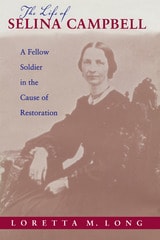
The Life of Selina Campbell
A Fellow Soldier in the Cause of RestorationLoretta M. Long Hunnicutt
University of Alabama Press, 2001
This first biography of Selina Campbell opens a window onto the experience of women in one of the most dynamic religious groups of 19th-century America
Loretta M. Long examines the life and influence of Selina Campbell, one of the most visible women in the 19th-century Disciples of Christ movement. Best known as the wife of Alexander Campbell, founder of the Disciples, Selina Campbell both shaped and exemplified the role of women in this dynamic religious group (also known as the Stone-Campbell movement). Her story demonstrates the importance of faith in the lives of many women during this era and adds a new dimension to the concept of the “separate spheres” of men and women, which women like Campbell interpreted in the context of their religious beliefs.
A household manager, mother, writer, and friend, Campbell held sway primarily in the domestic sphere, but she was not held captive by it. Her relationship with her husband was founded on a deep sense of partnership conditioned by their strong faith in an all-powerful God. Each of them took on complementary roles according to the perceived natural abilities of their genders: Alexander depended on Selina to manage his property and raise the children while he traveled the country preaching. Campbell outlived her husband by 30 years, and during that time published several newspaper articles and supported new causes, such as women in missions.
In the end, as Long amply demonstrates, Selina Campbell was neither her husband’s shadow nor solely a domestic worker. She was, in her husband’s eyes, a full partner and a “fellow soldier” in the cause of Restoration.
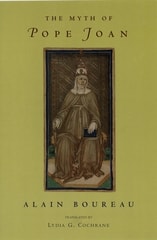
The Myth of Pope Joan
Alain Boureau
University of Chicago Press, 2001
Or so the legend goes—a legend that was fabricated sometime in the thirteenth century, according to Alain Boureau, and which has persisted in one form or another down to the present day. In this fascinating saga of belief and rhetoric, politics and religion, Boureau investigates the historical and ecclesiastical circumstances under which the myth of Pope Joan was constructed and the different uses to which it was put over the centuries. He shows, for instance, how Catholic clerics justified the exclusion of women from the papacy and the priesthood by employing the myth in misogynist moral tales, only to find the popess they had created turned against them in anti-Catholic propaganda during the Reformation.
Two Women of the Great Schism
The Revelations of Constance de Rabastens by Raymond de Sabanac and Life of the Blessed Ursulina of Parma by Simone ZanacchiRaymond de Sabanac and Simone Zanacchi
Iter Press, 2010
Whether a Christian Woman Should Be Educated and Other Writings from Her Intellectual Circle
Anna Maria van Schurman
University of Chicago Press, 1998
Gathered here in meticulous translation are Anna Maria van Schurman's defense of women's education, her letters to other learned women, and her own account of her early life, as well as responses to her work from male contemporaries, and rare writings by Schurman's mentor, Voetius. This volume will interest the general reader as well as students of women's, religious, and social history.
Women and Religion in Medieval and Renaissance Italy
Edited by Daniel Bornstein and Roberto Rusconi
University of Chicago Press, 1996
These essays explore the involvement of women in religious life throughout northern and central Italy and trace the evolution of communities of pious women as they tried to achieve their devotional goals despite the strictures of the ecclesiastical hierarchy. The contributors examine relations between holy women, their devout followers, and society at large.
Including contributions from leading figures in a new generation of Italian historians of religion, this book shows how women were able to carve out broad areas of influence by carefully exploiting the institutional church and by astutely manipulating religious percepts.
Women in Early Christianity
Translations from Greek TextsPatricia Cox Miller
Catholic University of America Press, 2005