Results by title
3 books match the query 'Women in the performing arts'
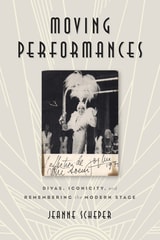
Moving Performances
Divas, Iconicity, and Remembering the Modern StageScheper, Jeanne
Rutgers University Press, 2017
Fabulous yet fierce, imperious yet impetuous, boss yet bitchy—divas are figures of paradox. Their place in culture is equally contradictory, as they are simultaneously venerated and marginalized, hailed as timeless but then frequently forgotten or exhumed as cult icons by future generations.
Focusing on four early twentieth-century divas—Aida Overton Walker, Loïe Fuller, Libby Holman, and Josephine Baker—who were icons in their own time, Moving Performances considers what their past and current reception reveals about changing ideas of race and gender. Jeanne Scheper examines how iconicity can actually work to the diva’s detriment, reducing her to a fetish object, a grotesque, or a figure of nostalgia. Yet she also locates more productive modes of reception that reach to revive the diva’s moving performances, imbuing her with an affective afterlife.
As it offers innovative theorizations of performance, reception, and affect, Moving Performances also introduces readers to four remarkable women who worked as both cultural producers and critics, deftly subverting the tropes of exoticism, orientalism, and primitivism commonly used to dismiss women of color. Rejecting iconic depictions of these divas as frozen in a past moment, Scheper vividly demonstrates how their performances continue to inspire ongoing movements.
[more]
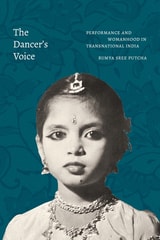
The Dancer's Voice
Performance and Womanhood in Transnational IndiaRumya Sree Putcha
Duke University Press, 2023
In The Dancer’s Voice Rumya Sree Putcha theorizes how the Indian classical dancer performs the complex dynamics of transnational Indian womanhood. Putcha argues that the public persona of the Indian dancer has come to represent India in the global imagination—a representation that supports caste hierarchies and Hindu ethnonationalism, as well as white supremacist model minority narratives. Generations of Indian women have been encouraged to embody the archetype of the dancer, popularized through film cultures from the 1930s to the present. Through analyses of films, immigration and marriage laws, histories of caste and race, advertising campaigns, and her own family’s heirlooms, photographs, and memories, Putcha reveals how women’s citizenship is based on separating their voices from their bodies. In listening closely to and for the dancer’s voice, she offers a new way to understand the intersections of body, voice, performance, caste, race, gender, and nation.
[more]
The Healing Stage
Black Women, Incarceration, and the Art of TransformationLisa Biggs
The Ohio State University Press, 2022
Winner, 2023 NCA Lilla A. Heston Award for Outstanding Scholarship in Interpretation and Performance Studies Winner of the 2023 ASTR Errol Hill Award Finalist, 2023 ASTR Barnard Hewitt Award for Outstanding Research in Theatre History Over the last five decades, Black women have been one of the fastest-growing segments of the global prison population, thanks to changes in policies that mandate incarceration for nonviolent offenses and criminalize what women do to survive interpersonal and state violence. In The Healing Stage, Lisa Biggs reveals how four ensembles of currently and formerly incarcerated women and their collaborating artists use theater and performance to challenge harmful policies and popular discourses that justify locking up “bad” women. Focusing on prison-based arts programs in the US and South Africa, Biggs illustrates how Black feminist cultural traditions—theater, dance, storytelling, poetry, humor, and protest—enable women to investigate the root causes of crime and refute dominant narratives about incarcerated women. In doing so, the arts initiatives that she writes about encourage individual and collective healing, a process of repair that exceeds state definitions of rehabilitation. These case studies offer powerful examples of how the labor of incarcerated Black women artists—some of the most marginalized and vulnerable people in our society—radically extends our knowledge of prison arts programs and our understanding of what is required to resolve human conflicts and protect women’s lives.
[more]