Results by title
3 books match the query 'Women plantation owners'
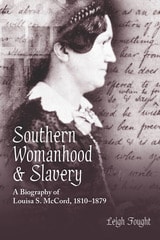
Southern Womanhood and Slavery
A Biography of Louisa S. McCord, 1810-1879Leigh Fought
University of Missouri Press, 2018
Southern Womanhood and Slavery is the first full-length biography of Louisa S. McCord, one of the most intriguing intellectuals in antebellum America. The daughter of South Carolina planter and politician Langdon Cheves, and an essayist in her own right, McCord supported unregulated free trade and the perpetuation of slavery and opposed the advancement of women’s rights. This study examines the origins of her ideas.
Leigh Fought constructs an exciting narrative that follows McCord from her childhood as the daughter of a state representative and president of the Bank of the United States through her efforts to accept her position as wife and mother, her career as an author and plantation mistress, and the Union invasion of South Carolina during the Civil War, to the end of her life in the emerging New South. Fought analyzes McCord’s poetry, letters, and essays in an effort to comprehend her acceptance of slavery and the submission of women. Fought concludes that McCord came to a defense of slavery through her experience with free labor in the North, which also reinforced her faith in the paternalist model for preserving social order.
McCord’s life as a writer on “unfeminine” subjects, her reputation as strong-minded and masculine, her late marriage, her continued ownership of her plantation after marriage, and her position as the matron of a Civil War hospital contradicted her own philosophy that women should remain the quiet force behind their husbands. She lived during a time of social flux in which free labor, slavery, and the role of women underwent dramatic changes, as well as a time that enabled her to discover and pursue her intellectual ambitions. Fought examines the conflict that resulted when those ambitions clashed with McCord’s role as a woman in the society of the South.
McCord’s voice was an interesting, articulate, and necessary feminine addition to antebellum white ideology. Moreover, her story demonstrates the ways in which southern women negotiated through patriarchy without surrendering their sense of self or disrupting the social order. Engaging and very readable, Southern Womanhood and Slavery will be of special interest to students of southern history and women’s studies, as well as to the general reader.
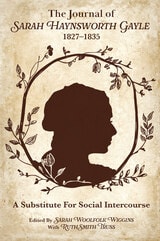
The Journal of Sarah Haynsworth Gayle, 1827–1835
A Substitute for Social IntercourseEdited by Sarah Woolfolk Wiggins with Ruth Smith Truss
University of Alabama Press, 2013
The remarkable journal of the young wife of early Alabama governor John Gayle and a primary source of our knowledge about early Alabama and the antebellum American South
Astonishing, tragic, and remarkable, the journal of Sarah Haynsworth Gayle, wife of early Alabama governor John Gayle, is among the most widely studied and seminal accounts of antebellum life in the American South. This is the first complete edition of the journal in print.
Bereft of the companionship of her often-absent husband, Sarah considered her journal “a substitute for social intercourse” during the period from 1827 to 1835. It became the social and intellectual companion to which she confided stories that reflected her personal life and the world of early Alabama. Sarah speaks directly to us of her loneliness, the challenges of child rearing, her fear of and frustration with the management of slaves, and the difficulty of balancing the responsibilities of a socially prominent woman with her family’s slender finances.
The poor condition of the journal and its transcripts, sometimes disintegrated or reassembled in the wrong order, has led historians to misinterpret Gayle’s words. Gayle’s descendants, Alabama’s famed Gorgases, deliberately obscured or defaced many passages. Using archival techniques to recover the text and restore the correct order, Sarah Wiggins and Ruth Truss reveal the unknown story of Sarah’s economic hardships, the question of her husband’s “temperance,” and her opium use.
The only reliable and unexpurgated edition of Sarah Gayle’s journal, now enhanced with a fascinating introduction and inset notes, The Journal of Sarah Haynsworth Gayle, 1827–1835, is a robust and gripping account and will be of inestimable value to our understanding of antebellum society, religion, intellectual culture, and slavery.
Published in cooperation with the University Libraries, The University of Alabama, with further financial support from the Library Leadership Board, the University Libraries, The University of Alabama.
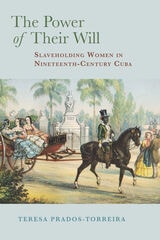
The Power of Their Will
Slaveholding Women in Nineteenth-Century CubaTeresa Prados-Torreira
University of Alabama Press, 2021
CHOICE OUTSTANDING ACADEMIC TITLE, 2022
“This fascinating book explores the unique circumstances of white slaveholding women in 19th-century Cuba and the enslaved peoples they controlled . . .This is a must read for scholars of the Caribbean and the African diaspora. Essential.” —CHOICE
In the early nineteenth century, while abolitionism was rising and the slave trade was declining in the Atlantic world, Spain used this opportunity to massively expand plantation slavery in Cuba. Between 1501 and 1866, more than 778,000 Africans were torn from their homelands and brought to work for the Cuban slaveholding class.
An understudied aspect of Cuban slaveholding society is the role of the white Cuban slave mistress (amas). The Power of Their Will: Slaveholding Women in Nineteenth-Century Cuba illuminates the interaction of female slaveholders and the enslaved during this time. Teresa Prados-Torreira shows, despite the lack of political power in a highly patriarchal society, Cuban women as property owners were instrumental in supporting the long duration of slavery, whether by enforcing the disciplining of the enslaved in the domestic sphere or helping to create the illusion of slavery as a humane institution. Thousands of Creole slaveholding women relied on slaves to lead a comfortable life. Even the subsistence of many poor women depended on the income derived from the hiring out of their enslaved.
In this accessible cultural history, culled from government documents, fiction, newspaper articles, traveler’s accounts, women’s wills, and archival research, Prados-Torreira coalesces a valuable narrative out of the often paradoxical and conflicting stories of the human bonds between the female owner and the enslaved. Narrative chapters, enlivened by vignettes, describe the daily life of slave mistresses in the main cities of Havana and Santiago and other towns, workings of sugar mills and coffee plantations, how slaveholding women coping with slave rebellions and wartime during the Ten Years’ War, and how personal relationships could occasionally affect the balance of power.