Results by title
8 books match the query 'Women scientists'
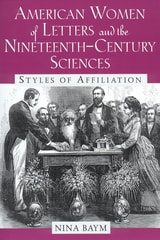
American Women of Letters and the Nineteenth-Century Sciences
Styles of AffiliationBaym, Nina
Rutgers University Press, 2001
Choice Outstanding Academic Title
During the nineteenth century, the content and institutional organization of the sciences evolved dramatically, altering the public's understanding of knowledge. As science grew in importance, many women of letters tried to incorporate it into a female worldview. Nina Baym explores the responses to science displayed in a range of writings by American women. Conceding that they could not become scientists, women insisted, however, that they were capable of understanding science and participating in its discourse. They used their access to publishing to advocate the study and transmission of scientific information to the general public.
Bayms book includes biographies and a full exploration of these women's works. Among those considered are:
• Almira Phelps, author of Familiar Lectures on Botany (it sold 350,000 copies)
• Sarah Hale, who filled Godey's Lady's Book with science articles
• Catharine Esther Beecher, who based her domestic advice on scientific information
• Elizabeth Cary Agassiz, the actual ghostwriter of her husband's popular science essays
• Emily Dickinson, whose poetry is replete with scientific images.
Baym also investigates science in women's novels, writing by and about women doctors, and the scientific claims advanced by women's spiritualist movements. This book truly breaks new ground, outlining a field of inquiry that few have noted exists.
Core Samples
A Climate Scientist's Experiments in Politics and MotherhoodAnna Farro Henderson
University of Minnesota Press, 2024
People live by their stories—how can we use them to accelerate action on climate change?
Climate scientist and policy expert Anna Farro Henderson embarks on a remarkable narrative journey in Core Samples, exploring how science is done, discussed, legislated, and imagined. Through stories both raucous and poignant—of far-flung expeditions, finding artistic inspiration in research, and traversing the systemic barriers women and mothers face in science and politics—she brings readers into the daily rhythms and intimacies of scientific research and political negotiation.
Grounded in her experiences as a climate scientist, an environmental policy advisor to Minnesota Senator Al Franken and Governor Mark Dayton, and a constant juggler of the many roles and responsibilities of professional moms, Henderson’s eclectic, unconventional essays range from observations, confessions, and meditations on lab and fieldwork to a packing list for a trip to the State Capitol and a lactation diary. Readers are invited on voyages as far afield as the Trinity nuclear test site in New Mexico, the Juneau Icefield in Alaska, and a meteor crater in Ghana—and as close to home as a town hall meeting in America’s corn belt.
A love letter to science and a bracing (and sometimes hilarious) portrait of the many obstacles women, mothers, and people digging for truth navigate, Core Samples illuminates the messy, contradictory humanity of our scientific and political institutions. Bringing us behind the closed doors of discovery and debate, Henderson exposes the flaws in research institutions, the halls of government, and the role of science in policy, yet she shows how each crack is also an invitation for camaraderie, creativity, and change.
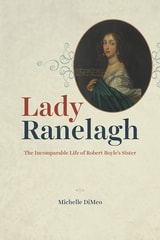
Lady Ranelagh
The Incomparable Life of Robert Boyle's SisterMichelle DiMeo
University of Chicago Press, 2021
Philosophers, mathematicians, politicians, and religious authorities sought her opinion on everything from decimalizing the currency to producing Hebrew grammars. She practiced medicine alongside distinguished male physicians, treating some of the most elite patients in London. Her medical recipes, political commentaries, and testimony concerning the philosophers’ stone gained international circulation. She was an important influence on Boyle and a formidable thinker in her own right.
Drawing from a wealth of new archival sources, Michelle DiMeo fills out Lady Ranelagh’s legacy in the context of a historically sensitive and nuanced interpretation of gender, science, and religion. The book re-creates the intellectual life of one of the most respected and influential women in seventeenth-century Europe, revealing how she managed to gain the admiration of diverse contemporaries, effect social change, and shape contemporary science.
Mothering from the Field
The Impact of Motherhood on Site-Based ResearchEdited by Bahiyyah Miallah Muhammad and Mélanie-Angela Neuilly
Rutgers University Press, 2019
Mothering from the Field offers both a mosaic of perspectives from current women scientists’ experiences of conducting field research across a variety of sub-disciplines while raising children, and an analytical framework to understand how we can redefine methodological and theoretical contributions based on mothers’ experiences in order not just to promote healthier, more inclusive, nurturing, and supportive environments in physical, life, and social sciences, but also to revolutionize how we conceptualize research.
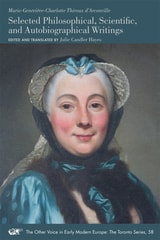
Selected Philosophical, Scientific, and Autobiographical Writings
Marie-Geneviève-Charlotte Thiroux d’Arconville
Iter Press, 2018
Edited and translated by Julie Candler Hayes
The Other Voice in Early Modern Europe: The Toronto Series, volume 58
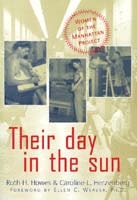
Their Day In The Sun
Ruth Howes
Temple University Press, 1999
The Manhattan Project also included women in every capacity. During World War II the manpower shortages opened the laboratory doors to women and they embraced the opportunity to demonstrate that they, too, could do "creative science." Although women participated in all aspects of the Manhattan Project, their contributions are either omitted or only mentioned briefly in most histories of the project. It is this hidden story that is presented in Their Day in the Sun through interviews, written records, and photographs of the women who were physicists, chemists, mathematicians, biologists, and technicians in the labs.
Authors Ruth H. Howes and Caroline L. Herzenberg have uncovered accounts of the scientific problems the women helped solve as well as the opportunities and discrimination they faced. Their Day in the Sun describes their abrupt recruitment for the war effort and includes anecdotes about everyday life in these clandestine improvised communities. A chapter about what happened to the women after the war and about their attitudes now, so many years later, toward the work they did on the bomb is included.
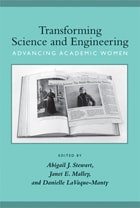
Transforming Science and Engineering
Advancing Academic WomenAbigail J. Stewart, Janet E. Malley, and Danielle LaVaque-Manty, Editors
University of Michigan Press, 2010
"If you have thrown up your hands in despair after trying to retain women science and engineering in the academy, read this book. It offers detailed descriptions of a wide array of tried-and-true programs that have been tested out by the NSF ADVANCE program."
---Joan C. Williams, 1066 Foundation Chair & Distinguished Professor of Law Director, Center for WorkLife Law University of California
"Solid and practical, this volume details the first years of NSF funded institutional change to remake gender dynamics inside U.S. science. What works? What doesn't? And why?"
---Londa Schiebinger, John L. Hinds Professor of History of Science and Barbara D. Finberg Director, Michelle R. Clayman Institute for Gender Research at Stanford University, and author of Has Feminism Changed Science?
"This book's time has come. Transforming Science and Engineering is important, and lots of people can learn from what has happened in the ADVANCE universities."
---Lotte Bailyn, Professor of Management, Behavioral and Policy Sciences Department, Sloan School of Management, MIT; author of Breaking the Mold: Redesigning Work for Productive and Satisfying Lives; and coauthor of Beyond Work-Family Balance: Advancing Gender Equity and Workplace Performance
"This collection profiles 16 NSF ADVANCE grant successes, sandwiched between an interview with Dr. Alice Hogan and Dr. Lee Harle's summary of cost-effective practices from ADVANCE programs, giving so many 'biggest bang for the buck' examples in so few pages that it will easily justify both the cost of the book and the reading time. These accounts do not continue the too-common vague referrals to 'unhealthy environment' or 'chilly climate,' but rather expound the situations before and after the interventions, something necessary in order to transplant the programs, or even to use the programs for idea generation. Transforming Science and Engineering is a model of excellence, and will be extremely useful for those women, men, faculty, or administrators wanting to help their universities move into the 21st century and attract to their campuses qualified women and men who want opportunities to attain their full potentials."
---Donna J. Nelson, Associate Professor of Chemistry, University of Oklahoma
In 2001, the National Science Foundation's ADVANCE Institutional Transformation program began awarding five-year grants to colleges and universities to address a common problem: how to improve the work environment for women faculty in science and engineering. Drawing on the expertise of scientists, engineers, social scientists, specialists in organizational behavior, and university administrators, this collection is the first to describe the variety of innovative efforts academic institutions around the country have undertaken.
Focusing on a wide range of topics, from how to foster women's academic success in small teaching institutions, to how to use interactive theater to promote faculty reflection about departmental culture, to how a particular department created and maintained a healthy climate for women's scientific success, the contributors discuss both the theoretical and empirical aspects of the initiatives, with emphasis on the practical issues involved in creating these approaches. The resulting evidence shows that these initiatives have the desired effects. The cases represented in this collection depict the many issues women faculty in science and engineering face, and the solutions that are presented can be widely accepted at academic institutions around the United States. The essays in Transforming Science and Engineering illustrate that creating work environments that sustain and advance women scientists and engineers benefits women, men, and underrepresented minorities.
Abigail J. Stewart is Sandra Schwartz Tangri Distinguished University Professor of Psychology and Women's Studies at the University of Michigan.
Janet E. Malley is a psychologist and Associate Director of the Institute for Research on Women and Gender at the University of Michigan.
Danielle LaVaque-Manty, former Research Associate at the Institute for Research on Women and Gender at the University of Michigan, teaches composition at U-M's Sweetland Writing Center.
Cover photo: Joanne Leonard
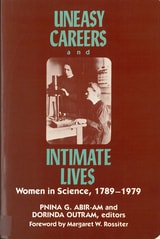
Uneasy Careers and Intimate Lives
Women in Science, 1789-1979Edited by Pnina Abir-Am and Dorinda Outram
Rutgers University Press, 1987
An international group of historians of science discuss a wide range of European and American women scientists--from early nineteenth-century English botanists to Marie Curie to the twentieth-century theoretical biologist, Dorothy Wrinch.