Results by title
11 books match the query 'World Bank'

A New Green Order?
The World Bank and the Politics of the Global Environment FacilityZoe Young
Pluto Press, 2002
Investigating the workings of this little known aid fund, Zoe Young takes a critical look at the conflicts involved, focusing on how the GEF's agenda relates to questions of globalisation, knowledge and accountability in the United States and the World Bank.
As our landscapes, fertility, cultures and ecosystems are being destroyed every day, Zoe Young gives a disturbing account of the complex issues that must be addressed before the world's environment can be managed more democratically - and effectively.
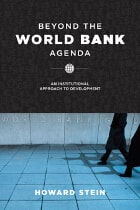
Beyond the World Bank Agenda
An Institutional Approach to DevelopmentHoward Stein
University of Chicago Press, 2008
Drawing on the examples of Africa, Asia, Latin America, and transitional European economies, this revolutionary volume proposes an alternative vision of institutional development with chapter-length applications to finance, state formation, and health care to provide a holistic, contextualized solution to the problems of developing nations. Beyond the World Bank Agenda will be essential reading for anyone concerned with forging a new strategy for sustainable development.
China's Participation in the IMF, the World Bank, and GATT
Toward a Global Economic OrderHarold K. Jacobson and Michel Oksenberg
University of Michigan Press, 1990
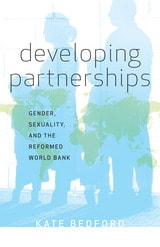
Developing Partnerships
Gender, Sexuality, and the Reformed World BankKate Bedford
University of Minnesota Press, 2009
A nuanced critique of how the World Bank encourages gender norms through its policies, Developing Partnerships argues that financial institutions are key players in the global enforcement of gender and family expectations.
By combining analysis of documents produced and sponsored by the World Bank with interviews of World Bank staffers and case studies, Kate Bedford presents a detailed examination of gender and sexuality in the policies of the world's largest and most influential development institution. Looking concurrently at economic and gender policy, Bedford connects reform of markets to reform of masculinities, loan agreements for export promotion to pamphlets for indigenous adolescents advising daily genital bathing, and attempts to strengthen institutions after the Washington Consensus to efforts to promote loving couplehood in response to economic crisis. In doing so, she reveals the shifting relationships between development and sexuality and the ways in which gender policy impacts debates about the future of neoliberalism.
Providing a multilayered account of how gender-aware policies are conceived and implemented by the World Bank, Developing Partnerships demonstrates as well how institutional practices shape development.
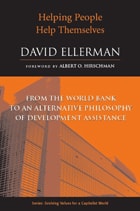
Helping People Help Themselves
From the World Bank to an Alternative Philosophy of Development AssistanceDavid Ellerman
University of Michigan Press, 2006
David Ellerman relates a deep theoretical groundwork for a philosophy of development, while offering a descriptive, practical suggestion of how goals of development can be better set and met. Beginning with the assertion that development assistance agencies are inherently structured to provide help that is ultimately unhelpful by overriding or undercutting the capacity of people to help themselves, David Ellerman argues that the best strategy for development is a drastic reduction in development assistance. The locus of initiative can then shift from the would-be helpers to the doers (recipients) of development. Ellerman presents various methods for shifting initiative that are indirect, enabling and autonomy-respecting. Eight representative figures in the fields of education, community organization, economic development, psychotherapy and management theory including: Albert Hirschman, Paulo Freire, John Dewey, and Søren Kierkegaard demonstrate how the major themes of assisting autonomy among people are essentially the same.
David Ellerman is currently a Visiting Scholar in the Economics Department at the University of California at Riverside.
Invested Interests
Capital, Culture, and the World BankBret Benjamin
University of Minnesota Press, 2007
Despite the World Bank’s profound impact on economic, political, and social conditions during the post–World War II era, cultural critics who rigorously theorize other institutions of colonialism and globalization have largely ignored the institution. Working to correct this blind spot, Bret Benjamin’s Invested Interests presents the first extended cultural analysis of the World Bank.
In Invested Interests, Benjamin contends that the World Bank has, from its inception, trafficked in culture. From the political context in which the Bank was chartered to its evolution into an interventionist development agency with vast, unchecked powers, Benjamin explores the Bank’s central role in the global dissemination of Fordist-Keynesianism, its conflicted support for nationalism and the nation-state, and its emerging awareness of the relationships between economics and culture. Benjamin argues that the Bank shapes, and is in turn shaped by, historical pressures of the age—most significantly the rise of third world national liberation movements. Reading a broad array of midcentury archival materials, Benjamin examines not only the Bank’s own growing attentiveness to cultural work but also its prominent place in the thinking of such anti-imperialist intellectuals as Aimé Césaire, Frantz Fanon, and Richard Wright.
Benjamin maps the Bank’s contemporary rhetorical maneuvering in the wake of ever-intensifying protests, offering close readings of the World Bank’s corporate literature, the activities of the antiglobalization World Social Forum, and the writings of prominent Bank critic Arundhati Roy, including her novel The God of Small Things.
Deftly investigating the World Bank’s ideological struggles over six decades, Invested Interests develops a conceptually and politically nuanced critique of the Bank as a cultural institution deeply enmeshed in the last century’s historical transformations of imperial power and anti-imperial struggle.
Bret Benjamin is associate professor of English and director of undergraduate studies at the University of Albany, SUNY.
Multilateral Institutions
A Critical IntroductionMorten Boas and Desmond McNeill
Pluto Press, 2003
The emphasis is on politics within and also between multilateral institutions, analysing the relations – both competitive and collaborative – between, for example, the World Bank and UNDP. NGOs are also shown to be important actors, and the role they have played in recent years is critically assessed. The book concludes with some emerging trends: the ‘privatisation’ of the system, regionalisation, and ‘the politics of protest’.
Bøås and McNeill do not simply take the policies of multilateral institutions at face value, but ask how and why these policies came into existence. They seek to promote critical, but informed, engagement both with the member states of multilateral institutions and the institutions themselves.
The Political Economy of Development
The World Bank, Neoliberalism and Development ResearchEdited by Kate Bayliss, Ben Fine, and Elisa Van Waeyenberge
Pluto Press, 2011
Any student, academic or practitioner wanting to succeed in development studies, radical or mainstream, must understand the World Bank's role and the evolution of its thinking and activities. The Political Economy of Development provides tools for gaining this understanding and applies them across a range of topics.
The research, practice and scholarship of development are always set against the backdrop of the World Bank, whose formidable presence shapes both development practice and thinking. This book brings together academics that specialise in different subject areas of development and reviews their findings in the context of the World Bank as knowledge bank, policy-maker and financial institution. The volume offers a compelling contribution to our understanding of development studies and of development itself.
The Political Economy of Development is an invaluable critical resource for students, policy-makers and activists in development studies.
The World Bank
A Critical PrimerEric Toussaint
Pluto Press, 2007
The World Bank is a controversial organisation. It is widely viewed with suspicion, as the international economic arm of the US, in thrall to the President who is responsible for appointing the head of the Bank.
Eric Toussaint gives a highly readable account of just why the World Bank has become so powerful. In short, clear chapters he shows how the bank operates, who funds it, and what it sets out to promote.
The Bank's main purpose is to grant loans to all the newly independent states of the developing world, to help them on their journey to recovery after colonial occupation. In reality, the conditions imposed on these states -- including enforced privatisation of all public services, and enforced neo-liberal rules on trade -- mean that the Bank has become the new colonial authority in everything but name.
This is a perfect book for anyone looking for a critical introduction to the history of the Bank and its role in world affairs.
The World Bank
Lending on a Global ScaleJo Marie Griesgraber
Pluto Press, 1996

World Bank Literature
Amitava Kumar
University of Minnesota Press, 2002
A trailblazing interrogation of the cultural, political, and economic implications of World Bank hegemony.
World Bank literature is more than a concept-it is a provocation, a call to arms. It is intended to prompt questions about each word, to probe globalization, political economy, and the role of literary and cultural studies. As asserted in this major work, it signals a radical rewriting of academic debates, a rigorous analysis of the World Bank and the International Monetary Fund (IMF), and a consideration of literature that deals with new global realities.
Made more relevant than ever by momentous antiglobalization demonstrations in Seattle and Genoa, World Bank Literature brings together essays by a distinguished group of economists, cultural and literary critics, social scientists, and public policy analysts to ask how to understand the influence of the World Bank/IMF on global economic power relations and cultural production. The authors attack this question in myriad ways, examining World Bank/IMF documents as literature, their impact on developing nations, the relationship between literature and globalization, the connection between the academy and the global economy, and the emergence of coalitions confronting the new power. World Bank Literature shows, above all, the multifarious and sometimes nefarious ways that abstract academic debates play themselves out concretely in social policy and cultural mores that reinforce traditional power structures. Contributors: Anthony C. Alessandrini, Kent State U; Bret Benjamin, SUNY, Albany; John Berger; Suzanne Bergeron, U of Michigan, Dearborn; Lorrayne Carroll, U of Southern Maine; Manthia Diawara, NYU; Grant Farred, Duke; Barbara Foley, Rutgers; Claire F. Fox, U of Iowa; Rosemary Hennessy, SUNY, Albany; Doug Henwood, Left Business Observer; Caren Irr, Brandeis; Joseph Medley, U of Southern Maine; Cary Nelson, U of Illinois; Gautam Premnath, U of Massachusetts, Boston; Bruce Robbins, Columbia; Andrew Ross, NYU; Subir Sinha, U of London; Kenneth Surin, Duke; Rashmi Varma, U of North Carolina; Evan Watkins, U of California, Davis; Phillip E. Wegner, U of Florida; Richard Wolff, U of Massachusetts.