Results by title
29 books match the query 'World War'
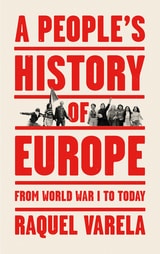
A People's History of Europe
From World War I to TodayRaquel Varela
Pluto Press, 2020
From the Russian Revolution, through May '68 and the Prague Spring, to the present day, we hear from feminists, trade unionists, conscientious objectors and activists and learn of immigration struggles, anti-colonial conflicts and labour movements. Cutting against the grain of mainstream histories, this is a history of Europe told from below.
Containing new and fascinating insights, Raquel Varela paints a different picture of the European story; one where ordinary Europeans are active agents of their own history.
A Soldier in World War I
The Diary of Elmer W. SherwoodRobert H. Ferrell
Indiana Historical Society Press, 2004
All the Hometown Boys
Wisconsin's 150th Machine Gun Battalion in World War IBrad Larson
University of Wisconsin Press, 2019
American Women in World War I
They Also ServedLettie Gavin
University Press of Colorado, 1997
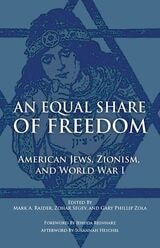
An Equal Share of Freedom
American Jews, Zionism, and World War IEdited by Mark Raider, Zohar Segev, and Gary Phillip Zola
University of Minnesota Press, 2024
An Equal Share of Freedom sheds new light on several important and interrelated dimensions of American, Jewish, and world history in the World War I era. Paying close attention to the Balfour Declaration as a hub around which to explore the period’s unfolding and turbulent social, cultural, and political developments, this collection of essays covers a diverse range of topics including Jewish doughboys, Zionist women authors, and political elites such as Golda Meir and Woodrow Wilson. The volume demonstrates the complex nature of Jewish ethnonational consciousness in the American setting and the impact of Zionism on US wartime and postwar activity.
The essays in this volume overturn timeworn assumptions that have long shaped the fields of American history and modern Jewish history. Taken as a whole, they demonstrate the war’s profound impact on American Jewish life and the transformation of American Jewry’s relationship with wider American society. These essays also illustrate the centrality of Zionism to the American Jewish experience and the extent to which American Jewry’s national consciousness and the future direction of the Zionist project were forged in the crucible of the Great War. An Equal Share of Freedom is the first volume in the Jacob Rader Marcus Series on the American Jewish Experience. In this series, Raider, Segev, and Zola highlight the myriad possibilities for expanding and deepening scholarly understanding of American Jews and the shared history of American society and the Jewish people in the twentieth century, starting with a look at World War I.
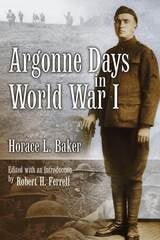
Argonne Days in World War I
Horace L. Baker, Edited & Intro by Robert H. Ferrell
University of Missouri Press, 2007
This poignant memoir recalls the great battle of the Meuse-Argonne, an epic conflict waged by well over a million men that saw casualties of 26,277 killed and 95,786 wounded. Many books have been written about General Pershing’s planning of the offensive; this one tells what happened to the soldiers who had to carry out his orders.
The Thirty-second was a shock division made up largely of National Guard units—farm boys from the Upper Midwest. But as casualties mounted, replacements were rushed into battle with little training—and devastating results. Baker knew friends and tent mates who were alive one day, dead the next, and he kept track of the battle in diary entries tucked into his Bible—and made evasively short in case of capture.
He shares his and his comrades’ thoughts about fighting in a harsh climate and terrain, relates their ongoing problems with short supplies, and tells how they managed to overcome their fears. It is a straightforward narrative that doesn’t glorify battle or appeal to patriotism yet conveys the horrors of warfare with striking accuracy. Historian Robert Ferrell’s new introduction puts Baker’s recollections in the context of the larger theater of war.
Baker fleshed out his diary in a book that saw limited publication in 1927 but has remained essentially unknown. Argonne Days in World War I is a masterpiece brimming with insight about the ordinary doughboys who fought in the European trenches. It conveys the spirit of a man who did his duty in a time of trouble—and is a testament to the spirit shared by thousands like him.

At the Periphery of a World War?
Urban Experiences of the First World War in Africa, East Asia, Latin America and South EuropeEdited by María Inés Tato, Ana Paula Pires, and Jan Schmidt
Campus Verlag, 2024
The First World War and its aftermath were significant events with widespread consequences that impacted everyday people. This book is the first comprehensive analysis of the various ways in which the Great War affected urban life, extending beyond the typically recognized regions such as the European great powers, the United States, and US colonies and spheres of influence. It explores the impacts on peripheral cities in East Asia, South Europe, Latin America, and Africa, which have often been overlooked in the historiography of the 1914 to 1918 conflict. Despite their historical neglect, these urban areas felt the repercussions of the war as it reshaped their structures, rhythms, and daily routines. This transformation influenced both private and public life, highlighting the crucial role these cities played as actors during wartime.
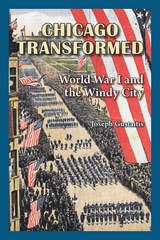
Chicago Transformed
World War I and the Windy CityJoseph Gustaitis
Southern Illinois University Press, 2016
It’s been called the “war that changed everything,” and it is difficult to think of a historical event that had a greater impact on the world than the First World War. Events during the war profoundly changed our nation, and Chicago, especially, was transformed during this period. Between 1913 and 1919, Chicago transitioned from a nineteenth-century city to the metropolis it is today. Despite the importance of the war years, this period has not been documented adequately in histories of the city. In Chicago in World War I: How the Great War Transformed a Great City, Joseph Gustaitis fills this gap in the historical record, covering the important wartime events, developments, movements, and people that helped shape Chicago.
Gustaitis attributes many of Chicago’s changes to the labor shortage caused by the war. African Americans from the South flocked to Chicago during the Great Migration, and Mexican immigration increased as well. This influx of new populations along with a wave of anti-German hysteria—which nearly extinguished German culture in Chicago—changed the city’s ethnic composition. As the ethnic landscape changed, so too did the culture. Jazz and blues accompanied African Americans to the city, and Chicago soon became America’s jazz and blues capital. Gustaitis also demonstrates how the nation’s first sexual revolution occurred not during the 1960s but during the World War I years, when the labor shortage opened up unprecedented employment opportunities for women. These opportunities gave women assertiveness and freedom that endured beyond the war years. In addition, the shortage of workers invigorated organized labor, and determined attempts were made to organize in Chicago’s two leading industrial workplaces—the stockyards and the steel mills—which helped launch the union movement of the twentieth century. Gustaitis explores other topics as well: Prohibition, which practically defined the city in the 1920s; the exploits of Chicago’s soldiers, both white and black; life on the home front; the War Exposition in Grant Park; and some of the city’s contributions to the war effort. The book also contains sketches of the wartime activities of prominent Chicagoans, including Jane Addams, Ernest Hemingway, Clarence Darrow, Rabbi Emil Hirsch, John T. McCutcheon, “Big Bill” Thompson, and Eunice Tietjens.
Although its focus is Chicago, this book provides insight into change nationwide, as many of the effects that the First World War had on the city also affected the United States as a whole. Drawing on a variety of sources and written in an accessible style that combines economic, cultural, and political history, Chicago in World War I: How the Great War Transformed a Great City portrays Chicago before the war, traces the changes initiated during the war years, and shows how these changes still endure in the cultural, ethnic, and political landscape of this great city and the nation.
Five Days in October
The Lost Battalion of World War IRobert H. Ferrell
University of Missouri Press, 2005
Now, in Five Days in October, historian Robert H. Ferrell presents new material—previously unavailable—about what really happened during those days in the forest. Despite the description of them as a lost battalion, the men were neither lost nor a battalion. The name was coined by a New York newspaper editor who, upon learning that a sizable body of troops had been surrounded, thought up the notion of a Lost Battalion—it possessed a ring sure to catch the attention of readers.
The trapped men actually belonged to companies from two battalions of the Seventy-seventh, and their exact placement was well known, reported by runners at the outset of the action and by six carrier pigeons released by their commander, Major Charles W. Whittlesey, during the five days his men were there. The causes of the entrapment were several, including command failures and tactical errors. The men had been sent ahead of the main division line without attention to flanks, and because of that failure, they were surrounded. Thus began a siege that took the lives of many men, leading to the collapse of the colonel of the 308th Infantry Regiment and, many believe, to the suicide of Major Whittlesey three years later.
This book grew out of Ferrell’s discovery of new material in the U.S. Army Military History Institute at the Army War College from the papers of General Hugh A. Drum and in the National Archives in College Park, Maryland. The Drum papers contain the court-martial record of the lieutenant of a machine-gun unit attached to the battalions, who advised Major Whittlesey to surrender, while the Seventy-seventh Division files contain full accounts of the taut relations between the Lost Battalion’s brigade commander and the Seventy-seventh’s division commander. By including this material, Ferrell gives a new accounting of this intriguing affair. Five Days in October will be welcomed by all those interested in a fuller understanding of the story of the Lost Battalion.

Flying for the Air Service
The Hughes Brothers in World War IDavid K. Vaughan
University of Wisconsin Press, 1998
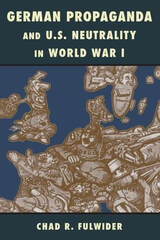
German Propaganda and U.S. Neutrality in World War I
Chad R. Fulwider
University of Missouri Press, 2016
In the fading evening light of August 4, 1914, Great Britain’s H.M.S. Telconia set off on a mission to sever the five transatlantic cables linking Germany and the United States. Thus Britain launched its first attack of World War I and simultaneously commenced what became the war’s most decisive battle: the battle for American public opinion.
In this revealing study, Chad Fulwider analyzes the efforts undertaken by German organizations, including the German Foreign Ministry, to keep the United States out of the war. Utilizing archival records, newspapers, and “official” propaganda, the book also assesses the cultural impact of Germany’s political mission within the United States and comments upon the perception of American life in Europe during the early twentieth century.
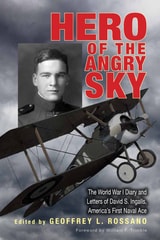
Hero of the Angry Sky
The World War I Diary and Letters of David S. Ingalls, America’s First Naval AceDavid S. Ingalls
Ohio University Press, 2012
Hero of the Angry Sky draws on the unpublished diaries, correspondence, informal memoir, and other personal documents of the U.S. Navy’s only flying “ace” of World War I to tell his unique story. David S. Ingalls was a prolific writer, and virtually all of his World War I aviation career is covered, from the teenager’s early, informal training in Palm Beach, Florida, to his exhilarating and terrifying missions over the Western Front. This edited collection of Ingalls’s writing details the career of the U.S. Navy’s most successful combat flyer from that conflict.
While Ingalls’s wartime experiences are compelling at a personal level, they also illuminate the larger, but still relatively unexplored, realm of early U.S. naval aviation. Ingalls’s engaging correspondence offers a rare personal view of the evolution of naval aviation during the war, both at home and abroad. There are no published biographies of navy combat flyers from this period, and just a handful of diaries and letters in print, the last appearing more than twenty years ago. Ingalls’s extensive letters and diaries add significantly to historians’ store of available material.
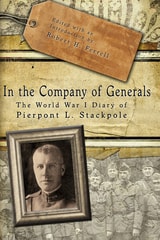
In the Company of Generals
The World War I Diary of Pierpont L. StackpoleEdited & Intro by Robert H. Ferrell
University of Missouri Press, 2009
Pierpont Stackpole was a Boston lawyer who in January 1918 became aide to Lieutenant General Hunter Liggett, soon to be commander of the first American corps in France. Stackpole’s diary, published here for the first time, is a major eyewitness account of the American Expeditionary Forces’ experience on the Western Front, offering an insider’s view into the workings of Liggett’s commands, his day-to-day business, and how he orchestrated his commands in trying and confusing situations.
Hunter Liggett did not fit John J. Pershing’s concept of the trim and energetic officer, but Pershing entrusted to him a corps and then an army command. Liggett assumed leadership of the U.S. First Army in mid-October of 1918, and after reorganizing, reinforcing, and resting, the battle-weary troops broke through the German lines in a fourth attack at the Meuse-Argonne—accomplishing what Pershing had failed to do in three previous attempts. The victory paved the way to armistice on November 11.
Liggett has long been a shadowy figure in the development of the American high command. He was “Old Army,” a veteran of Indian wars who nevertheless kept abreast of changes in warfare and more than other American officers was ready for the novelties of 1914–1918. Because few of his papers have survived, the diary of his aide—who rode in the general’s staff car as Liggett unburdened himself about fellow generals and their sometimes abysmal tactical notions—provides especially valuable insights into command within the AEF.
Stackpole’s diary also sheds light on other figures of the war, presenting a different view of the controversial Major General Clarence Edwards than has recently been recorded and relating the general staff’s attitudes about the flamboyant aviation figure Billy Mitchell. General Liggett built the American army in France, and the best measure of his achievement is this diary of his aide. That record stands here as a fascinating and authentic look at the Great War.
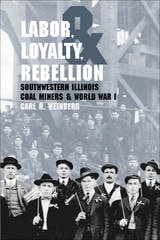
Labor, Loyalty, and Rebellion
Southwestern Illinois Coal Miners & World War ICarl R. Weinberg
Southern Illinois University Press, 2005
On April 5, 1918, as American troops fought German forces on the Western Front, German American coal miner Robert Prager was hanged from a tree outside Collinsville, Illinois, having been accused of disloyal utterances about the United States and chased out of town by a mob. In Labor, Loyalty, and Rebellion: Southwestern Illinois Coal Miners and World War I, Carl R. Weinberg offers a new perspective on the Prager lynching and confronts the widely accepted belief among labor historians that workers benefited from demonstrating loyalty to the nation.
The first published study of wartime strikes in southwestern Illinois is a powerful look at a group of people whose labor was essential to the war economy but whose instincts for class solidarity spawned a rebellion against mine owners both during and after the war. At the same time, their patriotism wreaked violent working-class disunity that crested in the brutal murder of an immigrant worker. Weinberg argues that the heightened patriotism of the Prager lynching masked deep class tensions within the mining communities of southwestern Illinois that exploded after the Great War ended.
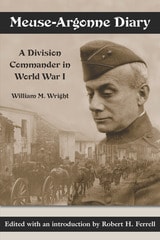
Meuse-Argonne Diary
A Division Commander in World War IWilliam M. Wright & Edited & Intro by Robert H. Ferrell
University of Missouri Press, 2004
September 13, 1918
Got no sleep at all last night.
About two o'clock in the morning Col. Heintzelman, chief of staff of the corps, came out and he was much pleased with what the division had accomplished and with the way they had gone through. It was the division's first battle and it played a very important and creditable part. Certain things fell down. . . . The truth of the matter is the troops got away from the wire and it was impossible to keep the wire up through the tangle of barbed wire and woods. We captured 3,000 prisoners on our front alone and have lost 521.
November 1, 1918 Considerable heavy artillery fire all night. The preparation fire went down promptly at 3:30, it was very heavy. . . . The barrage went down promptly at 5:30. Troops jumped off. At 7:30 thirty prisoners reported from Le Dhuy Fme., taken by the 353rd and 354th infantries. I don't understand what the 353rd Infantry is doing in there, as it is out of the sector. At 7:00 a.m. there was a distinct lull in the artillery fire. . . . I told Hanson at 8:05 to move his troops forward to parallel 86 immediately. He stated that he would get them going about 8:30, but actually did not get them started until about eleven o'clock. I sent for him on arrival and told him to hurry his men up. Before Lee left I had ordered the divisional reserve to move forward with its advance element on the first objective to maintain their echelonment in depth. Smyser came in at one o'clock and I ordered the divisional machine guns to the front to take position about one-half kilometer east of Dhuy Fme. At the time the reserves were ordered forward. I ordered Hanson to take his P.C. to Dhuy Fme. . . . Hanson has just arrived. I do not understand why he is always so slow. He seems to be inordinately stupid.
Over Here, Over There
Transatlantic Conversations on the Music of World War IEdited by William Brooks, Christina Bashford, and Gayle Magee
University of Illinois Press, 2019
Reel Patriotism
The Movies and World War ILeslie Midkiff DeBauche
University of Wisconsin Press, 1997
Leslie Midkiff DeBauche shows how the United States government’s need to garner public support for the war, conserve food, raise money, and enlist soldiers was met by the film industry. Throughout the nineteen months of American involvement in World War I, film studios supported the war effort through the production of short instructional films, public speaking activities of movie stars, the civic forum provided by movie theaters, and the National Association of the Motion Picture Industry’s provision of administrative personnel to work directly with government agencies. While feature films about the war itself never dominated the release schedules of film distributors, they did become a staple film industry offering throughout the late 1910s and 1920s.
The film industry had much to gain, DeBauche demonstrates, from working closely with the U.S. government. Though the war posed a direct challenge to the conduct of business as usual, the industry successfully weathered the war years. After the war, film producers, distributors, and exhibitors were able to capitalize on the good will of the movie-goer and the government that the industry’s war work created. It provided a buffer against national censorship when movie stars became embroiled in scandal, and it served as a selling point in the 1920s when major film companies began to trade their stock on Wall Street.
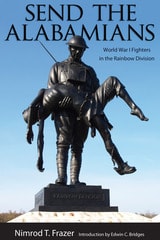
Send the Alabamians
World War I Fighters in the Rainbow DivisionNimrod T. Frazer
University of Alabama Press, 2014
The Remarkable Story of Alabama's Soldiers in America's Great War.
Send the Alabamians recounts the story of the 167th Infantry Regiment of the WWI Rainbow Division from their recruitment to their valiant service on the bloody fields of eastern France in the climactic final months of World War I.
To mark the centenary of World War I, Send the Alabamians tells the remarkable story of a division of Alabama recruits whose service Douglas MacArthur observed had not “been surpassed in military history.” The book borrows its title from a quip by American General Edward H. Plummer who commanded the young men during the inauspicious early days of their service. Impressed with their ferocity and esprit de corps but exasperated by their rambunctiousness, Plummer reportedly exclaimed: In time of war, send me all the Alabamians you can get, but in
time of peace, for Lord’s sake, send them to somebody else!
The ferocity of the Alabamians, so apt to get them in trouble at home, proved invaluable in the field. At the climactic Battle of Croix Rouge, the hot-blooded 167th exhibited unflinching valor and, in the face of machine guns, artillery shells, and poison gas, sustained casualty rates over 50 percent to dislodge and repel the deeply entrenched and heavily armed enemy.
Relying on extensive primary sources such as journals, letters, and military reports, Frazer draws a vivid picture of the individual soldiers who served in this division, so often overlooked but critical to the war’s success. After Gettysburg, the Battle of Croix Rouge is the most significant military engagement to involve Alabama soldiers in the state’s history. Families and genealogists will value the full roster of the 167th that accompanies the text.
Richly researched yet grippingly readable, Nimrod T. Frazer’s Send the Alabamians will delight those interested in WWI, the World Wars, Alabama history, or southern military history in general. Historians of the war, regimental historians, military history aficionados, and those interested in previously unexplored facets of Alabama history will prize this unique volume as well.
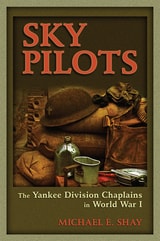
Sky Pilots
The Yankee Division Chaplains in World War IMichael E. Shay
University of Missouri Press, 2014
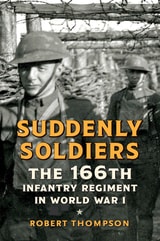
Suddenly Soldiers
The 166th Infantry Regiment in World War IRobert Thompson
Westholme Publishing, 2020
Finalist for the 2021 Army Historical Foundation Distinguished Writing Awards in Unit Histories
Americans Face the Horror of a Modern European War for the First Time
When America entered World War I in April 1917, state National Guard units had never planned to mobilize for this kind of war, and the men who made up the hometown companies of each regiment never imagined that they would be asked to fight in what was then the most savage war in human history—they were “innocents” being thrown into a horrendous European conflagration. Made up of companies from ten Ohio towns, the 166th Infantry Regiment became part of the famous 42nd Division, known as the “Rainbow Division.” They were the third American division to arrive in France, where they fought courageously in the trenches at Lunéville and Baccarat before being a key part of the American effort in the Second Battle of the Marne and the Saint Mihiel and Meuse-Argonne offensives. Despite their initial lack of training in modern warfare and weapons, the 166th Infantry compiled an impressive combat record. However, that record came at a terrible cost, with the regiment suffering over two thousand casualties in just nine months of fighting. While they battled the Germans, these hometown Guardsmen lived in trenches and foxholes for weeks at a time, while subsisting on canned beef and coffee amid near constant rain, deep mud, rats, and body lice that made their lives miserable. Because of poor planning and leadership from higher headquarters, they were often asked to achieve impossible objectives amid withering enemy machine-gun fire without proper logistics or artillery support. Yet, despite these challenges, they would persevere, overcome, and emerge victorious.
Using regimental histories and the letters and diaries of the soldiers who fought in France, Suddenly Soldiers: The 166th Infantry Regiment in World War I by author and historian Robert Thompson tells the compelling story of the young men—“citizen soldiers”—who have always borne the cost of America’s freedom with quiet courage.
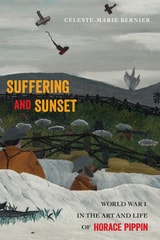
Suffering and Sunset
World War I in the Art and Life of Horace PippinCeleste-Marie Bernier
Temple University Press, 2017
For self-made artist and soldier Horace Pippin—who served in the 369th all-black infantry in World War I until he was wounded—war provided a formative experience that defined much of his life and work. His ability to transform combat service into canvases of emotive power, psychological depth, and realism showed not only how he viewed the world but also his mastery as a painter. In Suffering and Sunset, Celeste-Marie Bernier painstakingly traces Pippin’s life story of art as a life story of war.
Illustrated with more than sixty photographs, including works in various mediums—many in full color—this is the first intellectual history and cultural biography of Pippin. Working from newly discovered archives and unpublished materials, Bernier provides an in-depth investigation into the artist’s development of an alternative visual and textual lexicon and sheds light on his work in its aesthetic, social, and political contexts.
Suffering and Sunset illustrates Pippin’s status as a groundbreaking artist as it shows how this African American painter suffered from but also staged many artful resistances to racism in a white-dominated art world.
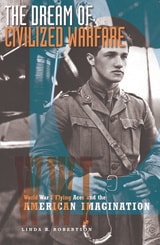
The Dream of Civilized Warfare
World War I Flying Aces and the American ImaginationLinda R. Robertson
University of Minnesota Press, 2005
Analyzes the link between “civilized warfare” and the American self-image
Linda R. Robertson argues that the development of the United States as a global military power arose from the influence of an image of air combat carefully constructed during World War I to mask the sordid realities of modern ground warfare. The Dream of Civilized Warfare carries this trajectory to its logical end, tracing the long history of the American desire to exert the nation’s will throughout the world without having to risk the lives of ground soldiers—a theme that continues to reverberate in public discussions, media portrayals, and policy decisions today.
Histories of American air power usually focus on World War II, when the air force became the foundation for the military strength of the United States. The equally fascinating story of World War I air combat is often relegated to a footnote, but it was the earlier war that first inspired the vision of the United States attaining dominance in world affairs through a massive air force. In The Dream of Civilized Warfare, Robertson presents the compelling story of the creation of the first American air force—and how, through the propaganda of the flying ace, a vision of “clean” or civilized combat was sold to politicians and the public. During World War I, air combat came to epitomize American ingenuity, technological superiority, adventure, leadership, and teamwork. Robertson reveals how the romantic and chivalric imagery associated with flying aces was a product of intentional propaganda and popular culture. Examining aviation history, military battles, films, literature, and political events, she looks at how the American public’s imagination was shaped—how flying aces offered not only a symbol of warfare in stark contrast to the muddy, brutal world of the trenches, but also a distraction to an American public resistant to both intervention in a European conflict and the new practice of conscription.
The Money Doctor in the Andes
U.S. Advisors, Investors, and Economic Reform in Latin America from World War I to the Great DepressionPaul W. Drake
Duke University Press, 1988
Drake links the Kemmerer missions to vital developments in the political economic history of the Andean republics in the interwar period. He analyzes the domestic interest groups and political forces whose convergent strategies gave the Kemmerer missions their remarkable record in achieving local success for the reforms proposed. Second, Drake situates the Kemmerer missions at the center of a process of political modernization that created new institutions and policy agencies in each of the five countries; the missions thereby contributed to the expansion of the central government as an agent of development in ways that later differed sharply from Kemmerer's orthodox policies. Finally, The Money Doctor in the Andes regards developments in the Andean countries in the context of the region's developing economic ties to the United States. Expectations that Kemmerer's plans would simultaneously attract foreign capital and control inflation drew support from sectors as diverse as trade unions and landowners. When the Depression deepened, Kemmerer's policies proved counterproductive and the fragile consensus that had installed them fell apart, but the political and administrative reforms endured—with far-reaching consequences.
They Called Them Soldier Boys
A Texas Infantry Regiment in World War IGregory W. Ball
University of North Texas Press, 2013
Unjustly Dishonored
An African American Division in World War IRobert H. Ferrell
University of Missouri Press, 2026
Unsafe for Democracy
World War I and the U.S. Justice Department's Covert Campaign to Suppress DissentWilliam H. Thomas Jr.
University of Wisconsin Press, 2009
“Recommended for all libraries.”—Frederic Krome, Library Journal
War's Waste
Rehabilitation in World War I AmericaBeth Linker
University of Chicago Press, 2011

World War and World Peace in the Age of Digital Capitalism
By Christian Fuchs
University of Westminster Press, 2025
In World War and World Peace in the Age of Digital Capitalism, Christian Fuchs asks: how do violence and war manifest themselves in global digital capitalism? How do digital capitalism and digital technologies manifest themselves in violence and warfare? What are the prospects for world peace today?
To prevent world war and advance world peace we need a better understanding of war and violence and their contexts and causes. We need to ask what war is, what violence is, what war and peace look like today and how they have changed in the 21st century. This book addresses these urgent questions and provides possible answers.

Yesterday There Was Glory
With the 4th Division, A.E.F., in World War IGerald Andrew Howell
University of North Texas Press, 2018