Results by title
127 books match the query 'World politics' and 4 start with a
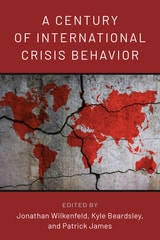
A Century of International Crisis Behavior
Edited by Jonathan Wilkenfeld, Kyle Beardsley, and Patrick James
University of Michigan Press, 2026
Perhaps more than ever, we need to invest in the study of the causes and consequences of crises. Since its founding in 1975, the International Crisis Behavior (ICB) Project has aimed to better equip academics, policymakers, and the next generation of engaged citizens to make sense of why crises arise and how they can be more effectively managed and prevented. The ICB Project’s data holdings consist of full-length qualitative case studies, along with an expanding range of quantitative datasets that include information regarding the characteristics of the states in crisis, crisis behavior, attempts at third-party crisis management, the role of nonstate actors, and the system-level context.
A Century of International Crisis Behavior summarizes the evolving patterns of international crisis behavior in the more than 500 cases cataloged since 1918, provides an accounting of the state of the scholarship to make sense of the patterns, and presents new findings that advance our understanding. Chapters are grouped according to their level of analysis: studies of systems, dyads, and states. The authors highlight what we have learned and what we have yet to learn regarding the prevention, escalation, and de-escalation of international crises.
A Study of Crisis
Michael Brecher and Jonathan Wilkenfeld
University of Michigan Press, 2000
The culmination of more than twenty years of research by Michael Brecher and Jonathan Wilkenfeld, the book analyzes crucial themes about crisis, conflict, and war and presents systematic knowledge about more than 400 crises, thirty-one protracted conflicts and almost 900 state participants. The authors explore many aspects of conflict, including the ethnic dimension, the effect of different kinds of political regimes--notably the question whether democracies are more peaceful than authoritarian regimes, and the role of violence in crisis management. They employ both case studies and aggregate data analysis in a Unified Model of Crisis to focus on two levels of analysis--hostile interactions among states, and the behavior of decision-makers who must cope with the challenge posed by a threat to values, time pressure, and the increased likelihood that military hostilities will engulf them.
This book will appeal to scholars in history, political science, sociology, and economics as well as policy makers interested in the causes and effects of crises in international relations. The rich data sets will serve researchers for years to come as they probe additional aspects of crisis, conflict and war in international relations.
Michael Brecher is R. B. Angus Professor of Political Science, McGill University. Jonathan Wilkenfeld is Professor and Chair of the Department of Government and Politics, University of Maryland. They are the coauthors of Crises in the Twentieth Century: A Handbook of International Crisis, among other books and articles.
Anarchy, Order and Integration
How to Manage InterdependenceHarvey Starr
University of Michigan Press, 2000
Armies of the Young
Child Soldiers in War and TerrorismRosen, David M
Rutgers University Press, 2005
Children have served as soldiers throughout history. They fought in the American Revolution, the Civil War, and in both world wars. They served as uniformed soldiers, camouflaged insurgents, and even suicide bombers. Indeed, the first U.S. soldier to be killed by hostile fire in the Afghanistan war was shot in ambush by a fourteen-year-old boy.
Does this mean that child soldiers are aggressors? Or are they victims? It is a difficult question with no obvious answer, yet in recent years the acceptable answer among humanitarian organizations and contemporary scholars has been resoundingly the latter. These children are most often seen as especially hideous examples of adult criminal exploitation.
In this provocative book, David M. Rosen argues that this response vastly oversimplifies the child soldier problem. Drawing on three dramatic examples-from Sierra Leone, Palestine, and Eastern Europe during the Holocaust-Rosen vividly illustrates this controversial view. In each case, he shows that children are not always passive victims, but often make the rational decision that not fighting is worse than fighting.
With a critical eye to international law, Armies of the Young urges readers to reconsider the situation of child combatants in light of circumstance and history before adopting uninformed child protectionist views. In the process, Rosen paints a memorable and unsettling picture of the role of children in international conflicts.