Results by title

18 books match the query 'Worship & Liturgy'
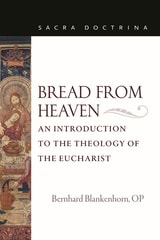
cover of Bread from Heaven: An Introduction to the Theology of the Eucharist

Bread from Heaven

An Introduction to the Theology of the Eucharist

Bernhard Blankenhorn

Catholic University of America Press, 2021
Bread from Heaven offers a contemporary theological synthesis on the Eucharist that brings together classical and critical biblical exegesis, debates on the early history of the Christian liturgy, patristic doctrine, the teachings offered by the Councils of Florence, Trent and Vatican II, and the Church’s lex orandi, all within a framework provided by the Eucharistic theology of Thomas Aquinas. The volume begins with Christ’s Bread of Life discourse in John 6, in light of the Old Testament theme of the manna, and the Synoptic accounts of the Last Supper. These biblical texts offer solid foundation for a theology of Eucharistic sacrifice, presence and Communion. It then continues with a historical and systematic study of the institution of the Eucharist by Christ, with special attention given to the emergence of the first Eucharistic prayers. Then follows a survey of key Christological and ecclesiological themes which undergird Eucharistic theology. The chapters on Eucharistic sacrifice and presence form the heart of the work. Here, the focus moves to key conciliar, patristic and Thomistic insights on these themes. Bread from Heaven clarifies misunderstandings of Eucharistic sacrifice and renders transubstantiation accessible to beginners. Blankenhorn concludes with a study of the consecration, the minister of the Eucharist and the fruits of communion. The chapter on the debate over the words of institution and the epiclesis gives a fresh perspective that integrates both eastern and western tradition. The study of the Eucharistic celebrant strikes a balance between a spirituality of the priest as acting in persona Christi and of the priest as praying in persona ecclesiae. The concluding chapter centers on the Eucharist’s unitive, mystical fruits in the Church. This textbook is ideal for an advanced undergraduate or graduate course on Eucharistic theology. It also seeks to advance the debate on several controversial historical and speculative issues in sacramental theology.
[more]
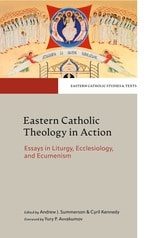
cover of Eastern Catholic Theology in Action: Essays in Liturgy, Ecclesiology, and Ecumenism

Eastern Catholic Theology in Action

Essays in Liturgy, Ecclesiology, and Ecumenism

Andrew J. Summerson

Catholic University of America Press, 2024
The Second Vatican Council urged Eastern Catholics to cultivate their share of divine revelation for the benefit of the entire Catholic Church. Yet, more than 50 years later, the Eastern Catholic Churches frequently remain on the margins, both in the theological academy and in the life of the Church more broadly. In an effort to remedy this situation, at least in part, this volume offers a scholarly reflection on the unique patrimony of the Eastern Catholic Churches, divided according to the categories of Liturgy, Theology, Spirituality, Discipline, and Culture. In so doing, it both follows the categories used to define a Church sui iuris in the Code of Canon Law for the Eastern Churches, and builds on the legacy of the Rev. Peter Galadza, to whom the volume is dedicated. On one hand, the volume and its essays are intentionally introductory, revealing the worlds of Eastern Catholicism and the variety of theological approaches that take place there. Emerging in part from the experience of teaching and preaching by scholars of Eastern Christianity, who are frequently asked for a basic introduction to Eastern Catholic theology, and have little to offer in response, these essays gather an international group of scholars engaging in critical, theological reflection from an Eastern Catholic perspective. This approach is rounded out by contributions from Roman Catholic, Orthodox, and Protestant scholars, who articulate their own reception and appreciation of the Eastern Catholic theological heritage.  At the same time, however, several of the essays in this volume relate the history and current reality of Eastern Catholicism to the Orthodox and Roman Catholic Churches, yet without ignoring how frequently Eastern Catholics live, worship, and theologize without self-conscious regard for their unique ecclesial situation. Indeed, these authors show, Eastern Catholic theology can be unself-consciously grounded in the patristic tradition, and Eastern Catholics can simply “do” theology, without worrying about ecclesial politics. Readers will thus find here the best of both worlds: both an introduction to the unique and frequently ignored patrimony of the Eastern Catholic Churches, and a series of essays that avoids the all-to-common pitfall of reducing these traditions to a parody of other Churches, Eastern or Western. Instead, by engaging with the sources of the Christian tradition – as Eastern Catholics, yes, but first and foremost as Christians – the authors reveal how much their tradition can offer the Catholic Church as a whole.
[more]
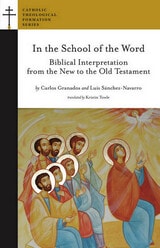
cover of In the School of the Word: Biblical Interpretation from the New to the Old Testament

In the School of the Word

Biblical Interpretation from the New to the Old Testament

Carlos Granados

Saint Paul Seminary Press, 2021
Carlos Granados and Luis Sánchez-Navarro propose reading the Bible with Christian faith, not as one approach among many, but as a disposition demanded by the New Testament for proper interpretation of both the Old and the New. Even so, the authors’ faith never leads them to dismiss history or to discard the tools of the historical-critical method. On the contrary, these sciences allow the faithful reader to take a holistic approach to biblical truth. When the reader also takes full account of the ecclesial reality in which the Bible was formed and transmitted, and in which it must be read still today, he or she encounters the word proclaimed by the text. Indeed, the words of Holy Writ ultimately proclaim the Word (Logos), Jesus Christ, in whose Spirit they were written. This book’s thirteen essays are grouped into three parts. Part I, “The Church, Living Subject of Sacred Scripture,” takes up a foundational theme of the whole book: sacred Scripture calls for a reading within the community of the People of God under the guidance of the Holy Spirit, and the same People constitute the living subject of Scripture. In Part II, “Christ, Exegete of the Fulfillment,” the authors focus on the relationship between the two biblical testaments. They argue that the Christian can both respect and venerate the Old Testament on its own terms, even as they find in Jesus, as presented in the New Testament and encountered in faith, the key for unlocking the Old Testament’s deepest meaning. The third and final part of this book, “The Teaching in Benedict XVI’s Verbum Domini,” examines Pope Benedict XVI’s 2010 post-synodal apostolic exhortation on the word of God in the life and mission of the Church. The authors’ years of shared prayer, study, conversation, and ministry have led to this coauthored book bearing witness to that ongoing unity that they live as confreres. Not surprisingly, they frequently reference the same theologians, especially Brevard Childs, Paul Beauchamp, SJ, and Pope Benedict XVI.
[more]
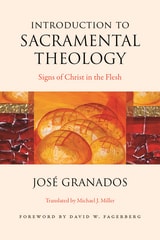
cover of Introduction to Sacramental Theology: Signs of Christ in the Flesh

Introduction to Sacramental Theology

Signs of Christ in the Flesh

Jose Granados

Catholic University of America Press, 2021
Introduction to Sacramental Theology presents a complete overview of sacramental theology from the viewpoint of the body. This viewpoint is supported, in the first place, by Revelation, for which the sacraments are the place where we enter into contact with the body of the risen Jesus. It is a viewpoint, secondly, which is firmly rooted in our concrete human bodily experience, thus allowing for a strong connection between faith and life, creation and redemption. From this point of view, the treatise on the sacraments occupies a strategic role. For the sacraments appear, not as the last of a series of topics (after dealing with Creation, Christ, the Church), but as the original place in which to stand in order to contemplate the entire Christian mystery. This point of view of the body, which resonates with contemporary philosophy, sheds fruitful light on classical themes, such as the relationship of the sacraments with creation, the composition of the sacramental sign, the efficacy of the sacraments, the sacramental character, the role of the minister, or the relationship of the sacrament with the Church as a sacrament. As a result of this approach, the Eucharist takes on a central role, since this is the sacrament where the body of Jesus is made present. The rest of the sacraments are seen as prolongations of the eucharistic body, so as to fill all the time and space of the faithful. This foundation of the theology of the sacraments in eucharistic theology is supported by an analysis of the patristic and medieval tradition. In order to support its conclusions, Introduction to Sacramental Theology examines the doctrine of Scripture (especially St. John and St. Paul), the main patristic and medieval authors (St. Augustine, Hugh of St. Victor, St. Bonaventure, St. Thomas Aquinas), the response of Trent to the protestant challenges, up to modern authors such as Scheeben, Rahner, Ratzinger, or Chauvet, including the teaching of Vatican II about the Church as a kind of sacrament.
[more]
cover of Liturgical Hermeneutics of Sacred Scripture

Liturgical Hermeneutics of Sacred Scripture

Marco Benini

Catholic University of America Press, 2023
The purpose of this book is to explore what a liturgical approach to the Bible looks like and what hermeneutical implications this might have: How does the liturgy celebrate, understand, and communicate Scripture? The starting point is Pope Benedict's affirmation that “a faith-filled understanding of sacred Scripture must always refer back to the liturgy” (Verbum Domini 52). The first part of the book (based on SC 24) provides significant examples to demonstrate: The liturgical order of readings intertextually combines Old Testament and New Testament readings using manifold hermeneutical principles, specifically how the psalms show the wide range of interpretations the liturgy employs. Prayers are biblically inspired and help to appropriate Scripture personally. The hymns convey Scripture in a poetic way. Signs and actions such as foot-washing or the Ephphetha rite enact Scripture. The study considers the Mass, the sacraments and the Liturgy of the Hours. In the second part, Benini systematically focuses on the various dimensions of liturgical hermeneutics of the Bible, which emerge from the first part. The study reflects the approaches the liturgy offers to Scripture and its liturgical reception. It explores theological aspects such as the unity of the two Testaments in Christ’s paschal mystery or the anamnesis as a central category in both Scripture and liturgy. The liturgy does not understand Scripture primarily as a document of the past, but celebrates it as a current and living “Word of the Lord,” as a medium of encounter with God: Scripture is sacramental. Liturgical Hermeneutics of Sacred Scripture seeks to contribute not only to the comparison of the Roman, Ambrosian, and Byzantine Rite regarding the Word of God, but most of all to the overall “liturgical approach” to Scripture. As such, it promotes an interdisciplinary dialogue of liturgical and biblical studies.
[more]
cover of Liturgical Theology in Thomas Aquinas: Sacrifice and Salvation History

Liturgical Theology in Thomas Aquinas

Sacrifice and Salvation History

Franck Quoex

Catholic University of America Press, 2023
In this volume, Fr. Franck Quoëx responds to Joseph Ratzinger’s call for a renewed appreciation of liturgical rite. A student of Pierre Gy, OP, he brings to this study of Aquinas’s liturgical theology a rare combination of expert knowledge of liturgical sources and history and the best of modern historical-critical research guided by sound theological judgment. Fr. Quoëx frames his study with an overview of the problem of rite in modern theological-anthropological discourse, before turning to Aquinas’ theory of worship in the treatise on the virtue of religion. He then explores Aquinas’ doctrine on the cultic dimensions of the Eucharist and other sacraments in his sacramental theology more broadly, finishing with a close study of the mass commentary of the Tertia Pars. Although there has been increasing attention to Thomas’s treatment of religion as a virtue, none have approached him from an anthropological angle with a focus on the nature of liturgical rite, or fully exploited the perspectives of liturgical scholarship to shed light on sacramental theology. Quoëx’s work, as the work of a Thomist, liturgist, and medievalist well versed in medieval liturgical development and in the genre of often-allegorical liturgical commentary, opens up this crucial but neglected facet of Aquinas’ theological synthesis. Few books have been published on Aquinas’s liturgical theology. Now that interest in Aquinas’s virtue theory and sacramental theology is growing rapidly, Quoëx’s studies are an invitation to further reflection on the topic of Aquinas’s liturgical theology with its manifold ramifications for and connections with other theological topics in his Summa, including his theological anthropology, his soteriology, his treatment of the Old and New Laws, and his account of the virtue of religion in connection with the other virtues.
[more]
cover of Lord I Love You! Homilies through the Liturgical Year: Volume 2: Advent, Christmas, Marian Feasts, and Saints Days

Lord I Love You! Homilies through the Liturgical Year

Volume 2: Advent, Christmas, Marian Feasts, and Saints Days

Pietro Pope Benedict XVI

Catholic University of America Press, 2025
Pope Benedict XVI was known for his brilliant mind, but he also had a heart in love with the Lord. In this careful selection from his papal homilies, read­ers can not only learn from his encyclopedic knowledge of the Christian tra­dition, but grow in their own love for God as they journey with Benedict through the seasons and feasts of the liturgical year. Lord I Love You! Volume 2 includes the joyful seasons of Advent and Christmas as well as important Marian feasts and other saints’ days throughout the year, making it an excel­lent choice for spiritual reading and a great Advent/Christmas gift idea for those who appreciate the late pope’s message of the centrality of Christ and the reliability of the Catholic tradition. Pope Benedict was not a charismatic preacher in the mold of his predecessor John Paul II, but the texts themselves are gems of Christian exhortation and reflection that are best appreciated on one’s knees in a chapel or held in one’s hands in a quiet place in one’s home—that is, in a book like this and not scrolling through a website. For scholars and students of the late pope, the collection also provides a helpful distillation of his main themes and princi­pal concerns into short, easily digestible pieces. The editor, Fr. Pietro Rossot­ti, uses the official Vatican translation with only minor spelling modifications and added footnotes with bibliographical references whenever possible.
[more]
cover of Lord, I Love You! Homilies through the Liturgical Year: Volume 1: Lent, Easter, and Solemnities of the Lord

Lord, I Love You! Homilies through the Liturgical Year

Volume 1: Lent, Easter, and Solemnities of the Lord

Pietro Pope Benedict XVI

Catholic University of America Press, 2025
Pope Benedict XVI was known for his brilliant mind, but he also had a heart in love with the Lord. In this careful selection from his papal homilies, readers can not only learn from his encyclopedic knowledge of the Christian tradition, but grow in their own love for God as they journey with Benedict through the seasons and feasts of the liturgical year. Lord I Love You! Volume 1 includes the holiest days of Lent and Easter as well as other important solemnities such as Trinity Sunday and Corpus Christi, making it an excellent choice for spiritual reading and a great Lenten gift idea for those who appreciated the late pope's message of the centrality of Christ and the reliability of the Catholic tradition. Pope Benedict was not a charismatic preacher in the mold of his predecessor John Paul II, but the texts themselves are gems of Christian exhortation and reflection that are best appreciated on one's knees in a chapel or held in one's hands in a quiet place in one's home--that is, in a book like this and not scrolling through a website. For scholars and students of the late pope, the collection also provides a helpful distillation of his main themes and principal concerns into short, easily digestible pieces. The editor, Fr. Pietro Rossotti, uses the official Vatican translation with only minor spelling modifications and added footnotes with bibliographical references whenever possible.
[more]
cover of St. Thomas and the Rites of Man: A Historical Study of the Summa Theologiae, Tertia Pars, Question 83, Articles 4 & 5

St. Thomas and the Rites of Man

A Historical Study of the Summa Theologiae, Tertia Pars, Question 83, Articles 4 & 5

Niels Krogh Rasmussen

Catholic University of America Press, 2026
Long buried in the archives of the Dominican studium at Le Saulchoir, the lectorate dissertation of Fr. Niels Krogh Rasmussen, OP, is now made available to a wider English-speaking audience interested in Saint Thomas Aquinas’s contribution to liturgical theology. Originally written in 1966, just after the Second Vatican Council, Rasmussen’s work is a witness to the intense liturgical ferment of those years and expresses an early attempt to appropriate the then-new postconciliar mode of liturgical reflection, bolstered by attentive historical-critical work, in the spirit of Saint Thomas. Treating the saint’s reflection on the Mass rites in the Summa Theologiae, Rasmussen shows how Aquinas, while writing in the disputed question format, nevertheless presents his readers with an expositio Missae, placing him within the tradition of great medieval Mass expositors, from Amalarius of Metz and Florus of Lyon in the ninth century, Saint Albert the Great and Durandus of Mende in the thirteenth century. By isolating this distinctly liturgical content (without, however, completely eschewing its original quaestio format), Rasmussen is able to highlight the distinctiveness of Thomas’s liturgical thought against that of his predecessors and contemporaries. Even if certain insights or expressions of Rasmussen’s may sound dated to the contemporary reader—since this work was composed in that interim period between Inter Oecumenici (1964) and the promulgation of the Missal of Paul VI (1969)—such insights in fact add to the historical value of this dissertation, offering a snapshot of a time when the reform of the liturgy was very much a living process with a terminus yet to be determined. 60 years later, students of Thomism, liturgical theology, and medieval studies can continue to benefit from this work.
[more]
cover of The Book of Before and After: The Liturgy of the Hours of the Church of the East

The Book of Before and After

The Liturgy of the Hours of the Church of the East

Andrew Younan

Catholic University of America Press, 2025

The Book of Before & After is the traditional name given to the book of commonly-used portions of the liturgy of the hours of the Church of the East (the branches of which are now the Chaldean Catholic Church, the Assyrian Church of the East, the Ancient Apostolic Assyrian Church of the East, and the Malabar Catholic Church). This volume will present, for the first time, a complete English translation (from the original Aramaic/Syriac) of all the Ordinaries and Commons of the Liturgy of the Hours used by all the Churches of this Tradition. It will also include a complete translation of the Psalter as included in the liturgical books (with antiphons and prayers between sets of Psalms), the full collection of the famous “Martyr Hymns,” and extensive selections of the Propers for each week of the Liturgical Year. Finally, the volume will also include translations of the Introductions written by the various Chaldean and Assyrian Patriarchs who published editions of the Hudhra (the full liturgy of the hours) over the past two centuries, as well as a comprehensive Introductory Essay by Younan. Many of the hymns translated in this volume will be singable according to their original melody.
[more]
cover of The Book of Hours of the Armenian Church Zamagirk: English Translation, Contexts and Perspectives

The Book of Hours of the Armenian Church Zamagirk

English Translation, Contexts and Perspectives

Michael Daniel Findikyan

Catholic University of America Press, 2027
The Book of Hours of the Armenian Church (Žamagirk‘): English Translation, Contexts, and Perspectives offers the first critically grounded English rendering of one of the central liturgical books of the Armenian Christian tradition—and, as such, the first complete translation of this text into any language. Long central to the daily cycle of prayer, the Žamagirk‘ preserves a rich and layered inheritance reaching back to the formative centuries of Christian worship, even as it bears the marks of later historical development. Prepared by a leading scholar of Armenian liturgy, with broader expertise in eastern Christian liturgical traditions, the translation attends closely to the structure, language, and internal logic of the text. It is designed not only to make the Žamagirk‘ accessible to English-speaking readers, but also to reflect, as faithfully as possible, the texture and rhythm of the original, and will be of interest not only to scholars but also to those who wish to engage the text for devotional use. The translation is accompanied by an extensive analytical study that situates the work within its historical, theological, and liturgical contexts. Particular attention is given to the distinctive features of the Armenian Liturgy of the Hours: its organization of psalmody and hymnography, its unique combinations of biblical and poetic materials, and its preservation of elements that point to early Jerusalemite practice. At the same time, the study explores the ways in which the tradition has remained dynamic, incorporating new layers while retaining older forms in often surprising configurations. More than a reference work, this volume opens a window onto the spiritual world embodied in the Armenian daily office, a world marked by a striking interplay of solemnity and lyricism, scriptural depth and poetic imagination, penitential gravity and buoyant hope. It will be of interest to scholars and students of liturgy, historians of Christianity, and all readers seeking to encounter one of the great yet comparatively little-known traditions of Christian prayer.
[more]
cover of The Fullness of Divine Worship: The Sacred Liturgy and its Renewal

The Fullness of Divine Worship

The Sacred Liturgy and its Renewal

Uwe Michael Lang

Catholic University of America Press, 2018
This volume offers a selection of essays from the pages of Antiphon: A Journal for Liturgical Renewal, the official organ of the Society for Catholic Liturgy. The Society was founded in 1995 as a multidisciplinary association of Catholic scholars, teachers, pastors, and ecclesiastical professionals in the Anglophone world, with the aim of promoting the scholarly study and practical renewal of the sacred liturgy.
[more]
cover of The Makers of the Sacred Harp

The Makers of the Sacred Harp

David Warren Steel with Richard H. Hulan

University of Illinois Press, 2010
This authoritative reference work investigates the roots of the Sacred Harp, the central collection of the deeply influential and long-lived southern tradition of shape-note singing. Where other studies of the Sacred Harp have focused on the sociology of present-day singers and their activities, David Warren Steel and Richard H. Hulan concentrate on the regional culture that produced the Sacred Harp in the nineteenth century and delve deeply into history of its authors and composers. They trace the sources of every tune and text in the Sacred Harp, from the work of B. F. White, E. J. King, and their west Georgia contemporaries who helped compile the original collection in 1844 to the contributions by various composers to the 1936 to 1991 editions.
 
The Makers of the Sacred Harp also includes analyses of the textual influences on the music--including metrical psalmody, English evangelical poets, American frontier preachers, camp meeting hymnody, and revival choruses--and essays placing the Sacred Harp as a product of the antebellum period with roots in religious revivalism. Drawing on census reports, local histories, family Bibles and other records, rich oral interviews with descendants, and Sacred Harp Publishing Company records, this volume reveals new details and insights about the history of this enduring American musical tradition.
[more]
cover of The Praise of 'Sons of Bitches': On the Worship of God by Fallen Men

The Praise of 'Sons of Bitches'

On the Worship of God by Fallen Men

James V. Schall

St. Augustine's Press, 2014
[more]
cover of The Proper of Time: Advent, Christmas, Lent, and Easter, Volume 1

The Proper of Time

Advent, Christmas, Lent, and Easter, Volume 1

Andrew Wadsworth

Catholic University of America Press, 2024
Cantate Domino is a five-volume commentary on the texts of the newly translated hymns of the Liturgy of the Hours. The hymns which recently appeared for the first time as a single corpus of English texts, will be included in the forthcoming USCCB revised edition of the Liturgy of the Hours. The hymns are drawn from among the very finest authors of the first millennium: Ambrose, Prudentius, and Gregory the Great together with later authors such as Thomas Aquinas, Leo XIII, and twentieth century authors who composed new hymns to be used in the psalter and celebration of the saints in the present Universal Calendar. The commentary concentrates on the Latin texts of the Liturgia Horarum, elucidated by the recently approved International Commission on English in the Liturgy (ICEL) translations. Commentaries have been prepared by a team of international scholars who bring both the depth of their knowledge together with the insights of those who have prepared liturgical texts in English during the sixty years of ICEL's existence. Previously unpublished material from ICEL's archives, including documents of the Consilium, which prepared the Latin texts for the liturgical books promulgated after the Second Vatican Council, will appear alongside commentaries which identify and explain biblical, classical, and liturgical allusions in the liturgical texts in a way that is of service to clergy, religious, liturgists, and students of the liturgy as well as the non-specialist reader, and all who seek to pray the Prayer of the Church with greater understanding.
[more]
cover of The Sacramental Theology of Marriage: One Flesh in One Spirit

The Sacramental Theology of Marriage

One Flesh in One Spirit

Jose Granados

Catholic University of America Press, 2026
The Sacramental Theology of Marriage offers a comprehensive vision of the dogmatic theology of marriage. It takes into account biblical and patristic sources, the teaching of the Magisterium (with particular emphasis on the Councils of Trent and Vatican II), and the most important contemporary theological contributions. It begins with a vision of the sacrament of mar­riage as the sacrament that integrates the order of creation into the order of sacraments. This dual dimension of marriage justifies the division of the book into two parts: marriage as a sacrament of creation and marriage as a sacrament of redemption instituted by Christ. To describe the coordinates of marriage in creation, the book refers to St. Augustine (the goods of marriage), St. Thomas Aquinas (the ends of marriage), and modern personalism as re­flected in the Second Vatican Council (the gifts of marriage). The book also draws on the theology of St. Bonaventure, who emphasized the institution of marriage by God in creation. The presentation of marriage as a sacrament of the new law is rooted in the way Christ lived the various meanings of the body. Marriage’s foundation in the body and in the experience of love sheds new light on the key milestones of its sacramentality: its matter and form, its signification, the grace it transmits, its liturgy and ministers, its indissolubil­ity, its role in building up the Church, and the path of holiness it opens to the spouses. In all of this, marriage emerges as a pivotal sacrament for articulating Christianity’s relationship to the cosmos and to society. The Sacramental The­ology of Marriage includes modern philosophical and theological explorations of the language of the body and the meaning of love (including the proposal of St. John Paul II). It also outlines the main principles for the pastoral care of marriage and family.
[more]
cover of The Unity Movement: Its Evolution and Spiritual Teachings

The Unity Movement

Its Evolution and Spiritual Teachings

Neal Vahle

Templeton Press, 2002

Prayer meetings held in 1889 in the Kansas City living room of Charles and Myrtle Fillmore were the beginning of what grew to be an international religious and educational movement. This book is an in-depth study of the people and beliefs that shaped it into one of the fastest growing movements of our time.

Neal Vahle documents the lives of the spiritual visionaries who created, organized, and led the Unity movement: Myrtle Fillmore, the 40-year-old wife and mother who was inspired by a Christian Science practitioner to cure herself of tuberculosis; Charles Fillmore, who had planned a business career but found, through study, prayer, meditation, and dream analysis, that he had another calling; H. Emily Cady, a New York City homeopathic physician whose book on Unity teachings, Lessons in Truth, was published in 1901, and has sold more than 1.6 million copies; Lowell Fillmore, eldest son of Charles and Myrtle, who clarified and popularized Unity teaching; and the other descendants of Myrtle and Charles, each of whom made immeasurable contributions.

He explores the key factors that led to the steady growth of the movement: the creation of the Unity School of Christianity; the development of Unity Village in Missouri; the evolution of "Silent Unity"; the publication program; the training of students; the development of centers and churches; and he presents and analyzes the controversies and debates within the organization. Vahle concludes the book with a look at the challenges facing the movement in the twenty-first century.
[more]
cover of Women and Communal Worship: Shaping the Early Modern Christian Liturgy

Women and Communal Worship

Shaping the Early Modern Christian Liturgy

Micheline White

University of Delaware Press, 2027

Women and Communal Worship advances our understanding of early modern women by uncovering and analyzing Christian women’s engagement with liturgical and communal worship between 1500 and 1750. The Protestant attack on the medieval liturgy was at the heart of the Reformation and Counter-Reformation, but women’s contributions to those momentous changes have been largely overlooked as scholars have focused on women’s private devotional practices and texts. This collection of essays demonstrates that communal worship was vital to women of all confessional stripes. Although they could not generally lead the liturgy, women shaped public devotion in important ways, whether at the level of the local congregation, the household chapel, the convent, the court, or the national church. Communal worship is thus a key site for examining women’s textual, literary, social, and political agency.

[more]