Results by title
14 books match the query 'Yaqui Indians'
A Yaqui Easter
Muriel Thayer Painter
University of Arizona Press, 1971
Au Te Waate / We Remember It
Hiaki Survival Through a Bitter WarMaria Fernanda Leyva; Edited by Heidi Harley
University of Arizona Press, 2025
This compelling work delves into the personal narratives of Hiaki (Yaqui) individuals who endured the tumultuous period from 1900 to 1930, when they faced systematic attacks, conscription, deportation, and enslavement under Mexican government policies. Presented in both the original Hiaki language and English translation, these accounts offer an unparalleled glimpse into the lives of those who resisted and survived the era’s harsh realities. The narratives describe military engagements, the struggles of refugee life, forced labor, and the resilience of families under extreme duress. This work provides a unique and unvarnished account of the impacts of Mexican colonialism and aggression on individuals and families, completely from the Hiaki perspective.
Au Te Waate / We Remember It is not just a historical account but a linguistic treasure, preserving the naturally produced speech of five Hiaki speakers from a previous era. Transcriptions of interviews recorded by author Maria Fernanda Leyva with family members and friends provide invaluable insights into the Hiaki language. The interviews document and preserve the narrative styles, vocabulary, and grammatical constructions of the time.
This work also serves as a crucial resource for scholars of linguistics and history alike, capturing dialect variation and illustrating the linguistic evolution of the Hiaki community. Additionally, for Hiaki people studying their own language, this book stands as a rich repository of cultural and linguistic heritage, meticulously maintained through side-by-side translations and contextual historical introductions.
The narratives in this book are anchored by the experiences of five Hiaki speakers, whose stories of displacement, survival, and resistance provide a deeply personal perspective on the broader historical events of the Porfirio Díaz dictatorship and the early years of the Mexican Revolution. Au Te Waate / We Remember It stands as an important record, preserving these critical voices for future generations and offering profound insights into the resilience of the Hiaki people.
Autobiography of a Yaqui Poet
Refugio Savala; Edited by Kathleen M. Sands
University of Arizona Press, 1980
Ejidos and Regions of Refuge in Northwestern Mexico
Edited by N. Ross Crumrine and Phil C. Weigand
University of Arizona Press, 1987
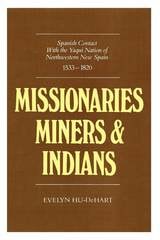
Missionaries, Miners, and Indians
Spanish Contact with the Yaqui Nation of Northwestern New Spain, 1533–1820Evelyn Hu-DeHart
University of Arizona Press, 1981
More than a tale of Yaqui Indian resistance, Missionaries, Miners, and Indians documents the history of the Jesuit missions during a period of encroaching secularization. The Yaqui rebellion of 1740, analyzed here in detail, enabled the Yaqui to work for the mines without repudiating the missions; however, the erosion of the mission system ultimately led to the Jesuits’ expulsion from New Spain in 1767, and through their own perseverance, the Yaqui were able to bring their culture intact into the nineteenth century.
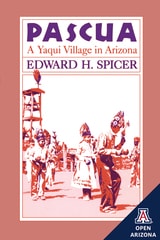
Pascua
A Yaqui Village in ArizonaEdward H. Spicer
University of Arizona Press, 0
Edward Spicer devoted most of his professional career to the study of the Yaquis and came to be regarded as a leading authority on that tribe. At the inception of his forty years of research stands Pascua, a firsthand description of daily village life.
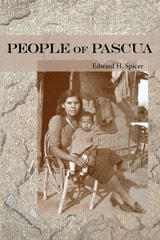
People of Pascua
Edward H. Spicer; Edited by Kathleen M. Sands and Rosamond B. Spicer
University of Arizona Press, 1988
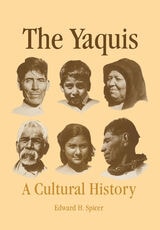
The Yaquis
A Cultural HistoryEdward H. Spicer
University of Arizona Press, 1980
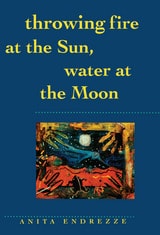
Throwing Fire at the Sun, Water at the Moon
Anita Endrezze
University of Arizona Press, 2000
Throwing Fire at the Sun, Water at the Moon is a blend of ancient myths, poetry, journal extracts, short stories, and essays that tell her people's story from the early 1500s to the present, and her family's story over the past five generations. Reproductions of Endrezze's paintings add an additional dimension to her story and illuminate it with striking visual imagery. Endrezze has combed history and legend to gather stories of her immediate family and her mythical ancient family, the two converging in the spirit of storytelling. She tells Aztec and Yaqui creation stories, tales of witches and seductresses, with recurring motifs from both Yaqui and Chicano culture. She shows how Christianity has deeply infused Yaqui beliefs, sharing poems about the Flood and stories of a Yaqui Jesus. She re-creates the coming of the Spaniards through the works of such historical personages as Andrés Pérez de Ribas. And finally she tells of those individuals who carry the Yaqui spirit into the present day. People like the Esperanza sisters, her grandmothers, and others balance characters like Coyote Woman and the Virgin of Guadalupe to show that Yaqui women are especially important as carriers of their culture.
Greater than the sum of its parts, Endrezze's work is a new kind of family history that features a startling use of language to invoke a people and their past--a time capsule with a female soul. Written to enable her to understand more about her ancestors and to pass this understanding on to her own children, Throwing Fire at the Sun, Water at the Moon helps us gain insight not only into Yaqui culture but into ourselves as well.
With Good Heart
Yaqui Beliefs and Ceremonies in Pascua VillageMuriel Thayer Painter
University of Arizona Press, 1986
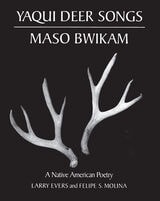
Yaqui Deer Songs/Maso Bwikam
A Native American PoetryLarry Evers and Felipe S. Molina
University of Arizona Press, 1987
Yaqui regard song as a kind of lingua franca of the intelligent universe. It is through song that experience with other living things is made intelligible and accessible to the human community. Deer songs often take the form of dialogues in which the deer and others in the wilderness world speak with one another or with the deer singers themselves. It is in this way, according to one deer singer, that “the wilderness world listens to itself even today.”
In this book authentic ceremonial songs, transcribed in both Yaqui and English, are the center of a fascinating discussion of the Deer Song tradition in Yaqui culture. Yaqui Deer Songs/Maso Bwikam thus enables non-Yaquis to hear these dialogues with the wilderness world for the first time.
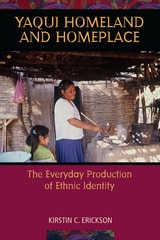
Yaqui Homeland and Homeplace
The Everyday Production of Ethnic IdentityKirstin C. Erickson
University of Arizona Press, 2008
Yaquis live in a portion of their ancestral homeland in Sonora, about 250 miles south of the Arizona border. A long history of displacement and ethnic struggle continues to shape the Yaqui sense of self, as Erickson discovered during the sixteen months that she lived in Potam, one of the eight historic Yaqui pueblos. She found that themes of identity frequently arise in the stories that Yaquis tell and that geography and location—space and place—figure prominently in their narratives.
Revisiting Edward Spicer’s groundbreaking anthropological study of the Yaquis of Potam pueblo undertaken more than sixty years ago, Erickson pays particular attention to the “cultural work” performed by Yaqui women today. She shows that by reaffirming their gendered identities and creating and occupying female-gendered spaces such as kitchens, household altars, and domestic ceremonial spaces, women constitute Yaqui ethnicity in ways that are as significant as actions taken by males in tribal leadership and public ceremony.
This absorbing study contributes new empirical knowledge about a Native American community as it adds to the growing anthropology of space/place and gender. By inviting readers into the homes and patios where Yaqui women discuss their lives, it offers a highly personalized account of how they construct—and reconstruct—their identity.
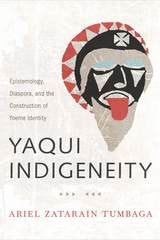
Yaqui Indigeneity
Epistemology, Diaspora, and the Construction of Yoeme IdentityAriel Zatarain Tumbaga
University of Arizona Press, 2018
Tumbaga examines colonial documents and nineteenth-century political literature that produce a Yaqui warrior mystique and reexamines the Mexican Revolution through indigenous culture. He delves into literary depictions of Yaqui battalions by writers like Martín Luis Guzmán and Carlos Fuentes and concludes that they conceal Yaqui politics and stigmatize Yaqui warriorhood, as well as misrepresent frequently performed deer dances as isolated exotic events.
Yaqui Indigeneity draws attention to a community of Chicana/o writers of Yaqui descent: Chicano-Yaqui authors such as Luis Valdez, Alma Luz Villanueva, Miguel Méndez, Alfredo Véa Jr., and Michael Nava, who possess a diaspora-based indigenous identity. Their writings rebut prior colonial and Mexican depictions of Yaquis—in particular, Véa’s La Maravilla exemplifies the new literary tradition that looks to indigenous oral tradition, religion, and history to address questions of cultural memory and immigration.
Using indigenous forms of knowledge, Tumbaga shows the important and growing body of literary work on Yaqui culture and history that demonstrates the historical and contemporary importance of the Yaqui nation in Mexican and Chicana/o history, politics, and culture.
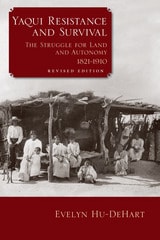
Yaqui Resistance and Survival
The Struggle for Land and Autonomy, 1821–1910Evelyn Hu-DeHart
University of Wisconsin Press, 2016
In this revised edition of her groundbreaking work, Hu-DeHart reviews and reflects on the growth in scholarship about the Yaqui, including advances in theoretical frameworks and methodologies on borderlands, transnationalism, diaspora, and collective memory that are especially relevant to their history.