Results by title
3 books match the query 'YouTube'
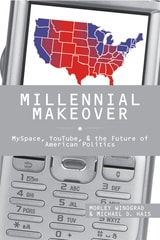
Millennial Makeover
MySpace, YouTube, and the Future of American PoliticsWinograd, Morley
Rutgers University Press, 2008
A 2008 New York Times Notable Book of the Year
It happens in America every four decades and it is about to happen again. America’s demand for change in the 2008 election will cause another of our country’s periodic political makeovers. This realignment, like all others before it, will result from the coming of age of a new generation of young Americans—the Millennial Generation—and the full emergence of the Internet-based communications technology that this generation uses so well. Beginning in 2008, almost everything about American politics and government will transform—voting patterns, the fortunes of the two political parties, the issues that engage the nation, and our government and its public policy.
Building on the seminal work of previous generational theorists,Morley Winograd and Michael D. Hais demonstrate and describe, for the first time, the two types of realignments—“idealist” and “civic”—that have alternated with one another throughout the nation’s history. Based on these patterns, Winograd and Hais predict that the next realignment will be very different from the last one that occurred in 1968. “Idealist” realignments, like the one put into motion forty years ago by the Baby Boomer Generation, produce, among other things, a political emphasis on divisive social issues and governmental gridlock. “Civic” realignments, like the one that is coming, and the one produced by the famous GI or “Greatest” Generation in the 1930s, by contrast, tend to produce societal unity, increased attention to and successful resolution of basic economic and foreign policy issues, and institution-building.
The authors detail the contours and causes of the country’s five previous political makeovers, before delving deeply into the generational and technological trends that will shape the next. The book’s final section forecasts the impact of the Millennial Makeover on the elections, issues, and public policies that will characterize America’s politics in the decades ahead.
For additional information go to:
Millennial Makeover website.
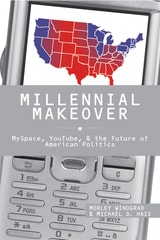
Millennial Makeover
MySpace, YouTube, and the Future of American PoliticsWinograd, Morley
Rutgers University Press, 2008
A 2008 New York Times Notable Book of the Year
It happens in America every four decades and it is about to happen again. America’s demand for change in the 2008 election will cause another of our country’s periodic political makeovers. This realignment, like all others before it, will result from the coming of age of a new generation of young Americans—the Millennial Generation—and the full emergence of the Internet-based communications technology that this generation uses so well. Beginning in 2008, almost everything about American politics and government will transform—voting patterns, the fortunes of the two political parties, the issues that engage the nation, and our government and its public policy.
Building on the seminal work of previous generational theorists,Morley Winograd and Michael D. Hais demonstrate and describe, for the first time, the two types of realignments—“idealist” and “civic”—that have alternated with one another throughout the nation’s history. Based on these patterns, Winograd and Hais predict that the next realignment will be very different from the last one that occurred in 1968. “Idealist” realignments, like the one put into motion forty years ago by the Baby Boomer Generation, produce, among other things, a political emphasis on divisive social issues and governmental gridlock. “Civic” realignments, like the one that is coming, and the one produced by the famous GI or “Greatest” Generation in the 1930s, by contrast, tend to produce societal unity, increased attention to and successful resolution of basic economic and foreign policy issues, and institution-building.
The authors detail the contours and causes of the country’s five previous political makeovers, before delving deeply into the generational and technological trends that will shape the next. The book’s final section forecasts the impact of the Millennial Makeover on the elections, issues, and public policies that will characterize America’s politics in the decades ahead.
For additional information go to:
Millennial Makeover website.
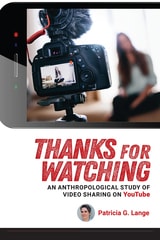
Thanks for Watching
An Anthropological Study of Video Sharing on YouTubePatricia G. Lange
University Press of Colorado, 2019
Lange draws on 152 interviews with YouTube participants at gatherings throughout the United States, content analyses of more than 300 videos, observations of interactions on and off the site, and participant-observation. She documents how the introduction of monetization options impacted perceived opportunities for open sharing and creative exploration of personal and social messages. Lange’s book provides new insight into patterns of digital migration, YouTube’s influence on off-site interactions, and the emotional impact of losing control over images. The book also debunks traditional myths about online interaction, such as the supposed online/offline binary, the notion that anonymity always degrades public discourse, and the popular characterization of online participants as over-sharing narcissists.
YouTubers' experiences illustrate fascinating hybrid forms of contemporary sociality that are neither purely mediated nor sufficient when conducted only in person. Combining intensive ethnography, analysis of video artifacts, and Lange’s personal vlogging experiences, the book explores how YouTubers are creating a posthuman collective characterized by interaction, support, and controversy. In analyzing the tensions between YouTubers' idealistic goals of sociality and the site's need for monetization, Thanks for Watching makes crucial contributions to cultural anthropology, digital ethnography, science and technology studies, new media studies, communication, interaction design, and posthumanism.
For its perceptive analysis of video blogging for self-expression and sociality, Thanks for Watching received the Franklyn S. Haiman Award for Distinguished Scholarship in Freedom of Expression (2020), from the National Communication Association.