Results by title
2 books match the query 'Zimmermann, Michael F.'

Dialogical Imaginations
Aisthesis as Social Perception and New Ideas of HumanismEdited by Michael F. Zimmermann with Gernot Müller, Christian Sauer, Kerstin Schmidt, Robert Schmidt, and Fosca Mariani Zini
Diaphanes, 0
Whereas language is situated in the communicative zones between subjects, the imagination, according to a widespread prejudice concerning its freedom, is often treated as obscurely originating from the inner self. Instead of focusing on individual or “private” imaginations by means of introspection, the contributors to the volume inquire into the dialogical formations the imagination shares with language, and into social ways of world making.
“Aisthesis” means perception, but, in this volume, as the cover illustration the artist Giulio Paolini made for us demonstrates, it is treated as inscribed into dialogue. Furthermore, the range of its meaning is extended to include societies’ capacities to perceive their own conditions and dispositions—those concerning their inner structures and their external, cultural, and natural contexts. The essays present a wide variety of cultural manifestations of social perception—from the documentary to the fictional. Philosophers and sociologists, literary and art historians, media and film analysts deal with figurations, topoi, and stereotypes as created in various communal spheres and as resulting from media and epistemological practices.
Many of the debates turn around dialogical humanism, but this is certainly not aimed at returning to normative models more regulating than describing the human. Our period has been marked by debates around the post-human, biopolitics, and an increasing awareness of crisis and of global interdependence. Previously, the concept of humanism had been criticized, for good reasons, by Foucault and by philosophers such as Judith Butler. If the editors propose to discuss humanism again, a reevaluation of the dialogical character of humanism—and a reconstruction of its history as marked by dialogical strategies—is the starting point. In dialogical humanism, man, instead of being defined by a system of norms, is and remains an argument—even if, in the final instance, inscrutable, inexhaustible.
[more]
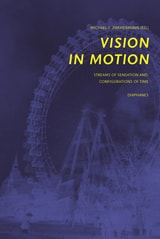
Vision in Motion
Streams of Sensation and Configurations of TimeEdited by Michael F. Zimmermann
Diaphanes, 2015
Vision is not just a simple recognition of what passes through our field of sight, the reflection and observation of light and shape. Even before Freud posited dreams as a way of “seeing” even as we sleep, the writings of philosophers, artists, and scientists from Goethe to Cézanne have argued that to understand vision as a mere mirroring of the outside world is to overlook a more important cognitive act of seeing that is dependent on time.
Bringing together a renowned international group of contributors, Vision in Motion explores one of the most vexing problems in the study of vision and cognition: To make sense of the sensations we experience when we see something, we must configure many moments into a synchronous image. This volume offers a critical reexamination of seeing that restores a concept of “vision in motion” that avoids reducing the sensations we experience to narrative chronological sequencing. The contributors draw on Hume, Bergson, and Deleuze, among others, to establish a nuanced idea of how we perceive.
Bringing together a renowned international group of contributors, Vision in Motion explores one of the most vexing problems in the study of vision and cognition: To make sense of the sensations we experience when we see something, we must configure many moments into a synchronous image. This volume offers a critical reexamination of seeing that restores a concept of “vision in motion” that avoids reducing the sensations we experience to narrative chronological sequencing. The contributors draw on Hume, Bergson, and Deleuze, among others, to establish a nuanced idea of how we perceive.
[more]