Results by title
14 books match the query 'Zion'
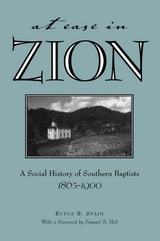
At Ease in Zion
Social History of Southern Baptists, 1865-1900Rufus B. Spain
University of Alabama Press, 2003
First published in 1967, Rufus Spain’s thorough investigation into Southern Baptist attitudes set the stage for research on religion in the American South. In At Ease in Zion, Spain questions the titular “ease” with society that Southern Baptists seemed to maintain following the Civil War. His analysis of denominational newspapers, as well as reports from the Southern Baptist Convention and state conventions, paint a compelling picture of the subjects’ complacency with their social existence, even as they criticized personal and recreational ethics.
While the South faced significant social, economic, and political changes after the Civil War, religion remained the primary moral influence. As the Southern Baptist denomination made up a significant majority of the population at that time, its leaders and attitudes had a clear and undeniable impact on social norms. Rufus Spain was one of the first writers to actively demonstrate the relationship between Southern religion and Southern society, and his work displays meticulous attention to the ways in which we are affected by complacency. He asserts that Southern Baptists viewed the American South as a version of God’s ideal society; any issues they wished to address were caused by individuals (such as those who did not conform to societal norms) or external attitudes (such as those in differing religions or regions).
At Ease in Zion is a critical part of the scholarly discussion on religion in society. Spain’s research offers a bold analysis of the American South and its citizens during one of the most tumultuous times in its history while providing a basis for arguments on “social Christianity” and its ever-shifting role in the world.
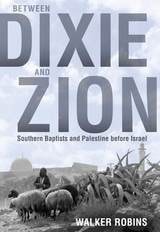
Between Dixie and Zion
Southern Baptists and Palestine before IsraelWalker Robins
University of Alabama Press, 2020
Explores the roots of evangelical Christian support for Israel through an examination of the Southern Baptist Convention
One week after the establishment of the State of Israel in 1948, delegates to the Southern Baptist Convention (SBC) repeatedly and overwhelmingly voted down resolutions congratulating fellow Southern Baptist Harry Truman on his role in Israel’s creation. From today’s perspective, this seems like a shocking result. After all, Christians—particularly the white evangelical Protestants who populate the SBC—are now the largest pro-Israel constituency in the United States. How could conservative evangelicals have been so hesitant in celebrating Israel’s birth in 1948? How did they then come to be so supportive?
Between Dixie and Zion: Southern Baptists and Palestine before Israel addresses these issues by exploring how Southern Baptists engaged what was called the “Palestine question”: whether Jews or Arabs would, or should, control the Holy Land after World War I. Walker Robins argues that, in the decades leading up to the creation of Israel, most Southern Baptists did not directly engage the Palestine question politically. Rather, they engaged it indirectly through a variety of encounters with the land, the peoples, and the politics of Palestine. Among the instrumental figures featured by Robins are tourists, foreign missionaries, Arab pastors, converts from Judaism, biblical interpreters, fundamentalist rebels, editorialists, and, of course, even a president. While all revered Palestine as the Holy Land, each approached and encountered the region according to their own priorities.
Nevertheless, Robins shows that Baptists consistently looked at the region through an Orientalist framework, broadly associating the Zionist movement with Western civilization, modernity, and progress over and against the Arabs, whom they viewed as uncivilized, premodern, and backward. He argues that such impressions were not idle—they suggested that the Zionists were bringing to fruition Baptists’ long-expressed hopes that Israel would regain the prosperity it had held in the biblical era, the Holy Land would one day be revived, and biblical prophecies preceding the return of Christ would be fulfilled.

Children of Zion
Henryk Grynberg
Northwestern University Press, 1997
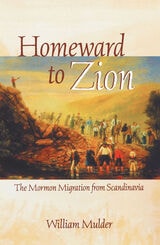
Homeward To Zion
The Mormon Migration from ScandinaviaWilliam Mulder
University of Minnesota Press, 2000
The classic history of this emblematic moment in U.S. immigration.
In the late nineteenth century, thirty thousand Mormons from Norway, Sweden, Denmark, and Finland immigrated to Utah, dissatisfied with conditions in their homelands. As their countrymen were farming rich fields in other parts of the United States, Scandinavian Mormons were making their way to Salt Lake City. Homeward to Zion tracks this movement from northern Europe to the western desert, examining the Mormon recruiting efforts in Scandinavia as well as the arduous journey across the Great Plains. Mulder draws extensively from personal narratives of these immigrants to relate their pioneering experience and their role in the history of Scandinavian migration and of the settlement of the American West.

Singing in Zion
Music and Song in the Life of One Arkansas FamilyRobert Cochran
University of Arkansas Press, 1999
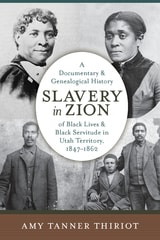
Slavery in Zion
A Documentary and Genealogical History of Black Lives and Black Servitude in Utah Territory, 1847-1862Amy Tanner Thiriot
University of Utah Press, 2022
Slavery in Zion has two major parts. The first section provides an introductory history, chapters on southern and western experiences, and information on life after emancipation. The second section is a biographical encyclopedia of names, relationships, and events. Although Slavery in Zion contains material applicable to legal history and the history of race and Mormonism, its most important contribution is as an archive of the experiences of Utah’s enslaved Black people, at last making their stories an integral part of the record of Utah and the American West—no longer forgotten or written out of history.

Sports in Zion
Mormon Recreation, 1890-1940Richard Ian Kimball
University of Illinois Press, 2002
If a religion cannot attract and instruct young people, it will struggle to survive, which is why recreational programs were second only to theological questions in the development of twentieth-century Mormonism. In this book, Richard Ian Kimball explores how Mormon leaders used recreational programs to ameliorate the problems of urbanization and industrialization and to inculcate morals and values in LDS youth. As well as promoting sports as a means of physical and spiritual excellence, Progressive Era Mormons established a variety of institutions such as the Deseret Gymnasium and camps for girls and boys, all designed to compete with more "worldly" attractions and to socialize adolescents into the faith.
Kimball employs a wealth of source material including periodicals, diaries, journals, personal papers, and institutional records to illuminate this hitherto underexplored aspect of the LDS church. In addition to uncovering the historical roots of many Mormon institutions still visible today, Sports in Zion is a detailed look at the broader functions of recreation in society.
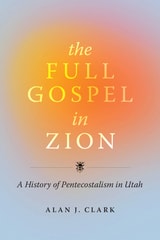
The Full Gospel in Zion
A History of Pentecostalism in UtahAlan J. Clark
University of Utah Press, 2022
In The Full Gospel in Zion, Alan J. Clark explores the dynamic history of Pentecostalism in Utah. Although the story of Pentecostalism now spans the globe, there is no previous study of its growth and development among the mountains and valleys of the Beehive State. This book recovers and reveals the identities of the earliest Pentecostal pioneers across the state and places the founding churches within the historical narrative of Utah religion in the twentieth and early twenty-first centuries.
Utah Pentecostals faced difficulties establishing churches and congregations in a region dominated by a Latter-day Saint majority. Pentecostals found that they shared surprising similarities in belief but faced unexpected obstacles in evangelism, as Latter-day Saints did not respond as other Christians did to the Pentecostal message. Clark draws from interviews conducted with church leaders and congregants and from the rich documentary record to show Utah Pentecostals’ perseverance in creating a strong foothold in Utah. His work offers a new look at the diversity and richness of Utah’s religious history.

The Mormon War
Zion and the Missouri Extermination Order of 1838Brandon G. Kinney
Westholme Publishing, 2011
How the Violent Expulsion of the Mormons from Missouri Changed the History of America and the West
In 1831, Joseph Smith, Jr., the founder of the Church of Christ—later to be renamed the Church of Jesus Christ of Latter Day Saints—revealed that Zion, or “New Jerusalem,” was to be established in Jackson County, Missouri. Smith sent some of his followers to begin the settlement, but they were soon expelled by locals who were suspicious of their religion and their abolitionist sympathies. Smith led an expedition to regain the settlement, but was unsuccessful. Seven years later, in January 1838, Smith fled to Missouri from Ohio to avoid a warrant for his arrest, and joined the Mormon community in the town of Far West, which became the new Zion. The same prejudices recurred and the Mormons found themselves subject to attacks from non-Mormons, including attempts to prevent them from voting. Despite his abhorrence of violence, Smith decided that it was necessary for Mormons to defend themselves, which resulted in a short and sharp conflict known as the Mormon War. A covert Mormon paramilitary unit, the Danites, was formed to pillage non- Mormon towns, while angry rhetoric rose from both sides. After the Missouri state militia was attacked at the Battle of Crooked River, Missouri governor Liburn William Boggs issued Executive Order 44, which called for Mormons to be “exterminated or driven from the State.” Non-Mormons responded by attacking a Mormon settlement at Haun’s Mill, killing men and boys and firing on the women. Following this massacre, the state militia surrounded Far West and arrested Smith and other Mormon leaders. Smith was tried for treason and narrowly avoided execution, but was allowed to go and join the rest of his followers who were forced from Missouri to Illinois, where they founded their next major town, Nauvoo. There, Smith would be murdered and the church would split into several factions, with Brigham Young leading the movement’s largest group to Utah.
In The Mormon War: Zion and the Missouri Extermination Order of 1838, Brandon G. Kinney unravels the complex series of events that led to a religious and ideological war of both blood and words. The Mormon War not only challenged the protection afforded by the First Amendment, it foreshadowed the partisan violence over slavery and states’ rights that would erupt across Missouri and Kansas. The war also fractured Smith’s Church and led ultimately to the unexpected settlement of a vast area of the West as a Mormon homeland. By tracing the life of Joseph Smith, Jr. and his quest for Zion, the author reveals that the religion he founded was destined for conflict—both internal and external—as long as he remained its leader.

Zion
TJ Jarrett
Southern Illinois University Press, 2014
Zion, the latest collection of poems by TJ Jarrett, is the poignant study of the resonating effects of the civil rights movement on one family. Jarrett lovingly explores the minutiae of mortality and race across three generations of “Dark Girls” who have come together one summer to grieve and to remember as one of them passes to the farther shore—a place beyond retribution, where there is only forgiveness.
The Mississippi of Jarrett’s collection is alive with fireflies and locusts and murders of crows; yet for some, it is a wasteland of unanswered prayers, burning evenings, and the shades of dead or disappeared loved ones. There, the dark nights of the soul weigh long and heavy, and “every heart has its solstice, and its ache is unrelenting.”
Yet much as every solstice has an equinox, every time to kill has a time to forgive. Throughout the volume, the author imagines opportunities for compassion on multiple levels, from sweeping pardons to the most intimate of mercies. Jarrett’s faceless narrator confesses the past through conversation and exploration with notorious Mississippi governor Theodore Bilbo: two minds, two hearts, two races at last face to face.
At once brutal and achingly tender, Jarrett’s volume itself is a vibrant and musical body, singing to all its parts.

Zion in the Courts
A Legal History of the Church of Jesus Christ of Latter-day Saints, 1830-1900Edwin Brown Firmage and Richard Collin Mangrum
University of Illinois Press, 1988
This first paperback edition includes two new introductory pieces in which the authors discuss the Mormon emphasis on settling disputes outside the court, a practice that foreshadows current trends toward arbitration and mediation.
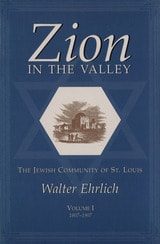
Zion in the Valley, Volume I
The Jewish Community of St. Louis, Volume I, 1807-1907Walter Ehrlich
University of Missouri Press, 1997
St. Louis contains one of the largest Jewish communities in the interior of the United States. Yet, despite the important contributions of St. Louis Jews to the city's cultural and economic growth and to national and international Jewry, no history of their accomplishments has heretofore been written.
In this masterful book, Walter Ehrlich shows how the St. Louis Jewish community grew in two separate yet intricately related milieux. One was the internal socioreligious community, which centered on relations of Jews with fellow Jews. The other was the broader secular environment, in which Jews individually and collectively interacted with the non-Jewish population, assuming significant roles in the political, economic, social, and religious developments of one of the country's most important urban centers.
Employing many previously unused primary materials--especially congregational archives, organizational and business records, contemporary newspapers, and vivid personal memoirs--Ehrlich presents a fascinating description of how individuals and groups contributed to the growth and development of a major American urban area. He clarifies significant aspects of social and economic structure, mobility, and philanthropy within the Jewish community and integrates them within the broader framework of American society. In the process, Ehrlich provides a unique perspective on St. Louis history, as well as on American urban, ethnic, and immigration history.
Zion in the Valley is an invaluable contribution to the field of Jewish studies. It will appeal to scholars and students of Jewish, urban, and ethnic history, as well as to members of the broader St. Louis community.
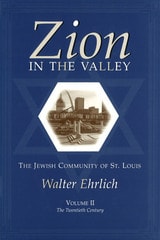
Zion in the Valley, Volume II
The Jewish Community of St. Louis, Volume II, The Twentieth CenturyWalter Ehrlich
University of Missouri Press, 2002
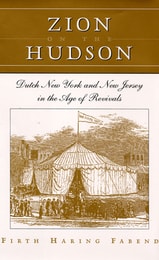
Zion on the Hudson
Dutch New York and New Jersey in the Age of RevivalsFabend, Firth Haring
Rutgers University Press, 2000
Winner of the 2001 New Jersey Author's Award by the New Jersey Academic Alliance
The Dutch came to the New World in the seventeenth century as explorers and traders, but religion soon followed, for it was accepted in the Netherlands that state and church were mutually benefited by advancing the “true Christian religion.” The influence of “Dutchness”—defined here as loyalty to what are presumed to be the distinctive qualities of Dutch national character and culture—persisted in New York and New Jersey for more than 200 years after Dutch emigration ended. Why?
Firth Haring Fabend finds the explanation in the devotion of the Reformed Dutch Church membership to the doctrines and traditions of their church. She looks at the individual and personal beliefs and behaviors of this often-neglected ethnic group. Thus, Zion on the Hudson presents both a broad and an intimate look at the way one mainstream Protestant denomination dealt with the transformative events of the evangelical era.
As Fabend describes the efforts of the Dutch to preserve the European standards and traditions of their church, while developing a taste for a new kind of theology and a preference for an American identity, she documents how Dutchness finally became a historical memory. The Americanization of the Reformed Dutch Church, Fabend writes, is a microcosm of the story of the Americanization of the United States itself.