Results by title

11 books match the query 'active 12th century'
cover of From Topic to Tale: Logic and Narrativity in the Middle Ages

From Topic to Tale

Logic and Narrativity in the Middle Ages

Eugene VanceForeword by Wlad Godzich

University of Minnesota Press, 1987

From Topic to Tale was first published in 1987. Minnesota Archive Editions uses digital technology to make long-unavailable books once again accessible, and are published unaltered from the original University of Minnesota Press editions.

The transition from the Middle Ages to the Renaissance has been discussed since the 1940s as a shift from a Latinate culture to one based on a vernacular language, and, since the 1960s, as a shift from orality to literacy. From Topic to Tale focuses on this multifaceted transition, but it poses the problem in different terms: it shows how a rhetorical tradition was transformed into a textual one, and ends ultimately in a discussion of the relationship between discourse and society.

The rise of French vernacular literacy in the twelfth century coincided with the emergence of logic as a powerful instrument of the human mind. With logic come a new concern for narrative coherence and form, a concern exemplified by the work of Chretien de Troyes. Many brilliant poetic achievements crystallized in the narrative art of Chretien, establishing an enduring tradition of literary technique for all of Europe. Eugene Vance explores the intellectual context of Chretien's vernacular literacy, and in particular, the interaction between the three "arts of language" (grammar, logic, and rhetoric) compromising the trivium. Until Vance, few critics have studied the contribution of logic to Chretiens poetics, nor have they assessed the ethical bond between rationalism and the new heroic code of romance.

Vance takes Chretien de Troyes' great romance, Yvain ou le chevalier au lion,as the centerpiece of the Twelfth-Century Renaissance. It is also central to his own thesis, which shows how Chretien forged a bold new vision of humans as social beings situated between beasts and angels and promulgated the symbolic powers of language, money, and heraldic art to regulate the effects of human desire. Vance's reading of the Yvain contributes not only to the intellectual history of the Middle Ages, but also to the continuing dialogue between contemporary critical theory and medieval culture.

Eugene Vance is professor of French and comparative literature at Emory University and principal editor of a University of Nebraska series, Regents Studies in Medieval Culture. Wlad Godzich is director of the Center for Humanistic Studies at the University of Minnesota and co-editor of the series Theory and History of Literature.
[more]
cover of Glamorous Sorcery: Magic and Literacy in the High Middle Ages

Glamorous Sorcery

Magic and Literacy in the High Middle Ages

David Rollo

University of Minnesota Press, 2000
[more]
cover of Gratian the Theologian

Gratian the Theologian

John C. Wei

Catholic University of America Press, 2016
Gratian the Theologian shows how one of the best-known canonists of the medieval period was also an accomplished theologian. Well into the twelfth century, compilations of Church law often dealt with theological issues. Gratian's Concordia discordantium canonum or Decretum, which was originally compiled around 1140, was no exception, and so Wei claims in this provocative book. The Decretum is the fundamental canon law work of the twelfth century, which served as both the standard textbook of canon law in the medieval schools and an authoritative law book in ecclesiastical and secular courts. Yet theology features prominently throughout the Decretum, both for its own sake and for its connection to canon law and canonistic jurisprudence.
[more]
cover of Gratian's Tractatus de penitentia

Gratian's Tractatus de penitentia

Atria A. Larson

Catholic University of America Press, 2016
Gratian's Decretum is one of the major works in European history, a text that in many ways launched the field of canon law. In this new volume, Atria Larson presents to students and scholars alike a critical edition of De penitentia (Decretum C.33 q.3), the foundational text on penance, both for canon law and for theology, of the twelfth century. This edition takes into account recent manuscript discoveries and research into the various recensions of Gratian's text and proposes a model for how a future critical edition of the entire Decretum could be formatted by offering a facing-page English translation. This translation is the first of this section of Gratian's De penitentia into any modern language and makes the text accessible to a wider audience. Both the Latin and the English text are presented in a way to make clear the development of Gratian's text in various stages within two main recensions. The edition and translation are preceded by an introduction relating the latest scholarship on Gratian and his text and are followed by three appendices, including one that provides a transcription of the relevant text from the debated manuscript Sankt Gallen, Stiftsbibliothek 673, and one that lists possible formal sources and related contemporary texts. This book provides a full edition and translation of the text studied in depth in Master of Penance: Gratian and the Development of Penitential Thought and Law in the Twelfth Century (CUA Press, 2014) by the same author.
[more]
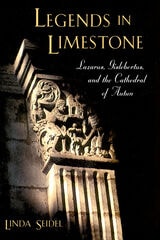
cover of Legends in Limestone: Lazarus, Gislebertus, and the Cathedral of Autun

Legends in Limestone

Lazarus, Gislebertus, and the Cathedral of Autun

Linda Seidel

University of Chicago Press, 1999

Whereas twelfth-century pilgrims flocked to the church of St-Lazare in Autun to visit the relics of its patron saint, present-day pilgrims journey there to admire its superb sculpture, said to have been created by the artist Gislebertus whose name is inscribed above one of the church doors. These two cults, of sculptor and of saint, form points of departure and arrival for Linda Seidel's study.

Legends in Limestone reveals how "Gislebertus, sculptor" was discovered and subsequently sanctified over the course of the last century. Seidel makes a compelling case for the identification of the name with an ancestor of the local ducal family, invoked for his role in the acquisition of the precious relics. With the aid of evidence drawn from the richly carved decoration of the building, she demonstrates how medieval visitors would have read a different holy narrative in the church fabric, one that constructed before their eyes an account of their patron saint's life.

Legends in Limestone, an absorbing study of one of France's most revered medieval monuments, provides fresh insights into modern and medieval interpretive practices.
[more]
cover of Marie de France and the Poetics of Memory

Marie de France and the Poetics of Memory

Logan E. Whalen

Catholic University of America Press, 2008
Marie de France and the Poetics of Memory presents the first exhaustive treatment of the rhetorical use of description and memory in all the narrative works of the late 12th-century poet, Marie de France--the first woman to compose literary texts in French.
[more]
cover of Master of Penance

Master of Penance

Arrai A. Larson

Catholic University of America Press, 2014
This book presents the first full-scale study of the Tractatus de penitentia (C.33 q.3) in Gratian's Decretum, which became the textbook for canon law and served as the basis of the church's developing jurisprudence, in theory and in practice
[more]
cover of Persecution and the Art of Writing

Persecution and the Art of Writing

Leo Strauss

University of Chicago Press, 1988
The essays collected in Persecution and the Art of Writing all deal with one problem—the relation between philosophy and politics. Here, Strauss sets forth the thesis that many philosophers, especially political philosophers, have reacted to the threat of persecution by disguising their most controversial and heterodox ideas.
[more]
cover of Peter Comestor's Lectures on the Glossed Gospel of John: A Study with a Critical Edition and Translation

Peter Comestor's Lectures on the Glossed Gospel of John

A Study with a Critical Edition and Translation

Peter Comestor

Catholic University of America Press, 2023

This monograph encompasses the first critical edition, translation, and historical study of a series of lectures from the cathedral school of Notre-Dame, Peter Comestor’s Glosses on the Glossed Gospel of John. Delivered in Paris in the mid-1150s, Comestor’s expansive lecture course on the Glossa ordinaria on the Gospel of John has survived in no fewer than seventeen manuscript witnesses, being preserved in the form of continuous transcripts taken in shorthand by a student-reporter (reportationes). The editor has selected the fifteen best witnesses to produce a critical edition and translation of the first chapter of Comestor’s lectures on the Gospel of John. In addition to the text of the original lectures, the edition includes appendices containing accretions to the lecture materials added by Comestor and his students, as well as the corresponding text of the Glossa ordinaria from which Comestor lectured. The Latin text and translation of Peter Comestor’s lectures are preceded by a wide-ranging critical study of the historical and intellectual context of Peter Comestor’s biblical teaching. This study begins with an outline of Comestor’s scholastic career and known works, with a detailed introduction to his Gospel lectures and the relevant historiography. Subsequently, a survey is made of the intellectual landscape of Comestor’s lectures: namely, the tradition of biblical teaching originating at the School of Laon, preserved in the Glossa ordinaria, and developed in the classroom by Peter Lombard and a succession of Parisian masters, notably Comestor himself. The following section examines the portion of the lectures presented in this book, encompassing an overview of its contents and structure, a description of Comestor’s teaching method and scholastic setting, a study of the text’s sources, and a consideration of Comestor’s participation and reception in the scholastic tradition. The final chapters contain a careful description of the manuscripts and editorial principles adopted in the Latin edition and translation.
[more]
cover of Sealed in Parchment: Rereadings of Knighthood in the Illuminated Manuscripts of Chretien de Troyes

Sealed in Parchment

Rereadings of Knighthood in the Illuminated Manuscripts of Chretien de Troyes

Sandra Hindman

University of Chicago Press, 1994
Chretien de Troyes was France's great medieval poet—inventor of the genre of courtly romance and popularizer of the Arthurian legend. The forty-four surviving manuscripts of his work (ten of them illuminated) pose a number of questions about who used these books and in what way. In Sealed in Parchment, Sandra Hindman scrutinizes both text and images to reveal what the manuscripts can tell us about medieval society and politics.
[more]
cover of The Anonymous Marie de France

The Anonymous Marie de France

R. Howard Bloch

University of Chicago Press, 2003

This book by one of our most admired and influential medievalists offers a fundamental reconception of the person generally assumed to be the first woman writer in French, the author known as Marie de France. The Anonymous Marie de France is the first work to consider all of the writing ascribed to Marie, including her famous Lais, her 103 animal fables, and the earliest vernacular Saint Patrick's Purgatory.

Evidence about Marie de France's life is so meager that we know next to nothing about her-not where she was born and to what rank, who her parents were, whether she was married or single, where she lived and might have traveled, whether she dwelled in cloister or at court, nor whether in England or France. In the face of this great writer's near anonymity, scholars have assumed her to be a simple, naive, and modest Christian figure. Bloch's claim, in contrast, is that Marie is among the most self-conscious, sophisticated, complicated, and disturbing figures of her time-the Joyce of the twelfth century. At a moment of great historical turning, the so-called Renaissance of the twelfth century, Marie was both a disrupter of prevailing cultural values and a founder of new ones. Her works, Bloch argues, reveal an author obsessed by writing, by memory, and by translation, and acutely aware not only of her role in the preservation of cultural memory, but of the transforming psychological, social, and political effects of writing within an oral tradition.

Marie's intervention lies in her obsession with the performative capacities of literature and in her acute awareness of the role of the subject in interpreting his or her own world. According to Bloch, Marie develops a theology of language in the Lais, which emphasize the impossibility of living in the flesh along with a social vision of feudalism in decline. She elaborates an ethics of language in the Fables, which, within the context of the court of Henry II, frame and form the urban values and legal institutions of the Anglo-Norman world. And in her Espurgatoire, she produces a startling examination of the afterlife which Bloch links to the English conquest and occupation of medieval Ireland.

With a penetrating glimpse into works such as these, The Anonymous Marie de France recovers the central achievements of one of the most pivotal figures in French literature. It is a study that will be of enormous value to medievalists, literary scholars, historians of France, and anyone interested in the advent of female authorship.
[more]