Results by title
7 books match the query 'de Duve, Thierry'
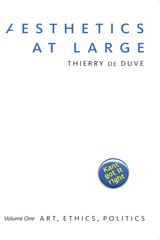
Aesthetics at Large
Volume 1: Art, Ethics, PoliticsThierry de Duve
University of Chicago Press, 2019
Central to de Duve’s re-reading of the Critique of Judgment is Kant’s idea of sensus communis, ultimately interpreted as the mere yet necessary idea that human beings are capable of living in peace with one another. De Duve pushes Kant’s skepticism to its limits by submitting the idea of sensus communis to various tests leading to questions such as: Do artists speak on behalf of all of us? Is art the transcendental ground of democracy? Or, Was Adorno right when he claimed that no poetry could be written after Auschwitz?
Loaded with de Duve’s trademark blend of wit and erudition and written without jargon, these essays radically renew current approaches to some of the most burning issues raised by modern and contemporary art. They are indispensable reading for anyone with a deep interest in art, art history, or philosophical aesthetics.
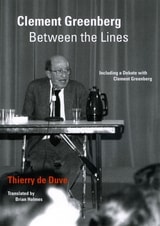
Clement Greenberg Between the Lines
Including a Debate with Clement GreenbergThierry de Duve
University of Chicago Press, 2010
Clement Greenberg (1909–1994), champion of abstract expressionism and modernism—of Pollock, Miró, and Matisse—has been esteemed by many as the greatest art critic of the second half of the twentieth century, and possibly the greatest art critic of all time. This volume, a lively reassessment of Greenberg’s writings, features three approaches to the man and his work: Greenberg as critic, doctrinaire, and theorist. The book also features a transcription of a public debate with Greenberg that de Duve organized at the University of Ottawa in 1988. Clement Greenberg Between the Lines will be an indispensable resource for students, scholars, and enthusiasts of modern art.
“In this compelling study, Thierry de Duve reads Greenberg against the grain of the famous critic’s critics—and sometimes against the grain of the critic himself. By reinterpreting Greenberg’s interpretations of Pollock, Duchamp, and other canonical figures, de Duve establishes new theoretical coordinates by which to understand the uneasy complexities and importance of Greenberg’s practice.” John O’Brian, editor of Clement Greenberg: The Collected Essays and Criticisms
“De Duve is an expert on theoretical aesthetics and thus well suited to reassess the formalist tenets of the late American art critic's theory on art and culture. . . . De Duve's close readings of Greenberg . . . contain much of interest, and the author clearly enjoys matching wits with ‘the world's best known art critic.’” Library Journal
Come On, Men, One More Effort …
Anthropogenesis, Christianity, SexuationThierry De Duve
Diaphanes, 2024
Thierry de Duve outlines the main features of a critical theory of male, all-too-male sexuation and cross-gender emancipation, drawing on Marcel Gauchet’s theses on Christianity as an exit from religion, Jacques Lacan’s algebra of desire, and Geneviève Morel’s analysis of the “law of the mother.”
Wouldn’t it have required more than the translation of the three Christian maxims “faith, hope, love” into the revolutionary maxims “liberté, egalité, fraternité?” Is there more to the knot of incarnation, fatherhood, and the cult of Mary than just Christian mysticism? Can the uncertainty of fatherhood become an act of faith that acknowledges a fundamental uncertainty?
Come On, Men, One More Effort… explores ways out of the dead end of political concepts adopted by the Enlightenment and their continued impact today, since the only possibility seems to be to embrace the religious and reject it at the same time.
Hommes, encore un effort…
Anthropogenèse, christianisme, sexuationThierry de Duve
Diaphanes, 2023
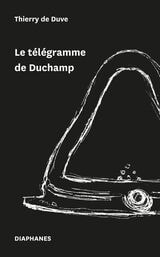
Le télégramme de Duchamp
French EditionThierry De Duve
Diaphanes, 2026
A new interpretation of the reception and legacy of Marcel Duchamp's controversial Fountain.
In 1917, Marcel Duchamp sent a “telegram” in the form of a urinal signed “R. Mutt.” When it arrived at its destination forty years later, it was both celebrated and vilified for proclaiming that anything could be art. From, that moment on, the entire Western art world was reconfigured as “Post-Duchamp.”
This new work from celebrated art historian and philosopher Thierry de Duve marks the completion of his decades-long effort to understand how Duchamp's Fountain marked a turning point in art history and to resolve the unprecedented problems this piece poses for philosophical aesthetics. Beyond shedding new light on the piece's initial reception and correcting certain historical errors, Le télégramme de Duchamp offers a bold interpretation of Fountain. Duve argues that Duchamp's urinal heralded the demise of the fine arts system and the advent of what he terms the system of “art in general." He further asserts, however, that this system did not originate in the 1960s but can be traced back to the 1880s. Duve's new book, therefore, shows that Duchamp was neither the creator nor agent of this new system, but rather its brilliant messenger.
Pictorial Nominalism
On Marcel Duchamp’s Passage from Painting to the ReadymadeThierry De Duve
University of Minnesota Press, 2005
Sewn in the Sweatshops of Marx
Beuys, Warhol, Klein, DuchampThierry de Duve
University of Chicago Press, 2012