Results by title

7 books match the query 'nbsp'
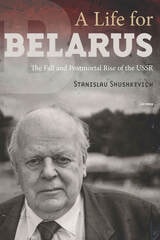
cover of A Life for Belarus: The Fall and Postmortal Rise of the USSR

A Life for Belarus

The Fall and Postmortal Rise of the USSR

Stanislau Shushkevich

Central European University Press, 2025

This memoir of the first president of an independent Belarus (1991-1994) tells about the revival of independent Belarus, the difficulties in establishing a democracy and a market economy, a hardened Soviet mentality, and the political immaturity of the intelligentsia and obduracy of the old nomenklatura.

Stanislau Shushkevich, born in 1934, narrates his path from a son of an “enemy of the people” to a doctorate in physics, and then to be the first head of independent Belarus. A series of entertaining essays discuss some major events as well as some minor ones that are barely known. The book describes Shushkevich’s role in hosting the Belavezha Accords, which brought about the end of the Soviet Union, and explores the motivation behind the decision for the de jure dissolution of the empire at a time when the major world leaders were categorically against the division of the USSR into independent states. The author draws particular attention to the role of the Baltic States in the late perestroika period. He also addresses the political passivity of the Soviet intelligentsia and the reasons for the revival of the Soviet Union in Russia and Belarus.

Shushkevich, who lives in Minsk, also provides valuable insights into contemporary Belarus, including an assessment of Lukashenka’s controversial role in recent events.

[more]
cover of Companion Spirits: More-Than-Secular Journeys in More-Than-Human Worlds

Companion Spirits

More-Than-Secular Journeys in More-Than-Human Worlds

Mayanthi L. Fernando

Duke University Press, 2027
In Companion Spirits, Mayanthi L. Fernando expands the concept of the more-than-human, offered as an antidote to anthropocentric worldmaking, beyond its secular foundations. Fernando argues that ways of thinking and being that underpin the Anthropocene—the idea that nature is inert, or that human mastery of the universe is possible—are effects of secularity. Drawing on autobiography, historiography, ethnography, theology, zoology, speculative fiction, and more, Fernando simultaneously examines the nexus of the Anthropocene and secularity and accounts for more-than-human worlds in more-than-secular ways. She also offers a counter-anthropology of the secular, tracking submerged sensibilities that do not adhere to dominant norms about science and religion, matter and spirit, reality and illusion. In so doing, she invites us, secular moderns included, to imagine the present, and the future, otherwise.
[more]
cover of Explaining Economic Backwardness: Post-1945 Polish Historians on Eastern Europe

Explaining Economic Backwardness

Post-1945 Polish Historians on Eastern Europe

Anna Sosnowska

Central European University Press, 2019

This monograph is about an exciting episode in the intellectual history of Europe: the vigorous debate among leading Polish historians on the sources of the economic development and non-development, including the origins of economic divisions within Europe. The work covers nearly fifty years of this debate between the publication of two pivotal works in 1947 and 1994. Anna Sosnowska provides an insightful interpretation of how local and generational experience shaped the notions of post-1945 Polish historians about Eastern European backwardness, and how their debate influenced Western historical sociology, social theories of development and dependency in peripheral areas, and the image of Eastern Europe in Western, Marxist-inspired social science. Although created under the adverse conditions of state socialism and censorship, this body of scholarship had an important repercussion in international social science of the post-war period, contributing an emphasis on international comparisons, as well as a stress on social theory and explanations. Sosnowska's analysis also helps to understand current differences that lead to conflicts between Europe’s richest and economically most developed core and its southern and eastern peripheries. The historians she studies also investigated analogies between paths in Eastern Europe and regions of West Africa, Latin America and East Asia.
[more]
cover of Hound Dog: A Song by Big Mama Thornton and Interpreted by Elvis Presley and Others

Hound Dog

A Song by Big Mama Thornton and Interpreted by Elvis Presley and Others

Eric Weisbard

Duke University Press, 2023
Many listeners first heard “Hound Dog” when Elvis Presley’s single topped the pop, country, and R&B charts in 1956. But some fans already knew the song from Big Mama Thornton’s earlier recording, a giant but exclusively R&B hit. In Hound Dog Eric Weisbard examines the racial, commercial, and cultural ramifications of Elvis’s appropriation of a Black woman’s anthem. He rethinks the history and influences of rock music in light of Rolling Stone's replacement of Presley’s “Hound Dog” with Thornton’s version in its 2021 “500 Greatest Songs of All Time” list. Taking readers from Presley and Thornton to Patti Page’s “Doggie in the Window,” the Stooges’ “I Wanna Be Your Dog,” and other dog ditties, Weisbard uses “Hound Dog” to reflect on one of rock’s fundamental dilemmas: the whiteness of the wail.
[more]
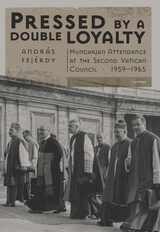
cover of Pressed by a Double Loyalty: Hungarian Attendance at the Second Vatican Council, 1959-1965

Pressed by a Double Loyalty

Hungarian Attendance at the Second Vatican Council, 1959-1965

András Fejérdy

Central European University Press, 2017
The Second Vatican Council is the single most influential event in the 20th century history of the Catholic Church. The book analyzes the relationship between the Council and the "Ostpolitik" of the Vatican through the history of the Hungarian presence at Vatican II. Pope John XXIII, elected in 1958, was a catalyst. The pope thought that his most urgent task was to renew contacts with the Church behind the iron curtain. Hungarian participation at the Council was also made possible by the new, pragmatic model in Hungarian church politics. After the crushing of the 1956 Revolution, churches in Hungary thought that the regime would last and were willing to compromise. Vatican II – in the perspective of Hungary – was not primarily an ecclesial event, but it remained closely joined to the negotiations between the Holy See and the Kádár regime: during the Council Hungary became the experimental laboratory of the Vatican's new eastern policy. Was it a Vatican decision or a Soviet instruction? Fejérdy suggests that it was a decision of the Holy See.
[more]
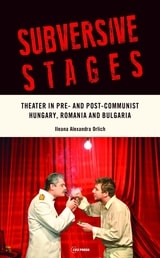
cover of Subversive Stages: Theater in Pre- and Post-Communist Hungary, Romania and Bulgaria

Subversive Stages

Theater in Pre- and Post-Communist Hungary, Romania and Bulgaria

Ileana Alexandra Orlich

Central European University Press, 2017
Exploring theater practices in communist and post-communist Hungary, Romania and Bulgaria, this book analyzes intertextuality or "inter-theatricality" as a political strategy, designed to criticize contemporary political conditions while at the same time trying to circumvent censorship. Plays by Romanian, Hungarian and Bulgarian dramatists are examined, who are "retrofitting" the past by adapting the political crimes and horrifying tactics of totalitarianism to the classical theatre (with Shakespeare a favorite) to reveal the region's traumatic history. By the sustained analysis of the aesthetic devices used as political tools, Orlich makes a very strong case for the continued relevance of the theater as one of the subtlest media in the public sphere. She embeds her close readings in a thorough historical analysis and displays a profound knowledge of the political role of theater history. In the Soviet bloc the theater of the absurd, experimentation, irony, and intertextual distancing (estrangement) are not seen as mere aesthetic language games but as political strategies that use indirection to say what cannot be said directly.
[more]
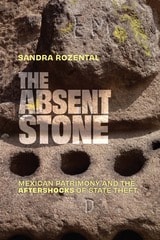
cover of The Absent Stone: Mexican Patrimony and the Aftershocks of State Theft

The Absent Stone

Mexican Patrimony and the Aftershocks of State Theft

Sandra Rozental

Duke University Press, 2026

Where and to whom do ancient things belong? What happens when they are stolen—not by a colonial power, but by a national museum claiming them as state patrimony? What kinds of healing and restitution can follow? In The Absent Stone, Sandra Rozental tells the story of the Piedra de los Tecomates, the largest stone monument in the Americas, popularly identified as the pre-Hispanic rain deity Tlaloc. In 1964, the Mexican state called in the military to forcefully relocate this 167-ton carving from the town of Coatlinchan to Mexico City’s National Anthropology Museum. Using in-depth historical and ethnographic research, Rozental traces how the stone’s absence continues to affect and unsettle Coatlinchan and its residents decades later, revealing the tensions between patrimony, nationalism, territory, memory, and materiality in Mexico. Questioning the premise that historical artifacts belong in museums under state-sanctioned care, The Absent Stone pushes contemporary critical scholarship on monuments and museum collections beyond the language of law, heritage, and cultural property, demonstrating how ancient things remain bound to the people and places they come from even after they are removed and displayed elsewhere.
[more]