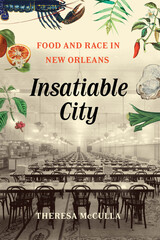
“Covering some 200 years of New Orleans’ history, McCulla convincingly demonstrates how the sensory pleasures of food consumption have been inextricably linked to commodification and violence, resulting from the complicated relations among the area’s Black, White, Creole and Indigenous populations. The book explores the tensions among auction blocks, dining tables, street vendors, sugar plantations, food markets, cookbooks, tourism and much more. McCulla opens our eyes to some of the unexpected ways in which New Orleans has long been an insatiable city.”
— Smithsonian
“[McCulla’s] stellar archival research at its most valuable unearths simple stories about complicated lives.”
— The Advocate
"Historian McCulla debuts with a fascinating dissection of the tangled links between consumption, food, and race in a city long known for its excesses. She contends that 'plenitude grew out of the labors of people in bondage' in 19th-century New Orleans, both in the form of food harvested by enslaved people, and 'slave auctions' held in coffeehouses, taverns, and hotels, where the combined 'entertainment' of food, drink, and enslaved bodies were served to locals and tourists. . . . The result is a top-notch scholarly study of the complex relationships between entertainment, consumption, and Black life in the American South."
— Publishers Weekly
“McCulla masterfully ties images to newspaper excerpts and individual stories, dipping you into an earlier time in New Orleans.”
— Civil Eats
“The book’s extensive use of primary materials, from visual sources and tourist pamphlets to architectural designs and oral histories, and its wonderfully accessible and engaging writing style, means that it not only will resonate with food historians and scholars of race in modern America but will also appeal to a broader readership that wishes to learn more about how the food we eat on a daily basis can reveal racial prejudices, systemic and enduring political and economic injustices, and important avenues for cultural renewal and revitalization.”
— Social History
“[Insatiable City] adds a different angle of analysis to the history of racial injustice and violence in New Orleans, which has generally been told in broad strokes. Deeply researched and beautifully written, this book will make readers think twice about the famous dishes they feast on when visiting New Orleans and the unspoken and complex history behind each bite.”
— History
“McCulla has written a wonderful book, a tour de force in fact. . . . Insatiable City is cross-disciplinary, demonstrating a masterful intersection of many historical fields, including food, business, capitalism, urbanism, labor, slavery, class, race, gender, and tourism. . . . The journey McCulla takes readers on is a curatorial sensation.”
— Journal of Southern History
“McCulla’s Insatiable City is a vital contribution to food studies, critical race studies, and New Orleans scholarship. By interrogating the intersections of race, labor, and food systems, the book challenges romanticized portrayals of Southern cuisine, revealing how histories of exploitation shape the city’s celebrated food culture. For scholars studying food justice, restaurant labor, and the commodification of cultural cuisines, Insatiable City provides an essential historical foundation. . . . McCulla’s meticulous research and compelling storytelling push readers to see New Orleans’ food culture not just as a source of pleasure, but as a landscape shaped by histories of violence, survival, and resistance.”
— Gastronomica
“A deep dive into the history of food culture in the Crescent City and the ties—generational, racial, and political—that have made the city’s distinct cuisine one of the most acclaimed in the world. . . . Insatiable City is a book all Orleanians, as well as the city’s millions of visitors, could benefit from reading, if only as a cogent reminder of the blood and tears mixed into that savory dish they’re about to enjoy.”
— Food and Environment Reporting Network
“In her incisive book Insatiable City, McCulla argues that the lasting appeal of New Orleans’s cuisine is inextricable from racial oppression rooted in ‘social, cultural, economic, and political systems of great violence.’ Stretching from France’s 1718 founding of New Orleans to the civil rights movement, McCulla carefully documents the intertwined history of New Orleans cuisine, enslavement, and escapist tourism, as the city emerged as an antebellum marketplace where everything and everyone appeared for sale.”
— American Historical Review
“McCulla’s Insatiable City covers 200 years of New Orleans history to show linkages between production and reception of race, power, social status, and labor in a city famous for its food culture. The book draws on menus, cookbooks, newspapers, postcards, photography, and other media to show how the production and reception of food shapes, and is shaped by these social forces.”
— Foodtank: “25 Books Guiding Us Toward More Regenerative Food Systems”
“In a new book, Insatiable City: Food and Race in New Orleans, McCulla gives voice to Louisiana’s black food industry workers whose stories were muted and marginalized by three hundred years of racial injustice. McCulla uses her extraordinary skills as an historian and curator to reveal how the enslaved, free people of color, and Black Americans created, shaped, and influenced Creole cuisine.”
— LouisianaHistory.info
“In Insatiable City, McCulla captivates the reader with an adept parsing of the complexities of the food of New Orleans. From the ‘consumption’ of the enslaved as agricultural laborers and food service workers of the antebellum period to the civil rights struggles of the twentieth century, she ably investigates and untangles the nuanced web of race and class that underpins the food of the Crescent City.”
— Jessica B. Harris, author of High on the Hog: A Culinary Journey from Africa to America
“McCulla’s Insatiable City begins amid rice and people on the Aurore, a slave ship traveling from Benin to Louisiana, and ends in present day New Orleans. Along the way she demonstrates time and time and time again that the celebrated food of New Orleans owes much of its greatness to the presence of African people, African intellect, and African ingredients. This is a scholarly work of the first rank.”
— Lolis Eric Elie, author of Treme: Stories and Recipes from the Heart of New Orleans
“With precision and care, McCulla considers how New Orleans’s culinary and racial histories have simmered together for centuries. Insatiable City offers a necessary reappraisal of the city’s beauty and its cruelty.”
— Andy Horowitz, author of Katrina: A History, 1915–2015
“Insatiable City is a comprehensive story of the ‘black hand in the pot’ in New Orleans. McCulla rightfully grounds Black chefs and cooks in the making of New Orleans greatest legacy, Creole cuisine. From the nineteenth-century marchandes who sold sweet calas fritters in Congo Square to civil rights activist Rudy Joseph Lombard who documented some of the greatest executive Black chefs in his groundbreaking cookbook Creole Feast, McCulla amplifies the culinary geniuses of Belle New Orleans.”
— Zella Palmer, author of Recipes and Remembrances of Fair Dillard, 1869–2019