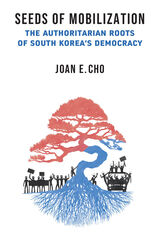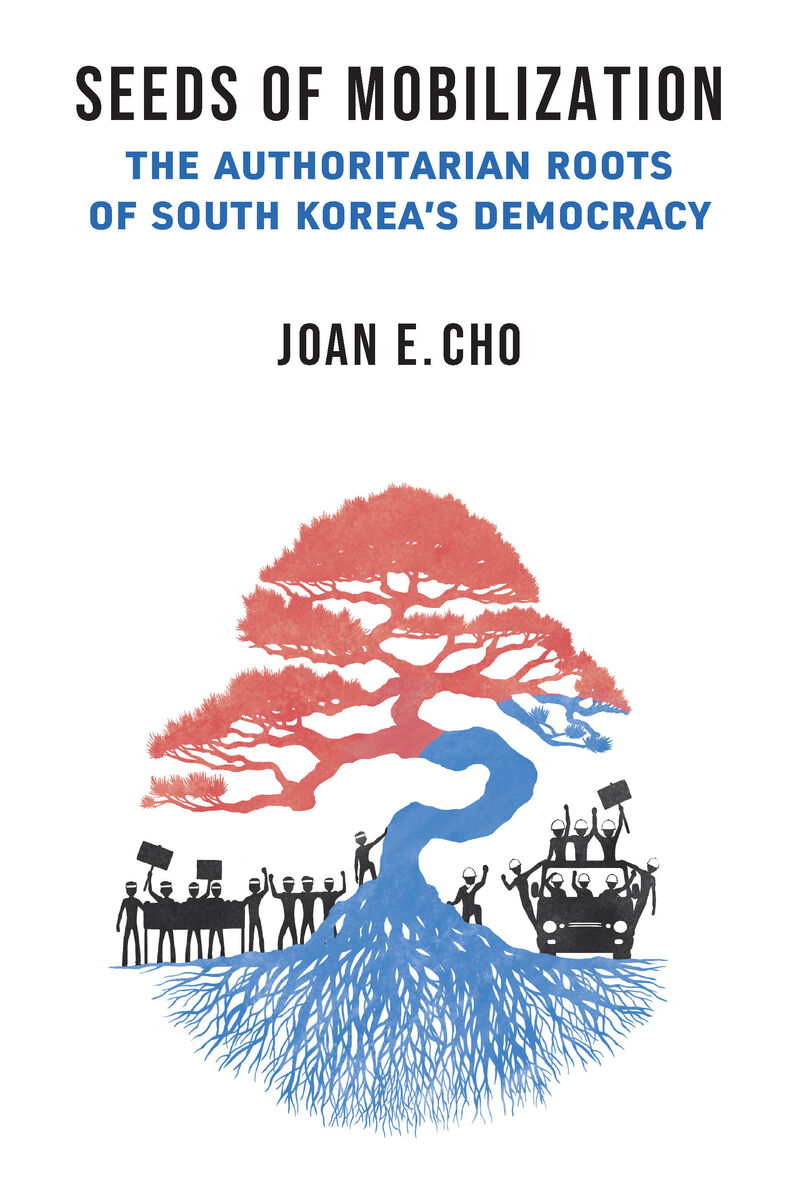
Seeds of Mobilization: The Authoritarian Roots of South Korea's Democracy
University of Michigan Press, 2024
Paper: 978-0-472-05660-6 | Cloth: 978-0-472-07660-4 | eISBN: 978-0-472-90403-7
Library of Congress Classification DS922.35.C47143 2024
Dewey Decimal Classification 320.53095195
Paper: 978-0-472-05660-6 | Cloth: 978-0-472-07660-4 | eISBN: 978-0-472-90403-7
Library of Congress Classification DS922.35.C47143 2024
Dewey Decimal Classification 320.53095195
ABOUT THIS BOOK | AUTHOR BIOGRAPHY | REVIEWS | TOC | REQUEST ACCESSIBLE FILE
ABOUT THIS BOOK
South Korea is sometimes held as a dream case of modernization theory, a testament to how economic development leads to democracy. Seeds of Mobilization takes a closer look at the history of South Korea to show that Korea’s advance to democracy was not linear. Instead, while Korea’s national economy grew dramatically under the regimes of Park Chung Hee (1961–79) and Chun Doo Hwan (1980–88), the political system first became increasingly authoritarian. Because modernization was founded on industrial complexes and tertiary education, these structures initially helped bolster the authoritarian regimes. In the long run, however, these structures later facilitated the anti-regime protests by various social movement groups—most importantly, workers and students—that ultimately brought democracy to the country.
By using original subnational protest event datasets, government publications, oral interviews, and publications from labor and student movement organizations, Joan E. Cho takes a long view of democratization that incorporates the decades before and after South Korea’s democratic transition. She demonstrates that Korea’s democratization resulted from a combination of factors from below and from above, and that authoritarian development itself was a hidden root cause of democratic development in South Korea. Seeds of Mobilization shows how socioeconomic development did not create a steady pressure toward democracy but acted as a “double-edged sword” that initially stabilized autocratic regimes before destabilizing them over time.
By using original subnational protest event datasets, government publications, oral interviews, and publications from labor and student movement organizations, Joan E. Cho takes a long view of democratization that incorporates the decades before and after South Korea’s democratic transition. She demonstrates that Korea’s democratization resulted from a combination of factors from below and from above, and that authoritarian development itself was a hidden root cause of democratic development in South Korea. Seeds of Mobilization shows how socioeconomic development did not create a steady pressure toward democracy but acted as a “double-edged sword” that initially stabilized autocratic regimes before destabilizing them over time.
See other books on: 2002- | Authoritarianism | Korea (South) | Mobilization | Seeds
See other titles from University of Michigan Press