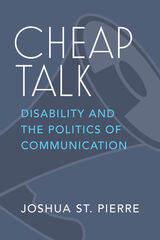
Cheap Talk: Disability and the Politics of Communication
University of Michigan Press, 2022
Cloth: 978-0-472-07534-8 | Paper: 978-0-472-05534-0 | eISBN: 978-0-472-90590-4 (OA) | eISBN: 978-0-472-22014-4 (standard)
Library of Congress Classification RC423
Dewey Decimal Classification 616.855
Cloth: 978-0-472-07534-8 | Paper: 978-0-472-05534-0 | eISBN: 978-0-472-90590-4 (OA) | eISBN: 978-0-472-22014-4 (standard)
Library of Congress Classification RC423
Dewey Decimal Classification 616.855
ABOUT THIS BOOK | AUTHOR BIOGRAPHY | REVIEWS | TOC | REQUEST ACCESSIBLE FILE
ABOUT THIS BOOK
In Cheap Talk: Disability and the Politics of Communication, Joshua St. Pierre flips the script on communication disability, positioning the unruly, disabled speaker at the center of analysis to challenge the belief that more communication is unquestionably good. Working with Gilles Deleuze’s suggestion that “[w]e don’t suffer these days from any lack of communication, but rather from all the forces making us say things when we’ve nothing much to say,” St. Pierre brings together the unlikely trio of the dysfluent speaker, the talking head, and the troll to show how speech is made cheap—and produced and repaired within human bodies—to meet the inhuman needs of capital. The book explores how technologies, like social media and the field of speech-language pathology, create smooth sites of contact that are exclusionary for disabled speakers and looks to the political possibilities of disabled voices to “de-face” the power of speech now entwined with capital.
See other books on: Communication | Communication in politics | Disability culture | Media & Internet | Stuttering
See other titles from University of Michigan Press