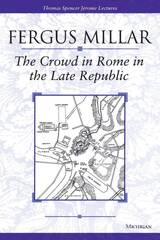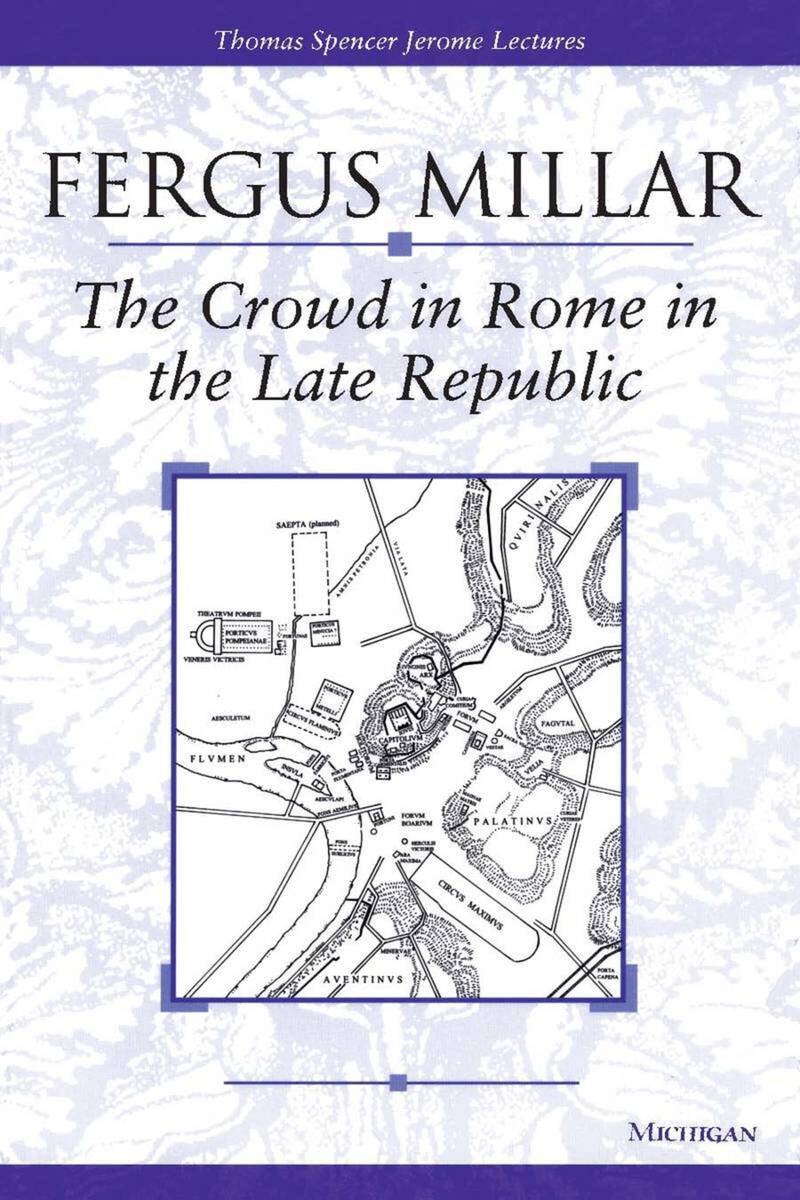
The Crowd in Rome in the Late Republic
University of Michigan Press, 2002
Cloth: 978-0-472-10892-3 | Paper: 978-0-472-08878-2
Library of Congress Classification DG254.2.M55 1998
Dewey Decimal Classification 937.05
Cloth: 978-0-472-10892-3 | Paper: 978-0-472-08878-2
Library of Congress Classification DG254.2.M55 1998
Dewey Decimal Classification 937.05
ABOUT THIS BOOK | AUTHOR BIOGRAPHY | REVIEWS | TOC | REQUEST ACCESSIBLE FILE
ABOUT THIS BOOK
It has often been thought that Roman politics was dominated by a governing class, or even aristocracy, and it has sometimes been presumed that the Senate was a legislative body. The Crowd in Rome in the Late Republic takes a dramatically new tack, and explores the consequences of a democracy in which public office could be gained only by direct election by the people. And while the Senate could indeed debate public matters, advise other office-holders, and make some administrative decisions, it could not legislate. An office-holder who wanted to pass a law had to step out of the Senate-house and propose it to the people in the Forum--where there were few guarantees.
In this important study, Fergus Millar explores the development of the Roman Republic, which, as it drew to a close in the middle decades of the first century B.C.E., had come to cover most of Italy. There were nearly a million adult male voters in the time of Cicero, but there were no constituencies, and no absentee ballots. To exercise their rights, voters had to come in person to Rome and to meet in the Forum. Millar takes the period from the dictatorship of Sulla to Caesar's crossing of the Rubicon and shows how the politics of the crowd was central to the great changes that took place year after year, and altered the Republic forever.
The originality of Millar's highly accessible work lies first in its serious treatment of the importance of open-air oratory in Roman public life, and second, in its use of the narratives of events that evidence provides. Third, it refuses to interpret these narratives in the light of modern theories about the importance of the client-patron system, or the domination of the Senate. This work questions how we should understand the Roman Republic: as a network of aristocratic families dominating the people, or an erratic and volatile democracy in which power was exercised by the tiny proportion of citizens who actually came to listen to speeches and to vote.
This work speaks to those interested in ancient history and its consequences in the modern world.
Fergus Millar is Camden Professor of Ancient History, Brasenose College, Oxford University.
See other books on: 265-30 B.C | Collective behavior | Crowd | Crowds | Millar, Fergus
See other titles from University of Michigan Press