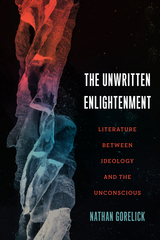
The Unwritten Enlightenment: Literature between Ideology and the Unconscious
Northwestern University Press, 2024
Cloth: 978-0-8101-4677-8 | Paper: 978-0-8101-4676-1 | eISBN: 978-0-8101-4678-5
Library of Congress Classification PN3495.G67 2024
Dewey Decimal Classification 809.3033
Cloth: 978-0-8101-4677-8 | Paper: 978-0-8101-4676-1 | eISBN: 978-0-8101-4678-5
Library of Congress Classification PN3495.G67 2024
Dewey Decimal Classification 809.3033
ABOUT THIS BOOK | AUTHOR BIOGRAPHY | REVIEWS | TOC | REQUEST ACCESSIBLE FILE
ABOUT THIS BOOK
Unveiling the fantasies that drove the Enlightenment and created modern literature
Nathan Gorelick’s The Unwritten Enlightenment: Literature between Ideology and the Unconscious traces the relations between literary criticism and psychoanalysis to their shared origins in the Enlightenment era’s novels and novelistic discourse, where the period’s efforts to invent new notions of subjectivity and individualism are most apparent. Gorelick shows how modern concepts of literature and the unconscious were generated in response to these efforts and by an ethical concern for what the language of the Enlightenment excludes, represses, or struggles to erase. Troubling the idea of the Enlightenment on its own terms, subverting its supposed authority from within, Gorelick thus reveals the workings of unconscious fantasy at the foundations of our contemporary political realities. The Unwritten Enlightenment makes clear that to criticize the Enlightenment’s deficiencies, ambiguities, and legacies of violence without regard for the unconscious fantasies that drive them risks reproducing the very patterns of thought, action, and imagination that the Enlightenment novel already unsettles.
Nathan Gorelick’s The Unwritten Enlightenment: Literature between Ideology and the Unconscious traces the relations between literary criticism and psychoanalysis to their shared origins in the Enlightenment era’s novels and novelistic discourse, where the period’s efforts to invent new notions of subjectivity and individualism are most apparent. Gorelick shows how modern concepts of literature and the unconscious were generated in response to these efforts and by an ethical concern for what the language of the Enlightenment excludes, represses, or struggles to erase. Troubling the idea of the Enlightenment on its own terms, subverting its supposed authority from within, Gorelick thus reveals the workings of unconscious fantasy at the foundations of our contemporary political realities. The Unwritten Enlightenment makes clear that to criticize the Enlightenment’s deficiencies, ambiguities, and legacies of violence without regard for the unconscious fantasies that drive them risks reproducing the very patterns of thought, action, and imagination that the Enlightenment novel already unsettles.
See other books on: Enlightenment | European fiction | Gorelick, Nathan | Semiotics & Theory | Unconscious
See other titles from Northwestern University Press