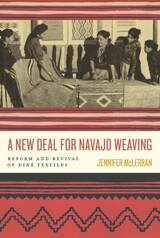
A New Deal for Navajo Weaving: Reform and Revival of Diné Textiles
University of Arizona Press, 2022
Cloth: 978-0-8165-4324-3 | Paper: 978-0-8165-5374-7 | eISBN: 978-0-8165-4624-4 (standard)
Library of Congress Classification E99.N3M314 2022
Dewey Decimal Classification 746.140899726
Cloth: 978-0-8165-4324-3 | Paper: 978-0-8165-5374-7 | eISBN: 978-0-8165-4624-4 (standard)
Library of Congress Classification E99.N3M314 2022
Dewey Decimal Classification 746.140899726
ABOUT THIS BOOK | AUTHOR BIOGRAPHY | REVIEWS | TOC
ABOUT THIS BOOK
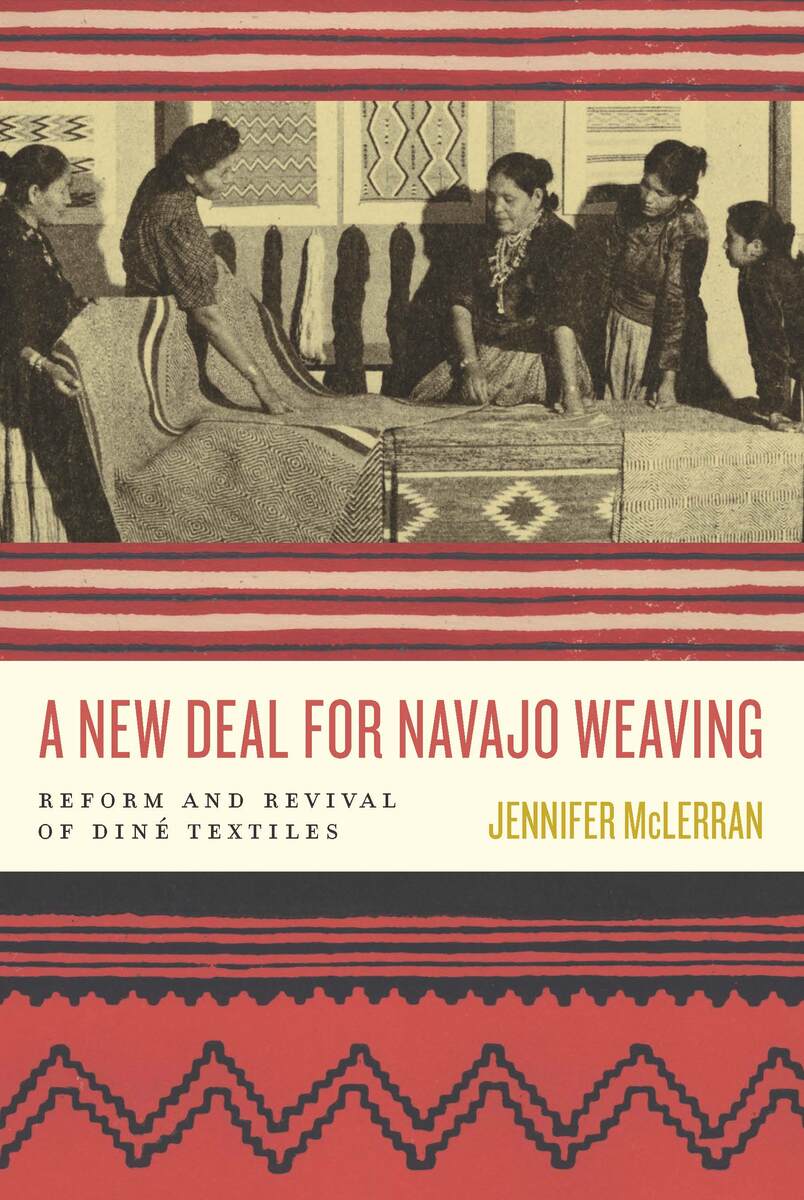
A New Deal for Navajo Weaving provides a detailed history of early to mid-twentieth-century Diné weaving projects by non-Natives who sought to improve the quality and marketability of Navajo weaving but in so doing failed to understand the cultural significance of weaving and its role in the lives of Diné women.
By the 1920s the durability and market value of Diné weavings had declined dramatically. Indian welfare advocates established projects aimed at improving the materials and techniques. Private efforts served as models for federal programs instituted by New Deal administrators. Historian Jennifer McLerran details how federal officials developed programs such as the Southwest Range and Sheep Breeding Laboratory at Fort Wingate in New Mexico and the Navajo Arts and Crafts Guild. Other federal efforts included the publication of Native natural dye recipes; the publication of portfolios of weaving designs to guide artisans; and the education of consumers through the exhibition of weavings, aiding them in their purchases and cultivating an upscale market. McLerran details how government officials sought to use these programs to bring the Diné into the national economy; instead, these federal tactics were ineffective because they marginalized Navajo women and ignored the important role weaving plays in the resilience and endurance of wider Diné culture.
By the 1920s the durability and market value of Diné weavings had declined dramatically. Indian welfare advocates established projects aimed at improving the materials and techniques. Private efforts served as models for federal programs instituted by New Deal administrators. Historian Jennifer McLerran details how federal officials developed programs such as the Southwest Range and Sheep Breeding Laboratory at Fort Wingate in New Mexico and the Navajo Arts and Crafts Guild. Other federal efforts included the publication of Native natural dye recipes; the publication of portfolios of weaving designs to guide artisans; and the education of consumers through the exhibition of weavings, aiding them in their purchases and cultivating an upscale market. McLerran details how government officials sought to use these programs to bring the Diné into the national economy; instead, these federal tactics were ineffective because they marginalized Navajo women and ignored the important role weaving plays in the resilience and endurance of wider Diné culture.
See other books on: Indian handicraft industries | Navajo Indians | Navajo textile fabrics | Reform | Revival
See other titles from University of Arizona Press