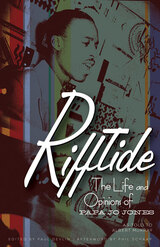
"Jo Jones, an elegant, swinging dude, always had a style of his own. When he was with us, you could hear him, feel him—everything was right there."—Count Basie
"I first met Jo Jones at the RKO Theater in Boston when I was a teenager in the early 1940s and we were friends until he passed away. He was my first influence and my major influence. He was ‘Papa’ Jo to me before they gave him that title. He was like a father to me. For drummers of my generation, Jo was the president of the drums just like Lester Young was president of the tenor saxophone. Jo loved to talk, and when he spoke it was almost as if he was playing the drums: you’d give him your undivided attention. Rifftide conveys a fine sense of his voice and the larger than life dimensions of his personality."—Roy Haynes
"Albert Murray has helped keep the incomparable Jo Jones alive through the voice of Count Basie in Good Morning Blues and fictionally in The Magic Keys, but in Rifftide, thanks to the persistence of editor Paul Devlin, we get to hear Jo himself in all his dynamic, adrenalized, anecdotal, no-bull glory—riffing with words as heartily as he did on the hi-hat."—Gary Giddins, author of Warning Shadows and Jazz
"Rifftide is a gem of a book about one of the forgotten founding fathers of Swing. Jo Jones was more than a jazz genius—he was also one of the great characters and chroniclers of American life during the Swing Era. Based on extensive oral interviews and years of painstaking research, Rifftide is a terrific source not only for students of jazz, but also American history, African-American studies, linguistics, and sociology. "—Debby Applegate, author of The Most Famous Man in America: The Biography of Henry Ward Beecher
"Papa Jo Jones is Brer Rabbit with a drum kit and opposable thumbs. In his own spellbinding voice, musical history and philosophy come alive on the page."—Mat Johnson, author of Pym
"Devlin does the rare work of presenting the intersection of musicianship and folklore in a volume that belongs in any serious jazz or African American culture collection."—Library Journal
"It is a very entertaining, thought provoking, and insightful read in better understanding such a burning talent and innovator. This is Papa Jo Jones, an American original through his riffing and unvarnished commentary on life and music."—JazzTimes Magazine
"Jones was a great innovator and an equally great synthesizer of percussion technique, someone who understood that the drummer could liberate both himself and the band by rethinking jazz rhythm, by creating a flow rather than a series of demarcations. . . . We are lucky to have Rifftide."—Michael Steinman, Jazz Lives
"Rifftide: The Life and Opinions of Papa Jo Jones is rife with stories of musical ingenuity amid the racial strife of the swing era and beyond."—The Root
"With a pronounced irascible streak to match his heterodox approach to drumming, Papa Jo Jones (1911-85) was an ideal candidate to star in the kind of book that delights jazz fans: the straight-talking, defiantly espousing firsthand record. Anyone interested in authenticity of voice is going to be on the verge of fist-pumping the air throughout, or else exclaiming, ‘You tell it like it is, baby,’ as if partaking in a call-and-response with the book."—The New York Times
"Rifftide: The Life and Opinions of Papa Jo Jones is a modest work, as charming, quirky, and enigmatic as its subject. . . . An invaluable and lengthy afterword by jazz historian and broadcaster Phil Schaap, who knew Jones for thirty years, makes the man and the musician come alive."—Modern Drummer
"Rifftide is an easy, fun read that I'll keep returning to."—Ethan Iverson
"Reading Devlin’s book, one can hear Jones’s voice and be sure they didn’t make two of those."—Alabama Writers’ Forum
"In Rifftide, Murray, Devlin and Schaap have taken Papa Jo’s digressions on music, show business, and people beyond biography or cultural history and have produced a reflection on the American experience in the tradition of Alexis de Tocqueville."—Alabama Writers’ Forum
"Jones is one of the great raconteurs of jazz, reminding me of Jelly Roll Morton in his effusiveness and convictions. There is a wealth of information in Jones’ meandering monologue through several eras of jazz history. He has seen it all and, as Ray Haynes says, loves to talk — about himself and all that he has seen."—Jazzhouse.org
— -