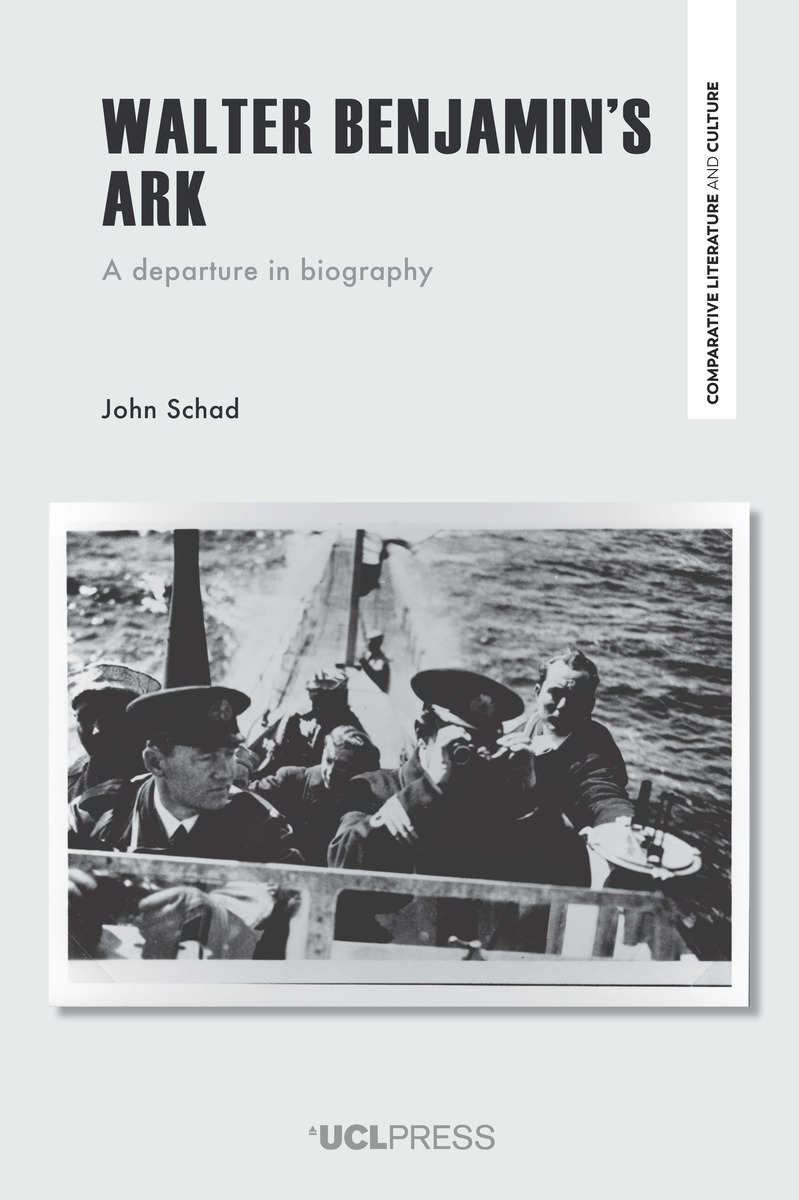
Walter Benjamin’s Ark: A Departure in Biography
University College London, 2025
Cloth: 978-1-80008-967-9 | Paper: 978-1-80008-969-3
See other books on: 20th Century | Comparative Literature | Departure | Literary Figures | Modern
See other titles from University College London
Cloth: 978-1-80008-967-9 | Paper: 978-1-80008-969-3
ABOUT THIS BOOK | AUTHOR BIOGRAPHY | REVIEWS | TOC
ABOUT THIS BOOK
The first-ever exploration of the curious life of Stefan Rafael Benjamin, Walter Benjamin’s only son.
Walter Benjamin’s Ark rereads the life and work of the German philosopher and critic through the life of his estranged son. With this innovative biography, John Schad not only brings to light the intriguing figure that is Stefan Rafael Benjamin, but also identifies him as that most crucial of Benjaminian specters, namely, the secret “you” or addressee of his father’s writings. In the process, he brings Walter Benjamin into a series of unlikely dramatic dialogues with Virginia Woolf, Rosa Luxemburg, Ludwig Wittgenstein, Gertrud Kolmar, Oscar Wilde, Franz Kafka, and Hamlet.
Walter Benjamin’s Ark rereads the life and work of the German philosopher and critic through the life of his estranged son. With this innovative biography, John Schad not only brings to light the intriguing figure that is Stefan Rafael Benjamin, but also identifies him as that most crucial of Benjaminian specters, namely, the secret “you” or addressee of his father’s writings. In the process, he brings Walter Benjamin into a series of unlikely dramatic dialogues with Virginia Woolf, Rosa Luxemburg, Ludwig Wittgenstein, Gertrud Kolmar, Oscar Wilde, Franz Kafka, and Hamlet.
See other books on: 20th Century | Comparative Literature | Departure | Literary Figures | Modern
See other titles from University College London