
 A SCHOLARLY BOOK REPOSITORY
156 start with A start with A
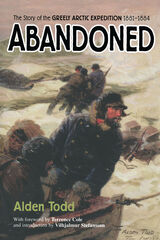
Abandoned is the gripping account of men battling for survival as they are pitted against the elements and each other. It is also the most complete and authentic account of the controversial Greely Expedition ever published, an exemplar of the best in chronicles of polar exploration.
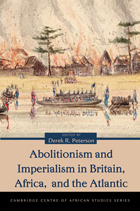
The abolition of the slave trade is normally understood to be the singular achievement of eighteenth-century British liberalism. Abolitionism and Imperialism in Britain, Africa, and the Atlantic expands both the temporal and the geographic framework in which the history of abolitionism is conceived. Abolitionism was a theater in which a variety of actors—slaves, African rulers, Caribbean planters, working-class radicals, British evangelicals, African political entrepreneurs—played a part. The Atlantic was an echo chamber, in which abolitionist symbols, ideas, and evidence were generated from a variety of vantage points. These essays highlight the range of political and moral projects in which the advocates of abolitionism were engaged, and in so doing it joins together geographies that are normally studied in isolation.
Where empires are often understood to involve the government of one people over another, Abolitionism and Imperialism shows that British values were formed, debated, and remade in the space of empire. Africans were not simply objects of British liberals’ benevolence. They played an active role in shaping, and extending, the values that Britain now regards as part of its national character. This book is therefore a contribution to the larger scholarship about the nature of modern empires.
Contributors: Christopher Leslie Brown, Seymour Drescher, Jonathon Glassman, Boyd Hilton, Robin Law, Phillip D. Morgan, Derek R. Peterson, John K. Thornton

This book complicates the conventional story that global abilition was essentially a British moralizing effort, “among the three or four perfectly virtuous pages comprised in the history of nations”. Using comparison and connection, this book tells a story of dynamic encounters between local and global contexts, of which the local efforts of British abolition campaigns were a part.
Looking at abolitions as a globally shared experience provides an important perspective, not only to the field of slavery and abolition studies, but also the field of global or world history.
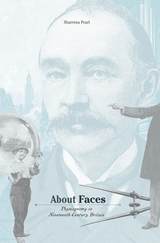
When nineteenth-century Londoners looked at each other, what did they see, and how did they want to be seen? Sharrona Pearl reveals the way that physiognomy, the study of facial features and their relationship to character, shaped the way that people understood one another and presented themselves.
Physiognomy was initially a practice used to get information about others, but soon became a way to self-consciously give information—on stage, in print, in images, in research, and especially on the street. Moving through a wide range of media, Pearl shows how physiognomical notions rested on instinct and honed a kind of shared subjectivity. She looks at the stakes for framing physiognomy—a practice with a long history—as a science in the nineteenth century.
By showing how physiognomy gave people permission to judge others, Pearl holds up a mirror both to Victorian times and our own.
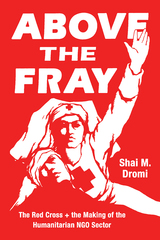
Drawing on archival research, Dromi traces the genesis of the Red Cross to a Calvinist movement working in mid-nineteenth-century Geneva. He shows how global humanitarian policies emerged from the Red Cross founding members’ faith that an international volunteer program not beholden to the state was the only ethical way to provide relief to victims of armed conflict. By illustrating how Calvinism shaped the humanitarian field, Dromi argues for the key role belief systems play in establishing social fields and institutions. Ultimately, Dromi shows the immeasurable social good that NGOs have achieved, but also points to their limitations and suggests that alternative models of humanitarian relief need to be considered.
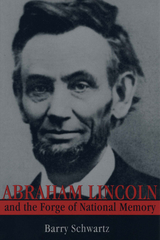
Schwartz draws on a wide array of materials—painting and sculpture, popular magazines and school textbooks, newspapers and oratory—to examine the role that Lincoln's memory has played in American life. He explains, for example, how dramatic funeral rites elevated Lincoln's reputation even while funeral eulogists questioned his presidential actions, and how his reputation diminished and grew over the next four decades. Schwartz links transformations of Lincoln's image to changes in the society. Commemorating Lincoln helped Americans to think about their country's development from a rural republic to an industrial democracy and to articulate the way economic and political reform, military power, ethnic and race relations, and nationalism enhanced their conception of themselves as one people.
Lincoln's memory assumed a double aspect of "mirror" and "lamp," acting at once as a reflection of the nation's concerns and an illumination of its ideals, and Schwartz offers a fascinating view of these two functions as they were realized in the commemorative symbols of an ever-widening circle of ethnic, religious, political, and regional communities. The first part of a study that will continue through the present, Abraham Lincoln and the Forge of National Memory is the story of how America has shaped its past selectively and imaginatively around images rooted in a real person whose character and achievements helped shape his country's future.
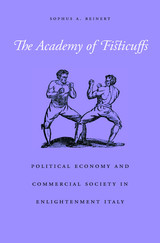
The terms “capitalism” and “socialism” continue to haunt our political and economic imaginations, but we rarely consider their interconnected early history. Even the eighteenth century had its “socialists,” but unlike those of the nineteenth, they paradoxically sought to make the world safe for “capitalists.” The word “socialists” was first used in Northern Italy as a term of contempt for the political economists and legal reformers Pietro Verri and Cesare Beccaria, author of the epochal On Crimes and Punishments. Yet the views and concerns of these first socialists, developed inside a pugnacious intellectual coterie dubbed the Academy of Fisticuffs, differ dramatically from those of the socialists that followed.
Sophus Reinert turns to Milan in the late 1700s to recover the Academy’s ideas and the policies they informed. At the core of their preoccupations lay the often lethal tension among states, markets, and human welfare in an era when the three were becoming increasingly intertwined. What distinguished these thinkers was their articulation of a secular basis for social organization, rooted in commerce, and their insistence that political economy trumped theology as the underpinning for peace and prosperity within and among nations.
Reinert argues that the Italian Enlightenment, no less than the Scottish, was central to the emergence of political economy and the project of creating market societies. By reconstructing ideas in their historical contexts, he addresses motivations and contingencies at the very foundations of modernity.
“Should stand for years as the definitive history of New Orleans’s first century.” —Jonathan Yardley, Washington Post
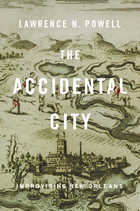
This is the story of a city that shouldn’t exist. In the seventeenth century, what is now America’s most beguiling metropolis was nothing more than a swamp: prone to flooding, infested with snakes, battered by hurricanes. But through the intense imperial rivalries of Spain, France, and England, and the ambitious, entrepreneurial merchants and settlers from four continents who risked their lives to succeed in colonial America, this unpromising site became a crossroads for the whole Atlantic world.
Lawrence N. Powell, a decades-long resident and observer of New Orleans, gives us the full sweep of the city’s history from its founding through Louisiana statehood in 1812. We see the Crescent City evolve from a French village, to an African market town, to a Spanish fortress, and finally to an Anglo-American center of trade and commerce. We hear and feel the mix of peoples, religions, and languages from four continents that make the place electric—and always on the verge of unraveling. The Accidental City is the story of land-jobbing schemes, stock market crashes, and nonstop squabbles over status, power, and position, with enough rogues, smugglers, and self-fashioners to fill a picaresque novel.
Powell’s tale underscores the fluidity and contingency of the past, revealing a place where people made their own history. This is a city, and a history, marked by challenges and perpetual shifts in shape and direction, like the sinuous river on which it is perched.
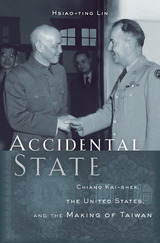
The existence of two Chinese states—one controlling mainland China, the other controlling the island of Taiwan—is often understood as a seemingly inevitable outcome of the Chinese civil war. Defeated by Mao Zedong, Chiang Kai-shek’s Nationalists fled to Taiwan to establish a rival state, thereby creating the “Two Chinas” dilemma that vexes international diplomacy to this day. Accidental State challenges this conventional narrative to offer a new perspective on the founding of modern Taiwan.
Hsiao-ting Lin marshals extensive research in recently declassified archives to show that the creation of a Taiwanese state in the early 1950s owed more to serendipity than careful geostrategic planning. It was the cumulative outcome of ad hoc half-measures and imperfect compromises, particularly when it came to the Nationalists’ often contentious relationship with the United States.
Taiwan’s political status was fraught from the start. The island had been formally ceded to Japan after the First Sino-Japanese War, and during World War II the Allies promised Chiang that Taiwan would revert to Chinese rule after Japan’s defeat. But as the Chinese civil war turned against the Nationalists, U.S. policymakers reassessed the wisdom of backing Chiang. The idea of placing Taiwan under United Nations trusteeship gained traction. Cold War realities, and the fear of Taiwan falling into Communist hands, led Washington to recalibrate U.S. policy. Yet American support of a Taiwan-based Republic of China remained ambivalent, and Taiwan had to eke out a place for itself in international affairs as a de facto, if not fully sovereign, state.

What does it feel like to live helplessly in a world that is coming undone? Nathan Hensley turns to Victorian literature to uncover a prehistory of this deeply contemporary sense of powerlessness. For many in nineteenth-century Britain, their world seemed so scarred by human rapacity that restoring it seemed beyond the powers of any one individual. Like George Eliot’s characters in Middlemarch or the doomed lovers of Wuthering Heights, observers of the gathering carbon economy felt themselves ensnared by interlocked and broken systems. In the face of damage so vast and apparently irreversible, what could possibly be done?
To answer this question, Hensley shows that nineteenth-century writers and artists devised new ways to understand action—and hope. They rescaled action away from the grandly heroic and toward minor adjustments and collaborative interventions. They turned away from logical proofs and direct argumentation and instead called on aesthetic technologies like sonnets and fractured lyrics, watercolor sketches and vast, multiplot novels, finding scope for action not at the level of the theme or the thesis, but in gestures and details. Ranging from J. M. W. Turner’s painterly technique to Emily Brontë’s dreamlike fragments (and reading along the way works by Alfred, Lord Tennyson, H. G. Wells, Lewis Carroll, Gerard Manley Hopkins, William Berryman, Charlotte Brontë, George Eliot, and Christina Rossetti), Hensley’s study makes an important contribution to Victorian studies and the environmental humanities.
Kervégan begins with Hegel’s term “objective spirit,” the public manifestation of our deepest commitments, the binding norms that shape our existence as subjects and agents. He examines objective spirit in three realms: the notion of right, the theory of society, and the state. In conversation with Tocqueville and other theorists of democracy, whether in the Anglophone world or in Europe, Kervégan shows how Hegel—often associated with grand metaphysical ideas—actually had a specific conception of civil society and the state. In Hegel’s view, public institutions represent the fulfillment of deep subjective needs—and in that sense, demonstrate that the real is the rational, because what surrounds us is the product of our collective mindedness. This groundbreaking analysis will guide the study of Hegel and nineteenth-century political thought for years to come.
Although overshadowed by his contemporaries Adam Smith and David Hume, the Scottish philosopher Adam Ferguson strongly influenced eighteenth-century currents of political thought. A major reassessment of this neglected figure, Adam Ferguson in the Scottish Enlightenment: The Roman Past and Europe’s Future sheds new light on Ferguson as a serious critic, rather than an advocate, of the Enlightenment belief in liberal progress. Unlike the philosophes who looked upon Europe’s growing prosperity and saw confirmation of a utopian future, Ferguson saw something else: a reminder of Rome’s lesson that egalitarian democracy could become a self-undermining path to dictatorship.
Ferguson viewed the intrinsic power struggle between civil and military authorities as the central dilemma of modern constitutional governments. He believed that the key to understanding the forces that propel nations toward tyranny lay in analysis of ancient Roman history. It was the alliance between popular and militaristic factions within the Roman republic, Ferguson believed, which ultimately precipitated its downfall. Democratic forces, intended as a means of liberation from tyranny, could all too easily become the engine of political oppression—a fear that proved prescient when the French Revolution spawned the expansionist wars of Napoleon.
As Iain McDaniel makes clear, Ferguson’s skepticism about the ability of constitutional states to weather pervasive conditions of warfare and emergency has particular relevance for twenty-first-century geopolitics. This revelatory study will resonate with debates over the troubling tendency of powerful democracies to curtail civil liberties and pursue imperial ambitions.
Praise for the hardcover edition:
"A momentous book which I feel is destined to become a classic in the category of scholarly narcotic books."
—Claude Brown, author of the bestseller, Manchild in the Promised Land.
"The drug literature is filled with the stereotyped opinions of non-addicted, middle-class pundits who have had little direct contact with addicts. These stories are reality. Narcotic addicts of the inner cities are both tough and gentle, deceptive when necessary and yet often generous--above all, shrewd judges of character. While judging them, the clinician is also being judged."
—Vincent P. Dole, M.D., The Rockefeller Institute.
"What was it like to be a narcotic addict during the Anslinger era? No book will probably ever appear that gives a better picture than this one. . . . a singularly readable and informative work on a subject ordinarily buried in clichés and stereotypes."
—Donald W. Goodwin, Journal of the American Medical Association
" . . . an important contribution to the growing body of literature that attempts to more clearly define the nature of drug addiction. . . . [This book] will appeal to a diverse audience. Academicians, politicians, and the general reader will find this approach to drug addiction extremely beneficial, insightful, and instructive. . . . Without qualification anyone wishing to acquire a better understanding of drug addicts and addiction will benefit from reading this book."
—John C. McWilliams, Pennsylvania Magazine of History and Biography
"This study has much to say to a general audience, as well as those involved in drug control."
—Publishers Weekly
"The authors' comments are perceptive and the interviews make interesting reading."
—John Duffy, Journal of American History
"This book adds a vital and often compelling human dimension to the story of drug use and law enforcement. The material will be of great value to other specialists, such as those interested in the history of organized crime and of outsiders in general."
—H. Wayne Morgan, Journal of Southern History
"This book represents a significant and valuable addition to the contemporary substance abuse literature. . . . this book presents findings from a novel and remarkably imaginative research approach in a cogent and exceptionally informative manner."
—William M. Harvey, Journal of Psychoactive Drugs
"This is a good and important book filled with new information containing provocative elements usually brought forth through the touching details of personal experience. . . . There isn't a recollection which isn't of intrinsic value and many point to issues hardly ever broached in more conventional studies."
—Alan Block, Journal of Social History
From the beginning to the end of his career, the philosopher Theodor W. Adorno sustained an uneasy but enduring bond with existentialism. His attitude overall was that of unsparing criticism, verging on polemic. In Kierkegaard he saw an early paragon for the late flowering of bourgeois solipsism; in Heidegger, an impresario for a “jargon of authenticity” cloaking its idealism in an aura of pseudo-concreteness and neo-romantic kitsch. Even in the straitened rationalism of Husserl’s phenomenology Adorno saw a vain attempt to break free from the prison-house of consciousness.
“Gordon, in a detailed, sensitive, fair-minded way, leads the reader through Adorno’s various, usually quite vigorous, rhetorically pointed attacks on both transcendental and existential phenomenology from 1930 on…[A] singularly illuminating study.”
—Robert Pippin, Critical Inquiry
“Gordon’s book offers a significant contribution to our understanding of Adorno’s thought. He writes with expertise, authority, and compendious scholarship, moving with confidence across the thinkers he examines…After this book, it will not be possible to explain Adorno’s philosophical development without serious consideration of [Gordon’s] reactions to them.”
—Richard Westerman, Symposium
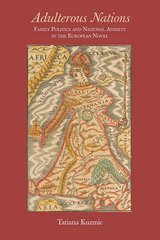
In Adulterous Nations, Tatiana Kuzmic enlarges our perspective on the nineteenth-century novel of adultery, showing how it often served as a metaphor for relationships between the imperialistic and the colonized. In the context of the long-standing practice of gendering nations as female, the novels under discussion here—George Eliot’s Middlemarch, Theodor Fontane’s Effi Briest, and Leo Tolstoy’s Anna Karenina, along with August Šenoa’s The Goldsmith’s Gold and Henryk Sienkiewicz’s Quo Vadis—can be understood as depicting international crises on the scale of the nuclear family. In each example, an outsider figure is responsible for the disruption experienced by the family. Kuzmic deftly argues that the hopes, anxieties, and interests of European nations during this period can be discerned in the destabilizing force of adultery. Reading the work of Šenoa and Sienkiewicz, from Croatia and Poland, respectively, Kuzmic illuminates the relationship between the literature of dominant nations and that of the semicolonized territories that posed a threat to them. Ultimately, Kuzmic’s study enhances our understanding of not only these five novels but nineteenth-century European literature more generally.

In Calvin’s Geneva, the changes associated with the Reformation were particularly abrupt and far-reaching, in large part owing to John Calvin himself. Adultery and Divorce in Calvin’s Geneva makes two major contributions to our understanding of this time. The first is to the history of divorce. The second is in illustrating the operations of the Consistory of Geneva—an institution designed to control in all its variety the behavior of the entire population—which was established at Calvin’s insistence in 1541. This mandate came shortly after the city officially adopted Protestantism in 1536, a time when divorce became legally possible for the first time in centuries.
Robert Kingdon illustrates the changes that accompanied the earliest Calvinist divorces by examining in depth a few of the most dramatic cases and showing how divorce affected real individuals. He considers first, and in the most detail, divorce for adultery, the best-known grounds for divorce and the best documented. He also covers the only other generally accepted grounds for these early divorces—desertion.
The second contribution of the book, to show the work of the Consistory of Geneva, is a first step toward a fuller study of the institution. Kingdon has supervised the first accurate and complete transcription of the twenty-one volumes of registers of the Consistory and has made the first extended use of these materials, as well as other documents that have never before been so fully utilized.
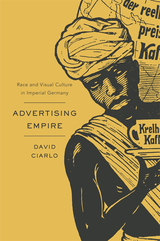
At the end of the nineteenth century, Germany turned toward colonialism, establishing protectorates in Africa, and toward a mass consumer society, mapping the meaning of commodities through advertising. These developments, distinct in the world of political economy, were intertwined in the world of visual culture.
David Ciarlo offers an innovative visual history of each of these transformations. Tracing commercial imagery across different products and media, Ciarlo shows how and why the “African native” had emerged by 1900 to become a familiar figure in the German landscape, selling everything from soap to shirts to coffee. The racialization of black figures, first associated with the American minstrel shows that toured Germany, found ever greater purchase in German advertising up to and after 1905, when Germany waged war against the Herero in Southwest Africa. The new reach of advertising not only expanded the domestic audience for German colonialism, but transformed colonialism’s political and cultural meaning as well, by infusing it with a simplified racial cast.
The visual realm shaped the worldview of the colonial rulers, illuminated the importance of commodities, and in the process, drew a path to German modernity. The powerful vision of racial difference at the core of this modernity would have profound consequences for the future.
Published by University of Delaware Press. Distributed worldwide by Rutgers University Press.
Myths are a central part of our reality. But merely debunking them lets us forget why they are created in the first place and why we need them. André Fischer draws on key examples from German postwar culture, from novelists Hans Henny Jahnn and Hubert Fichte, to sculptor and performance artist Joseph Beuys, and filmmaker Werner Herzog, to show that mythmaking is an indispensable human practice in times of crisis.
Against the background of mythologies based in nineteenth-century romanticism and their ideological continuation in Nazism, fresh forms of mythmaking in the narrative, visual, and performative arts emerged as an aesthetic paradigm in postwar modernism. Boldly rewriting the cultural history of an era and setting in transition, The Aesthetics of Mythmaking in German Postwar Culture counters the predominant narrative of an exclusively rational Vergangenheitsbewältigung (“coming to terms with the past”). Far from being merely reactionary, the turn toward myth offered a dimension of existential orientation that had been neglected by other influential aesthetic paradigms of the postwar period. Fischer’s wide-ranging, transmedia account offers an inclusive perspective on myth beyond storytelling and instead develops mythopoesis as a formal strategy of modernism at large.
Among all the great thinkers of the past two hundred years, Nietzsche continues to occupy a special place--not only for a broad range of academics but also for members of a wider public, who find some of their most pressing existential concerns addressed in his works. Central among these concerns is the question of the meaning of a life characterized by inescapable suffering, at a time when the traditional responses inspired by Christianity are increasingly losing their credibility. While most recent studies of Nietzsche's works have lost sight of this fundamental issue, Bernard Reginster's book The Affirmation of Life brings it sharply into focus.
Reginster identifies overcoming nihilism as a central objective of Nietzsche's philosophical project, and shows how this concern systematically animates all of his main ideas. In particular, Reginster's work develops an original and elegant interpretation of the will to power, which convincingly explains how Nietzsche uses this doctrine to mount a critique of the dominant Christian values, to overcome the nihilistic despair they produce, and to determine the conditions of a new affirmation of life. Thus, Reginster attributes to Nietzsche a compelling substantive ethical outlook based on the notions of challenge and creativity--an outlook that involves a radical reevaluation of the role and significance of suffering in human existence.
Replete with deeply original insights on many familiar--and frequently misunderstood--Nietzschean concepts, Reginster's book will be essential to anyone approaching this towering figure of Western intellectual history.
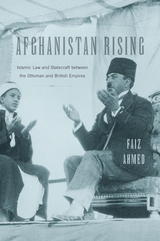
Debunking conventional narratives of Afghanistan as a perennial war zone or marginal frontier, Faiz Ahmed presents a vibrant account of the first Muslim-majority country to gain independence from the British Empire, form a fully sovereign government, and promulgate an original constitution after the fall of the Ottoman Empire.
Far from a landlocked wilderness, turn-of-the-twentieth-century Afghanistan was a magnet for itinerant scholars and emissaries shuttling between Ottoman and British imperial domains. Tracing Afghans’ longstanding but seldom examined scholastic ties to Istanbul, Damascus, and Baghdad, as well as greater Delhi and Lahore, Ahmed vividly describes how the Kabul court recruited jurists to craft a modern state within the interpretive traditions of Islamic law and ethics, or shariʿa, and international legal norms. Beginning with the first Ottoman mission to Kabul in 1877, and culminating with parallel independence struggles in Afghanistan, India, and Turkey after World War I, this rich narrative explores encounters between diverse streams of Muslim thought and politics—from Young Turk lawyers to Pashtun clerics; Ottoman Arab officers to British Raj bureaucrats; and the last caliphs to a remarkable dynasty of Afghan kings and queens.
By unearthing a lost history behind Afghanistan’s independence and first constitution, Ahmed shows how debates today on Islam, governance, and the rule of law have deep roots in a beleaguered land. Based on research in six countries and as many languages, Afghanistan Rising rediscovers a time when Kabul stood proudly for anticolonial coalitions, self-determination, and contested visions of reform in the Global South and Islamicate world.
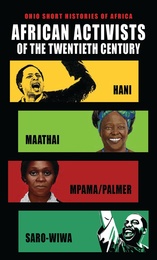
An omnibus collection of concise and up-to-date biographies of four influential figures from modern African history.
Chris Hani, by Hugh Macmillan
Chris Hani was one of the most highly respected leaders of the African National Congress, the South African Communist Party, and uMkhonto we Sizwe. His assassination in 1993 threatened to upset the country’s transition to democracy and prompted an intervention by Nelson Mandela that ultimately accelerated apartheid’s demise.
Wangari Maathai, by Tabitha Kanogo
This concise biography tells the story of Wangari Maathai, the Kenyan activist and Nobel Peace Prize winner who devoted her life to campaigning for environmental conservation, sustainable development, democracy, human rights, gender equality, and the eradication of poverty.
Josie Mpama/Palmer: Get Up and Get Moving, by Robert R. Edgar
Highly critical of the patriarchal attitudes that hindered Black women’s political activism, South Africa’s Josie Mpama/Palmer was an outspoken advocate for women’s social and political equality, a member of the Communist Party of South Africa, and an antiapartheid activist.
Ken Saro-Wiwa, by Roy Doron and Toyin Falola
A penetrating, accessible portrait of the Nigerian activist whose execution galvanized the world. Ken Saro-Wiwa became a martyr and symbolized modern Africans’ struggle against military dictatorship, corporate power, and environmental exploitation.
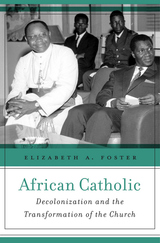
Winner of the John Gilmary Shea Prize
A groundbreaking history of how Africans in the French Empire embraced both African independence and their Catholic faith during the upheaval of decolonization, leading to a fundamental reorientation of the Catholic Church.
African Catholic examines how French imperialists and the Africans they ruled imagined the religious future of French sub-Saharan Africa in the years just before and after decolonization. The story encompasses the political transition to independence, Catholic contributions to black intellectual currents, and efforts to alter the church hierarchy to create an authentically “African” church.
Elizabeth Foster recreates a Franco-African world forged by conquest, colonization, missions, and conversions—one that still exists today. We meet missionaries in Africa and their superiors in France, African Catholic students abroad destined to become leaders in their home countries, African Catholic intellectuals and young clergymen, along with French and African lay activists. All of these men and women were preoccupied with the future of France’s colonies, the place of Catholicism in a postcolonial Africa, and the struggle over their personal loyalties to the Vatican, France, and the new African states.
Having served as the nuncio to France and the Vatican’s liaison to UNESCO in the 1950s, Pope John XXIII understood as few others did the central questions that arose in the postwar Franco-African Catholic world. Was the church truly universal? Was Catholicism a conservative pillar of order or a force to liberate subjugated and exploited peoples? Could the church change with the times? He was thinking of Africa on the eve of Vatican II, declaring in a radio address shortly before the council opened, “Vis-à-vis the underdeveloped countries, the church presents itself as it is and as it wants to be: the church of all.”

By bringing instances of Afro-Asian traffic in the realms of politics, economics, and culture to the foreground, this collection maps an alternative global circuit. The issue examines the non-Eurocentric form of cosmopolitanism that emerged from creative encounters of racialized people in Jazz Age Paris, the Harlem Renaissance, and colonial Shanghai. It reconceptualizes the Indian Ocean as a crucial site for Afro-Asian cross-pollination and investigates the cinematic culture of kung fu as a global discourse of Afro-Asian anti-imperialism.
Contributors. Brent Edwards, Andrew F. Jones, Yukiko Koshiro, Bill Mullen, Vijay Prashad, William Schaefer, Nikhil Pal Singh, Françoise Vergès, Daniel Widener
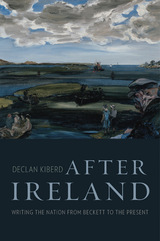
Ireland is suffering from a crisis of authority. Catholic Church scandals, political corruption, and economic collapse have shaken the Irish people’s faith in their institutions and thrown the nation’s struggle for independence into question. While Declan Kiberd explores how political failures and economic globalization have eroded Irish sovereignty, he also sees a way out of this crisis. After Ireland surveys thirty works by modern writers that speak to worrisome trends in Irish life and yet also imagine a renewed, more plural and open nation.
After Dublin burned in 1916, Samuel Beckett feared “the birth of a nation might also seal its doom.” In Waiting for Godot and a range of powerful works by other writers, Kiberd traces the development of an early warning system in Irish literature that portended social, cultural, and political decline. Edna O’Brien, Frank O’Connor, Seamus Heaney, and Michael Hartnett lamented the loss of the Irish language, Gaelic tradition, and rural life. Nuala Ní Dhomhnaill and Eavan Boland grappled with institutional corruption and the end of traditional Catholicism. These themes, though bleak, led to audacious experimentation, exemplified in the plays of Brian Friel and Tom Murphy and the novels of John Banville. Their achievements embody the defiance and resourcefulness of Ireland’s founding spirit—and a strange kind of hope.
After Ireland places these writers and others at the center of Ireland’s ongoing fight for independence. In their diagnoses of Ireland’s troubles, Irish artists preserve and extend a humane culture, planting the seeds of a sound moral economy.
From Kant to Kierkegaard, from Hegel to Heidegger, continental philosophers have indelibly shaped the trajectory of Western thought since the eighteenth century. Although much has been written about these monumental thinkers, students and scholars lack a definitive guide to the entire scope of the continental tradition. The most comprehensive reference work to date, this eight-volume History of Continental Philosophy will both encapsulate the subject and reorient our understanding of it. Beginning with an overview of Kant’s philosophy and its initial reception, the History traces the evolution of continental philosophy through major figures as well as movements such as existentialism, phenomenology, hermeneutics, and poststructuralism. The final volume outlines the current state of the field, bringing the work of both historical and modern thinkers to bear on such contemporary topics as feminism, globalization, and the environment. Throughout, the volumes examine important philosophical figures and developments in their historical, political, and cultural contexts.
The first reference of its kind, A History of Continental Philosophy has been written and edited by internationally recognized experts with a commitment to explaining complex thinkers, texts, and movements in rigorous yet jargon-free essays suitable for both undergraduates and seasoned specialists. These volumes also elucidate ongoing debates about the nature of continental and analytic philosophy, surveying the distinctive, sometimes overlapping characteristics and approaches of each tradition. Featuring helpful overviews of major topics and plotting road maps to their underlying contexts, A History of Continental Philosophy is destined to be the resource of first and last resort for students and scholars alike.
Over the last twenty years, a concerted effort has been made to uncover the history of the Holodomor, the Great Famine of 1932–1933 in Ukraine. Now, with the archives opened and the essential story told, it becomes possible to explore in detail what happened after the Holodomor and to examine its impact on Ukraine and its people.
In 2008 the Ukrainian Research Institute at Harvard University hosted an international conference entitled “The Great Famine in Ukraine: The Holodomor and Its Consequences, 1933 to the Present.” The papers, most of which are contained in this volume, concern a wide range of topics, such as the immediate aftermath of the Holodomor and its subsequent effect on Ukraine’s people and communities; World War II, with its wartime and postwar famines; and the impact of the Holodomor on subsequent generations of Ukrainians and present-day Ukrainian culture. Through the efforts of the historians, archivists, and demographers represented here, a fuller history of the Holodomor continues to emerge.
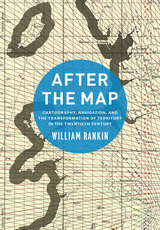
In After the Map, William Rankin argues that although this shift did not render traditional maps obsolete, it did radically change our experience of geographic knowledge, from the God’s-eye view of the map to the embedded subjectivity of GPS. Likewise, older concerns with geographic truth and objectivity have been upstaged by a new emphasis on simplicity, reliability, and convenience. After the Map shows how this change in geographic perspective is ultimately a transformation of the nature of territory, both social and political.
Scholars have described the eighteenth century in China as a time of “state activism” when the state sought to strengthen its control on various social and cultural sectors. The Taiping Rebellion and the postbellum restoration efforts of the mid-nineteenth century have frequently been associated with the origins of elite activism. However, drawing upon a wide array of sources, including previously untapped Qing government documents, After the Prosperous Age argues that the ascendance of elite activism can be traced to the Jiaqing and Daoguang reigns in the early nineteenth century, and that the Taiping Rebellion served as a second catalyst for the expansion of elite public roles rather than initiating such an expansion.
The first four decades of the nineteenth century in China remain almost uncharted territory. By analyzing the social and cultural interplay between state power and local elites of Suzhou, a city renowned for its economic prosperity and strong sense of local pride, from the eighteenth to the early nineteenth century, Seunghyun Han illuminates the significance of this period in terms of the reformulation of state-elite relations marked by the unfolding of elite public activism and the dissolution of a centralized cultural order.
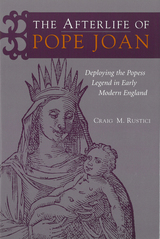
The legend concerning a popess had first taken written form in the thirteenth century and for several hundred years was more or less accepted. The Reformation, however, polarized discussions of the legend, pitting Catholics, who denied the story’s veracity, against Protestants, who suspected a cover-up and instantly cited Joan as evidence of papal depravity. In this heated environment, writers reimagined Joan variously as a sorceress, a hermaphrodite, and even a noteworthy author.
The Afterlife of Pope Joan examines sixteenth- and seventeenth-century debates concerning the popess’s existence, uncovering the disputants’ historiographic methods, rules of evidence, rhetorical devices, and assumptions concerning what is probable and possible for women and transvestites. Author Craig Rustici then investigates the cultural significance of a series of notions advanced in those debates: the claim that Queen Elizabeth I was a popess in her own right, the charge that Joan penned a book of sorcery, and the curious hypothesis that the popess was not a disguised woman at all but rather a man who experienced a sort of spontaneous sex change.
The Afterlife of Pope Joan draws upon the discourses of religion, politics, natural philosophy, and imaginative literature, demonstrating how the popess functioned as a powerful rhetorical instrument and revealing anxieties and ambivalences about gender roles that persist even today.
Craig M. Rustici is Associate Professor of English at Hofstra University.
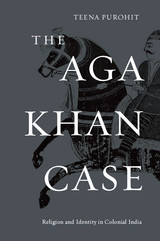
An overwhelmingly Arab-centric perspective dominates the West’s understanding of Islam and leads to a view of this religion as exclusively Middle Eastern and monolithic. Teena Purohit presses for a reorientation that would conceptualize Islam instead as a heterogeneous religion that has found a variety of expressions in local contexts throughout history. The story she tells of an Ismaili community in colonial India illustrates how much more complex Muslim identity is, and always has been, than the media would have us believe.
The Aga Khan Case focuses on a nineteenth-century court case in Bombay that influenced how religious identity was defined in India and subsequently the British Empire. The case arose when a group of Indians known as the Khojas refused to pay tithes to the Aga Khan, a Persian nobleman and hereditary spiritual leader of the Ismailis. The Khojas abided by both Hindu and Muslim customs and did not identify with a single religion prior to the court’s ruling in 1866, when the judge declared them to be converts to Ismaili Islam beholden to the Aga Khan.
In her analysis of the ginans, the religious texts of the Khojas that formed the basis of the judge’s decision, Purohit reveals that the religious practices they describe are not derivations of a Middle Eastern Islam but manifestations of a local vernacular one. Purohit suggests that only when we understand Islam as inseparable from the specific cultural milieus in which it flourishes do we fully grasp the meaning of this global religion.
In this timely and incisive work, Nicols Fox examines contemporary resistance to technology and places it in a surprising historical context. She brilliantly illuminates the rich but oftentimes unrecognized literary and philosophical tradition that has existed for nearly two centuries, since the first Luddites—the ""machine breaking"" followers of the mythical Ned Ludd—lifted their sledgehammers in protest against the Industrial Revolution. Tracing that current of thought through some of the great minds of the 19th and 20th centuries—William Blake, Mary Shelley, Charles Dickens, John Ruskin, William Morris, Henry David Thoreau, Ralph Waldo Emerson, Robert Graves, Aldo Leopold, Rachel Carson, and many others—Fox demonstrates that modern protests against consumptive lifestyles and misgivings about the relentless march of mechanization are part of a fascinating hidden history. She shows as well that the Luddite tradition can yield important insights into how we might reshape both technology and modern life so that human, community, and environmental values take precedence over the demands of the machine.
In Against the Machine, Nicols Fox writes with compelling immediacy—bringing a new dimension and depth to the debate over what technology means, both now and for our future.
“A mind-blowing tour de force that unwraps the myriad objects of addiction that surround us…Intelligent, incisive, and sometimes grimly entertaining.”
—Rod Phillips, author of Alcohol: A History
“A fascinating history of corporate America’s efforts to shape our habits and desires.”
—Vox
We live in an age of addiction, from compulsive gaming and shopping to binge eating and opioid abuse. Sugar can be as habit-forming as cocaine, researchers tell us, and social media apps are deliberately hooking our kids. But what can we do to resist temptations that insidiously rewire our brains? A renowned expert on addiction, David Courtwright reveals how global enterprises have both created and catered to our addictions. The Age of Addiction chronicles the triumph of what he calls “limbic capitalism,” the growing network of competitive businesses targeting the brain pathways responsible for feeling, motivation, and long-term memory.
“Compulsively readable…In crisp and playful prose and with plenty of needed humor, Courtwright has written a fascinating history of what we like and why we like it, from the first taste of beer in the ancient Middle East to opioids in West Virginia.”
—American Conservative
“A sweeping, ambitious account of the evolution of addiction…This bold, thought-provoking synthesis will appeal to fans of ‘big history’ in the tradition of Guns, Germs, and Steel.”
—Publishers Weekly
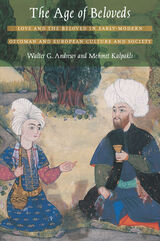
The authors show that the “age of beloveds” was not just an Ottoman, eastern European, or Islamic phenomenon. It extended into western Europe as well, pervading the cultures of Venice, Florence, Rome, and London during the same period. Andrews and Kalpakli contend that in an age dominated by absolute rulers and troubled by war, cultural change, and religious upheaval, the attachments of dependent courtiers and the longings of anxious commoners aroused an intense interest in love and the beloved. The Age of Beloveds reveals new commonalities in the cultural history of two worlds long seen as radically different.
In 1900 the global average life expectancy at birth was thirty-one years. By 2000 it was sixty-six. Yet, alongside unprecedented improvements in longevity and material well-being, the twentieth century also saw the rise of fascism and communism and a second world war followed by a cold war. This book tells the story of the battles between economic systems that defined the last century and created today's world.
The nineteenth century was a period of rapid economic growth characterized by relatively open markets and more personal liberty, but it also brought great inequality within and between nations. The following century offered sharp challenges to free-wheeling capitalism from both communism and fascism, whose competing visions of planned economic development attracted millions of people buffeted by the economic storms of the 1930s. The Age of Equality describes the ways in which market-oriented economies eventually overcame the threat of these visions and provided a blueprint for reform in nonmarket economies. This was achieved not through unbridled capitalism but by combining the efficiency and growth potential of markets with government policies to promote greater equality of opportunity and outcome. Following on the heels of economic reform, rapid catch-up growth in countries such as China, India, Indonesia, Brazil, and Poland helped to reduce global inequality.
At a time when inequality is on the rise in nations as disparate as the United States and Egypt, Pomfret’s interpretation of how governments of market economies faced the challenges of the twentieth century is both instructive and cautionary.
The move to a new publisher has given The Age of Johnson: A Scholarly Annual the opportunity to recommit to what it does best: present to a wide readership cant-free scholarly articles and essays and searching book reviews, all featuring a wide variety of approaches, written by both seasoned scholars and relative newcomers. Volume 24 features commentary on a range of Johnsonian topics: his reaction to Milton, his relation to the Allen family, his notes in his edition of Shakespeare, his use of Oliver Goldsmith in his Dictionary, and his always fascinating Nachleben. The volume also includes articles on topics of strong interest to Johnson: penal reform, Charlotte Lennox's professional literary career, and the "conjectural history" of Homer in the eighteenth century.
For more than two decades, The Age of Johnson has presented a vast corpus of Johnsonian studies "in the broadest sense," as founding editor Paul J. Korshin put it in the preface to Volume 1, and it has retained the interest of a wide readership. In thousands of pages of articles, review essays, and reviews, The Age of Johnson has made a permanent contribution to our understanding of the eighteenth century, and particularly of Samuel Johnson, his circle, and his interests, and has also served as an outlet for writers who are not academics but have something important to say about the eighteenth century.
ISSN 0884-5816.
A New York Times Book Review Editors’ Choice
Responsibility—which once meant the moral duty to help and support others—has come to be equated with an obligation to be self-sufficient. This has guided recent reforms of the welfare state, making key entitlements conditional on good behavior. Drawing on political theory and moral philosophy, Yascha Mounk shows why this re-imagining of personal responsibility is pernicious—and suggests how it might be overcome.
“This important book prompts us to reconsider the role of luck and choice in debates about welfare, and to rethink our mutual responsibilities as citizens.”
—Michael J. Sandel, author of Justice
“A smart and engaging book… Do we so value holding people accountable that we are willing to jeopardize our own welfare for a proper comeuppance?”
—New York Times Book Review
“An important new book… [Mounk] mounts a compelling case that political rhetoric…has shifted over the last half century toward a markedly punitive vision of social welfare.”
—Los Angeles Review of Books
“A terrific book. The insight at its heart—that the conception of responsibility now at work in much public rhetoric and policy is both punitive and ill-conceived—is very important and should be widely heeded.”
—Jedediah Purdy, author of After Nature: A Politics for the Anthropocene
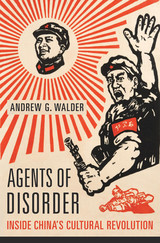
Why did the Chinese party state collapse so quickly after the onset of the Cultural Revolution? The award-winning author of China Under Mao offers a surprising answer that holds a powerful implicit warning for today’s governments.
By May 1966, just seventeen years after its founding, the People’s Republic of China had become one of the most powerfully centralized states in modern history. But that summer everything changed. Mao Zedong called for students to attack intellectuals and officials who allegedly lacked commitment to revolutionary principles. Rebels responded by toppling local governments across the country, ushering in nearly two years of conflict that in places came close to civil war and resulted in nearly 1.6 million dead.
How and why did the party state collapse so rapidly? Standard accounts depict a revolution instigated from the top down and escalated from the bottom up. In this pathbreaking reconsideration of the origins and trajectory of the Cultural Revolution, Andrew Walder offers a startling new conclusion: party cadres seized power from their superiors, setting off a chain reaction of violence, intensified by a mishandled army intervention. This inside-out dynamic explains how virulent factions formed, why the conflict escalated, and why the repression that ended the disorder was so much worse than the violence it was meant to contain.
Based on over 2,000 local annals chronicling some 34,000 revolutionary episodes across China, Agents of Disorder offers an original interpretation of familiar but complex events and suggests a broader lesson for our times: forces of order that we count on to stanch violence can instead generate devastating bloodshed.
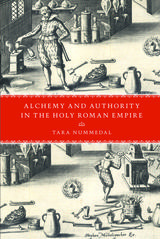
Drawing on criminal trial records, contracts, laboratory inventories, satires, and vernacular alchemical treatises, Alchemy and Authority in the Holy Roman Empire situates the everyday alchemists, largely invisible to modern scholars until now, at the center of the development of early modern science and commerce. Reconstructing the workaday world of entrepreneurial alchemists, Tara Nummedal shows how allegations of fraud shaped their practices and prospects. These debates not only reveal enormously diverse understandings of what the “real” alchemy was and who could practice it; they also connect a set of little-known practitioners to the largest questions about commerce, trust, and intellectual authority in early modern Europe.
Aldo Moro’s kidnapping and violent death in 1978 shocked Italy as no other event has during the entire history of the Republic. It had much the same effect in Italy as the assassination of President John F. Kennedy had in the United States, with both cases giving rise to endless conspiracy theories. The dominant Christian Democratic leader for twenty years, Moro had embodied the country’s peculiar religious politics, its values as well as its practices. He was perceived as the most exemplary representative of the Catholic political tradition in Italy. The Red Brigades who killed him thought that in striking Moro they would cause the collapse of the capitalist establishment and clear the way for a Marxist-Leninist revolution.
In his thorough account of the long and anguished quest for justice in the Moro murder case, Richard Drake provides a detailed portrait of the tragedy and its aftermath as complex symbols of a turbulent age in Italian history. Since Moro’s murder, documents from two parliamentary inquiries and four sets of trials explain the historical and political process and illuminate two enduring themes in Italian history. First, the records contain a wealth of examples bearing on the nation’s longstanding culture of ideological extremism and violence. Second, Moro’s story reveals much about the inner workings of democracy Italian style, including the roles of the United States and the Mafia. These insights are especially valuable today in understanding why the Italian establishment is in a state of collapse.
The Moro case also explores the worldwide problem of terrorism. In great detail, the case reveals the mentality, the tactics, and the strategy of the Red Brigades and related groups. Moro’s fate has a universal poignancy, with aspects of a classical Greek tragedy. Drake provides a full historical account of how the Italian people have come to terms with this tragedy.
Recounts Kojève’s key role in the pivotal exchange of ideas between Eastern and Western European intellectuals in the early twentieth century
This book shines critical new light on the story of Alexandre Kojève’s intellectual origins and his role in the emigration of Russian philosophy into the West in the early twentieth century. Trevor Wilson illustrates how Kojève, at once adversarial to the insular communities of émigré philosophy and yet dependent on their networks and ideas for professional success, navigated the specters of the Russian tradition in pursuit of an autonomous self-definition as a philosopher and intellectual.
Alexandre Kojève and the Specters of Russian Philosophy analyzes the philosopher’s complicated relationship to the interwar diaspora and the complex role played by the Russian tradition in his intellectual formation. Wilson examines Kojève’s early writings in the émigré press on Russian religious philosophy, Soviet politics, and Eurasianism and argues for their enduring relevance for understanding Kojève in his mature period. Crucially, he contextualizes Kojève’s famed seminars on Hegel and examines how Kojève’s thought became embedded in the politics of the Cold War. Based on newly transcribed and translated archival material, he highlights a previously unacknowledged, transnational exchange of ideas between Eastern and Western European intellectuals and shows how it played a pivotal role in twentieth-century intellectual history—and its legacy in the twenty-first.
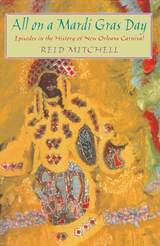
With this colorful study, Reid Mitchell takes us to Mardi Gras--to a yearly ritual that sweeps the richly multicultural city of New Orleans into a frenzy of parades, pageantry, dance, drunkenness, music, sexual display, and social and political bombast. In All on a Mardi Gras Day Mitchell tells us some of the most intriguing stories of Carnival since 1804. Woven into his narrative are observations of the meaning and messages of Mardi Gras--themes of unity, exclusion, and elitism course through these tales as they do through the Crescent City.
Moving through the decades, Mitchell describes the city's diverse cultures coming together to compete in Carnival performances. We observe powerful social clubs, or krewes, designing their elaborate parade displays and extravagant parties; Creoles and Americans in conflict over whose dances belong in the ballroom; enslaved Africans and African Americans preserving a sense of their heritage in processions and dances; white supremacists battling Reconstruction; working-class blacks creating the flamboyant Krewe of Zulu; the birth and reign of jazz; the gay community holding lavish balls; and of course tourists purchasing an authentic experience according to the dictates of our commercial culture. Interracial friction, nativism, Jim Crow separatism, the hippie movement--Mitchell illuminates the expression of these and other American themes in events ranging from the 1901 formation of the anti-prohibitionist Carrie Nation Club to the controversial 1991 ordinance desegregating Carnival parade krewes.
Through the conflicts, Mitchell asserts, "I see in Mardi Gras much what I hear in a really good jazz band: a model for the just society, the joyous community, the heavenly city...A model for community where individual expression is the basis for social harmony and where continuity is the basis for creativity." All on a Mardi Gras Day journeys into a world where hope persists for a rare balance between diversity and unity.
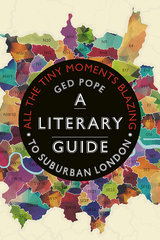
The London suburbs have, for more than two hundred and fifty years, fired the creative literary imagination: whether this is Samuel Johnson hiding away in bucolic preindustrial Streatham, Italo Svevo cheering on Charlton Athletic Football Club down at The Valley, or Angela Carter hymning the joyful “wrongness” of living south-of-the-river in Brixton. From Richmond to Rainham, Cockfosters to Croydon, this sweeping literary tour of the thirty-two London Boroughs describes how writers, from the seventeenth century on, have responded to and fictionally reimagined London’s suburbs. It introduces us to the great suburban novels, such as Hanif Kureishi’s Bromley-set The Buddha of Suburbia, Lawrence Durrell’s The Black Book, and Zadie Smith’s NW. It also reveals the lesser-known short stories, diaries, poems, local guides, travelogues, memoirs, and biographies, which together show how these communities have long been closely observed, keenly remembered, and brilliantly imagined.
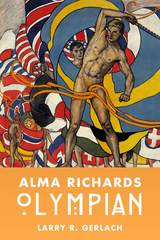
The book traces Richards from his boyhood in rural Parowan, Utah, to Cornell and through his service as an officer in World War I and his teaching career in Los Angeles. His story is that of a remarkable athlete, but also that of a man struggling for personal fulfillment while endeavoring to retain his Mormon heritage amid his changing religious circumstances and participation. More than a century has passed since Alma Richards won an Olympic gold medal, yet this story about man and sport—the drive to excel, victory as validation of hard work, the quest for public recognition and, ultimately, the achievement of self-identity and self-satisfaction—still resonates today.
In The Alpine Enlightenment, historian Kathleen Kete takes us into the world of the Genevan geologist, physicist, inventor, and mountaineer Horace-Bénédict de Saussure. During his prodigious climbs into the upper ranges of the Alps, Saussure focused intensely on the natural phenomena he encountered—glaciers, crevasses, changes in the weather, and shifts in the color of the sky—and he described what he saw, heard, and touched with great precision. Kete uses Saussure’s evocative writings, which emphasized above all physical engagement with the earth, to uncover not just how people during the Enlightenment thought about nature, but more importantly how they experienced it. As Kete shows, Saussure thought with and through his body; he harnessed his senses to understand the forces that shaped the world around him. In so doing, he offered a vision of nature as worthy of respect independent of human needs, anticipating present-day concerns about the environment and our shared place within it.
In Altarity, Taylor develops a genealogy of otherness and difference that is based on the principle of creative juxtaposition. Rather than relying on a historical or chronological survey of crucial moments in modern philosophical thinking, he explores the complex question of difference through the strategies of contrast, resonance, and design. Taylor brings together the work of thinkers as diverse as Hegel, Heidegger, Merleau-Ponty, Lacan, Bataille, Kristeva, Levinas, Blanchot, Derrida, and Kierkegaard to fashion a broad intellectual scheme.
Situated in an interdisciplinary discourse, Altarity signifies a harnessing of continental and American habits of intellectual thought and illustrates the singularity that emerges from such a configuration. As such, the book functions as a mirror of our intellectual moment and offers the academy a rigorous way of acknowledging the limitations of its own interpretive practices.
With an attitude at once respectful and interrogative, closely attentive to Levinas's texts while in dialogue with readings by Derrida, Blanchot, and Bataille, Altered Reading shows how the thread of the literary leads directly to the internal tensions of Levinas's ethical discourse. Jill Robbins provides a comprehensive critical account of Levinas's early and mature philosophy as well as later key transitional essays. In an invaluable appendix, she includes her own translation of an important, previously untranslated essay by Bataille on Levinas.
Altered Reading will interest philosophers, literary critics, scholars of religion, and others drawn to Levinas's work.
A Bollywood blockbuster when it was released in 1977, Amar Akbar Anthony has become a classic of Hindi cinema and a touchstone of Indian popular culture. Delighting audiences with its songs and madcap adventures, the film follows the heroics of three Bombay brothers separated in childhood from their parents and one another. Beyond the freewheeling comedy and camp, however, is a potent vision of social harmony, as the three protagonists, each raised in a different religion, discover they are true brothers in the end. William Elison, Christian Lee Novetzke, and Andy Rotman offer a sympathetic and layered interpretation of the film’s deeper symbolism, seeing it as a lens for understanding modern India’s experience with secular democracy.
Amar Akbar Anthony’s celebration of an India built on pluralism and religious tolerance continues to resonate with audiences today. But it also invites a critique of modernity’s mixed blessings. As the authors show, the film’s sunny exterior only partially conceals darker elements: the shadow of Partition, the crisis of Emergency Rule, and the vexed implications of the metaphor of the family for the nation. The lessons viewers draw from the film depend largely on which brother they recognize as its hero. Is it Amar, the straight-edge Hindu policeman? Is it Akbar, the romantic Muslim singer? Or is it Anthony, the Christian outlaw with a heart of gold? In this book’s innovative and multi-perspectival approach, each brother makes his case for himself (although the last word belongs to their mother).
In May 1941, Gertrude van Tijn arrived in Lisbon on a mission of mercy from German-occupied Amsterdam. She came with Nazi approval to the capital of neutral Portugal to negotiate the departure from Hitler’s Europe of thousands of German and Dutch Jews. Was this middle-aged Jewish woman, burdened with such a terrible responsibility, merely a pawn of the Nazis, or was her journey a genuine opportunity to save large numbers of Jews from the gas chambers? In such impossible circumstances, what is just action, and what is complicity?
A moving account of courage and of all-too-human failings in the face of extraordinary moral challenges, The Ambiguity of Virtue tells the story of Van Tijn’s work on behalf of her fellow Jews as the avenues that might save them were closed off. Between 1933 and 1940 Van Tijn helped organize Jewish emigration from Germany. After the Germans occupied Holland, she worked for the Nazi‐appointed Jewish Council in Amsterdam and enabled many Jews to escape. Some later called her a heroine for the choices she made; others denounced her as a collaborator.
Bernard Wasserstein’s haunting narrative draws readers into the twilight world of wartime Europe, to expose the wrenching dilemmas that confronted Jews under Nazi occupation. Gertrude van Tijn’s experience raises crucial questions about German policy toward the Jews, about the role of the Jewish Council, and about Dutch, American, and British responses to the persecution and mass murder of Jews on an unimaginable scale.
Alexander Karn analyzes more than a dozen Holocaust commissions—in Germany, Switzerland, France, Poland, Austria, Latvia, Lithuania, and elsewhere—in a comparative framework, situating each in the context of past and present politics, to evaluate their potential for promoting justice and their capacity for bringing the perspectives of rival groups more closely together. Karn also evaluates the media coverage these commissions received and probes their public reception from multiple angles.
Arguing that historical commissions have been underused as a tool for conflict management, Karn develops a program for historical mediation and moral reparation that can deepen democratic commitment and strengthen human rights in both transitional regimes and existing liberal states.
American Anti-Pastoral reads the events in Roth’s novel in relation to the history of Brookside and its region. While Roth’s protagonist Seymour “Swede” Levov initially views Old Rimrock as an idyllic paradise within the Garden State, its real-world counterpart has a more complex past in its origins as a small industrial village, as well as a site for the politics of exclusionary zoning and a 1960s anti-war protest at its celebrated 4th of July parade. Literary historian and Brookside native Thomas Gustafson casts Roth’s canonical novel in a fresh light as he studies both Old Rimrock in comparison to Brookside and the novel in relationship to NJ literature, making a case for it as the Great New Jersey novel. For Roth fans and history buffs alike, American Anti-Pastoral peels back the myths about the bucolic Garden State countryside to reveal deep fissures along the fault-lines of race and religion in American democracy.
This is the rollicking, never-before-published memoir of a fascinating woman with an uncanny knack for being in the right place in the most interesting times. Of racially mixed heritage, Anita Reynolds was proudly African American but often passed for Indian, Mexican, or Creole. Actress, dancer, model, literary critic, psychologist, but above all free-spirited provocateur, she was, as her Parisian friends nicknamed her, an “American cocktail.”
One of the first black stars of the silent era, she appeared in Hollywood movies with Rudolph Valentino, attended Charlie Chaplin’s anarchist meetings, and studied dance with Ruth St. Denis. She moved to New York in the 1920s and made a splash with both Harlem Renaissance elites and Greenwich Village bohemians. An émigré in Paris, she fell in with the Left Bank avant-garde, befriending Antonin Artaud, Man Ray, and Pablo Picasso. Next, she took up residence as a journalist in Barcelona during the Spanish Civil War and witnessed firsthand the growing menace of fascism. In 1940, as the Nazi panzers closed in on Paris, Reynolds spent the final days before the French capitulation as a Red Cross nurse, afterward making a mad dash for Lisbon to escape on the last ship departing Europe.
In prose that perfectly captures the globetrotting nonchalance of its author, American Cocktail presents a stimulating, unforgettable self-portrait of a truly extraordinary woman.

American Interests and Policies in the Middle East, 1900-1939 was first published in
1963. Minnesota Archive Editions uses digital technology to make long-unavailable books once again accessible, and are published unaltered from the original University of Minnesota Press editions.Scholars concerned with the diplomatic history of the United States have largely neglected the subject of American relations with the Middle East during the four decades before World War I. With this study, Professor DeNovo fills the gap by describing and assessing the United States' cultural, economic, and diplomatic relations with Turkey, Persia, and the Arab East in that period. He traces, chronologically and topically, the activities of such American interest groups as Protestant missionaries, educators, philanthropists, archaeologists, businessmen, and technical advisers, as well as the official actions of their government.
The account falls roughly into three chronological periods. The first section traces the interest groups through the pre-World War I years of political and cultural stirring in the Ottoman Empire and Persia. Special attention is given to the Chester Project for railroad development in Turkey. The second part deals with the upheavals accompanying World War I and the tasks of peacemaking from the Mudros armistice through the Lausanne settlement of 1923. The latter chapters detail the rise of the Turkish national movement, the deepening Persian and Arab nationalism, and the accommodation of American cultural and economic groups to these conditions. The author points out that before World War II began, Americans had acquired a significant interest in Middle Eastern oil and had become emotionally involved in the Arab-Zionist tension. In 1939 the United States was on the verge of a new phase in its Middle Eastern relations when that region would become more intimately linked to America's national security.
Charles Lumpkins shows that black residents of East St. Louis had engaged in formal politics since the 1870s, exerting influence through the ballot and through patronage in a city dominated by powerful real estate interests even as many African Americans elsewhere experienced setbacks in exercising their political and economic rights.
While Lumpkins asserts that the race riots were a pogrom—an organized massacre of a particular ethnic group—orchestrated by certain businessmen intent on preventing black residents from attaining political power and on turning the city into a “sundown” town permanently cleared of African Americans, he also demonstrates how the African American community survived. He situates the activities of the black citizens of East St. Louis in the context of the larger story of the African American quest for freedom, citizenship, and equality.
American Policy Toward Communist Eastern Europe was first published in 1965. Minnesota Archive Editions uses digital technology to make long-unavailable books once again accessible, and are published unaltered from the original University of Minnesota Press editions.
Perhaps no aspect of American foreign relations has been in greater need of clarification and understanding than our policy toward the Communist nations of Eastern Europe, both as to what has happened in the past and what is possible for the future. In this book a former State Department Official, now on the staff of the Council on Foreign Relations, provides objective information which will help students, professors, members of adult study groups, and others concerned with American foreign policy to understand and discuss this important subject.
Mr. Campbell reminds us that the cold war began in Eastern Europe in the aftermath of the second World War. Since that time, the question of what to do about Eastern Europe has been in the forefront of American foreign policy. For some years, he contends, we have been uncertain of our objectives and ambivalent in our policies. Meanwhile, changes since the death of Stalin have created new situations both for the Soviet Union and for the West.In analyzing what has happened, the author emphasizes the forces which have shaken the unity of the Soviet bloc to create new perspectives and possibilities. He discusses the effects of the Soviet- Chinese split, the relationship of the German question to that of Eastern Europe, and the phenomenon of national Communism as it has appeared in different forms in Yugoslavia, Poland, Rumania, and elsewhere.After presenting the historical background, the author discusses American aims and current policies and outlines the choices he sees ahead. He does not plead for any one of the alternative lines of action, presenting them, rather, as a basis for reasoned consideration and debate.
"[Gilmore] demonstrates the profound, sustained, engagement with society embodied in the works of Emerson, Hawthorne, Thoreau and Melville. In effect, he relocates the American Renaissance where it properly belongs, at the centre of a broad social, economic, and ideological movement from the Jacksonian era to the Civil War. Basically, Gilmore's argument concerns the writers' participation in what Thoreau called 'the curse of trade.' He details their mixed resistance to and complicity in the burgeoning literary marketplace and, by extension, the entire ' economic revolution' which between 1830 and 1860 'transformed the United States into a market society'. . . .
"The result is a model of literary-historical revisionism. Gilmore's opening chapters on Emerson and Thoreau show that 'transcendental' thought and language can come fully alive when understood within the material processes and ideological constraints of their time. . . . The remaining five chapters, on Hawthorne and Melville, contain some of the most penetrating recent commentaries on the aesthetic strategies of American Romantic fiction, presented within and through some of the most astute, thoughtful considerations I know of commodification and the 'democratic public' in mid-nineteenth-century America. . . . Practically and methodologically, American Romanticism and the Marketplace has a significant place in the movement towards a new American literary history. It places Gilmore at the forefront of a new generation of critics who are not just reinterpreting familiar texts or discovering new texts to interpret, but reshaping our ways of thinking about literature and culture."—Sacvan Bercovitch, Times Literary Supplement
"Gilmore writes with energy, clarity, and wit. The reader is enriched by this book." William H. Shurr, American Literature

For a man who liked being called the American, Mark Twain spent a surprising amount of time outside the continental United States. Biographer Roy Morris, Jr., focuses on the dozen years Twain spent overseas and on the popular travel books—The Innocents Abroad, A Tramp Abroad, and Following the Equator—he wrote about his adventures. Unintimidated by Old World sophistication and unafraid to travel to less developed parts of the globe, Twain encouraged American readers to follow him around the world at the dawn of mass tourism, when advances in transportation made leisure travel possible for an emerging middle class. In so doing, he helped lead Americans into the twentieth century and guided them toward more cosmopolitan views.
In his first book, The Innocents Abroad (1869), Twain introduced readers to the “American Vandal,” a brash, unapologetic visitor to foreign lands, unimpressed with the local ambiance but eager to appropriate any souvenir that could be carried off. He adopted this persona throughout his career, even after he grew into an international celebrity who dined with the German Kaiser, traded quips with the king of England, gossiped with the Austrian emperor, and negotiated with the president of Transvaal for the release of war prisoners. American Vandal presents an unfamiliar Twain: not the bred-in-the-bone Midwesterner we associate with Huck Finn and Tom Sawyer but a global citizen whose exposure to other peoples and places influenced his evolving positions on race, war, and imperialism, as both he and America emerged on the world stage.
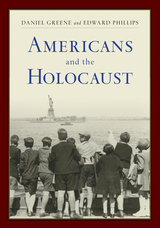
Americans and the Holocaust explores these enduring questions by gathering together more than one hundred primary sources that reveal how Americans debated their responsibility to respond to Nazism. Drawing on groundbreaking research conducted for the United States Holocaust Memorial Museum’s Americans and the Holocaust exhibition, these carefully chosen sources help readers understand how Americans’ responses to Nazism were shaped by the challenging circumstances in the United States during the 1920s, 1930s, and 1940s, including profound economic crisis, fear of communism, pervasive antisemitism and racism, and widespread isolationism.
Collecting newspaper and magazine articles, popular culture materials, and government records, Americans and the Holocaust is a valuable resource for students and historians seeking to shed light on this dark era in world history.
To explore further, visit the United States Holocaust Memorial Museum's digital exhibit, available here: https://exhibitions.ushmm.org/americans-and-the-holocaust
Published in association with the United States Holocaust Memorial Museum.
The Cold War dominated world affairs during the half century following World War II. It ended in victory for the United States, yet it was a costly triumph, claiming trillions of dollars in defense spending and the lives of nearly 100,000 U.S. soldiers. Apocalyptic anti-communism sharply limited the range of acceptable political debate, while American actions overseas led to the death of millions of innocent civilians and destabilized dozens of nations that posed no threat to the United States.
In a brilliant new interpretation, Campbell Craig and Fredrik Logevall reexamine the successes and failures of America’s Cold War. The United States dealt effectively with the threats of Soviet predominance in Europe and of nuclear war in the early years of the conflict. But in engineering this policy, American leaders successfully paved the way for domestic actors and institutions with a vested interest in the struggle’s continuation. Long after the U.S.S.R. had been effectively contained, Washington continued to wage a virulent Cold War that entailed a massive arms buildup, wars in Korea and Vietnam, the support of repressive regimes and counterinsurgencies, and a pronounced militarization of American political culture.
American foreign policy after 1945 was never simply a response to communist power or a crusade contrived solely by domestic interests. It was always an amalgamation of both. This provocative book lays bare the emergence of a political tradition in Washington that feeds on external dangers, real or imagined, a mindset that inflames U.S. foreign policy to this day.
“A creative, carefully researched, and incisive analysis of U.S. strategy during the long struggle against the Soviet Union.”
—Stephen M. Walt, Foreign Policy
“Craig and Logevall remind us that American foreign policy is decided as much by domestic pressures as external threats. America’s Cold War is history at its provocative best.”
—Mark Atwood Lawrence, author of The Vietnam War
The Cold War dominated world affairs during the half century following World War II. America prevailed, but only after fifty years of grim international struggle, costly wars in Korea and Vietnam, trillions of dollars in military spending, and decades of nuclear showdowns. Was all of that necessary?
In this new edition of their landmark history, Campbell Craig and Fredrik Logevall engage with recent scholarship on the late Cold War, including the Reagan and Bush administrations and the collapse of the Soviet regime, and expand their discussion of the nuclear revolution and origins of the Vietnam War. Yet they maintain their original argument: that America’s response to a very real Soviet threat gave rise to a military and political system in Washington that is addicted to insecurity and the endless pursuit of enemies to destroy. America’s Cold War speaks vividly to debates about forever wars and threat inflation at the center of American politics today.
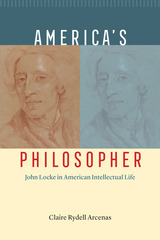
The influence of polymath philosopher John Locke (1632–1704) can still be found in a dizzying range of fields, as his writings touch on issues of identity, republicanism, and the nature of knowledge itself. Claire Rydell Arcenas’s new book tells the story of Americans’ longstanding yet ever-mutable obsession with this English thinker’s ideas, a saga whose most recent manifestations have found the so-called Father of Liberalism held up as a right-wing icon.
The first book to detail Locke’s trans-Atlantic influence from the eighteenth century until today, America’s Philosopher shows how and why interpretations of his ideas have captivated Americans in ways few other philosophers—from any nation—ever have. As Arcenas makes clear, each generation has essentially remade Locke in its own image, taking inspiration and transmuting his ideas to suit the needs of the particular historical moment. Drawing from a host of vernacular sources to illuminate Locke’s often contradictory impact on American daily and intellectual life from before the Revolutionary War to the present, Arcenas delivers a pathbreaking work in the history of ideas.
This is an auto-narrated audiobook edition of this book.
America’s Philosopher examines how John Locke has been interpreted, reinterpreted, and misinterpreted over three centuries of American history.
The influence of polymath philosopher John Locke (1632–1704) can still be found in a dizzying range of fields, as his writings touch on issues of identity, republicanism, and the nature of knowledge itself. Claire Rydell Arcenas’s new book tells the story of Americans’ longstanding yet ever-mutable obsession with this English thinker’s ideas, a saga whose most recent manifestations have found the so-called Father of Liberalism held up as a right-wing icon.
The first book to detail Locke’s trans-Atlantic influence from the eighteenth century until today, America’s Philosopher shows how and why interpretations of his ideas have captivated Americans in ways few other philosophers—from any nation—ever have. As Arcenas makes clear, each generation has essentially remade Locke in its own image, taking inspiration and transmuting his ideas to suit the needs of the particular historical moment. Drawing from a host of vernacular sources to illuminate Locke’s often contradictory impact on American daily and intellectual life from before the Revolutionary War to the present, Arcenas delivers a pathbreaking work in the history of ideas.
American philosophers like Peirce, James, Royce, and
Dewey have forged a unique philosophical tradition—one
that is rich and complex enough to represent a genuine
alternative to the analytic, phenomenological, and
hermeneutical traditions which have originated in Britain
or Europe.
"In my judgment, John Smith has no equal today in
combining two scholarly qualities: the analysis of
philosophical texts with penetration and rigor, and the
discernment of what it is in these texts that matters.
These qualities are in evidence throughout the essays in
America's Philosophical Vision. Whether he is
evaluating Rorty's view of Dewey; the pragmatic theory of
experience and truth; theories of freedom, creativity,
and the self; Royce's conception of community; or
synoptic philosophic visions, Smith always succeeds in
uniting a comprehensive understanding of philosophic
writings with a sure grasp of their import for human
culture and aspiration. It is a great benefit to
students of American thought that these papers have now
been collected into one volume."—James Gouinlock, Emory
University
Rescuing the premodern family from the grim picture many historians have given us of life in early Europe, Ancestors offers a major reassessment of a crucial aspect of European history—and tells a story of age-old domesticity inextricably linked, and surprisingly similar, to our own.
An elegant summa on family life in Europe past, this compact and powerful book extends and completes a project begun with Steven Ozment’s When Fathers Ruled: Family Life in Reformation Europe. Here Ozment, the leading historian of the family in the middle centuries, replaces the often miserable depiction of premodern family relations with a delicately nuanced portrait of a vibrant and loving social group. Mining the records of families’ private lives—from diaries and letters to fiction and woodcuts—Ozment shows us a preindustrial family not very different from the later family of high industry that is generally viewed as the precursor to the sentimental nuclear family of today.
In Ancestors, we see the familiar pattern of a domestic wife and working father in a home in which spousal and parental love were amply present: parents cherished their children, wives were helpmeets in providing for the family, and the genders were nearly equal. Contrary to the abstractions of history, parents then—as now—were sensitive to the emotional and psychological needs of their children, treated them with affection, and gave them a secure early life and caring preparation for adulthood.
As it recasts familial history, Ancestors resonates beyond its time, revealing how much the story of the premodern family has to say to a modern society that finds itself in the throes of a family crisis.

1995 paperback, Saga Publishers / Folio Private
To lend weight to his charge that the public school teacher has been betrayed and gravity to his indictment of the educational establishment for that betrayal, Jurgen Herbst goes back to the beginnings of teacher education in America in the 1830s and traces its evolution up to the 1920s, by which time the essential damage had been done.
Initially, attempts were made to upgrade public school teaching to a genuine profession, but that ideal was gradually abandoned. In its stead, with the advent of newly emerging graduate schools of education in the early decades of the twentieth century, came the so-called professionalization of public education. At the expense of the training of elementary school teachers (mostly women), teacher educators shifted their attention to the turning out of educational "specialists" (mostly men)—administrators, faculty members at normal schools and teachers colleges, adult education teachers, and educational researchers.
Ultimately a history of the neglect of the American public school teacher, And Sadly Teach ends with a plea and a message that ring loud and clear. The plea: that the current reform proposals for American teacher education—the Carnegie and the Holmes reports—be heeded. The message: that the key to successful school reform lies in educating teacher’s true professionals and in acknowledging them as such in their classrooms.

And the World Stood Silent gathers the Sephardim's French, Greek, Italian, and Judeo-Spanish poems, accompanied by English translations, about their long journey to the concentration and extermination camps. Isaac Jack Lévy also surveys the 2,000-year history of the Sephardim and discusses their poetry in relation to major religious, historical, and philosophical questions.
Wrenchingly conveying the pathos and suffering of the Jewish community during World War II, And the World Stood Silent is invaluable as a historical account and as a documentary source.
The book provides a connection to seldom discussed aspects of the Holocaust: the gulf between rich and poor Jews and how this translated into everyday survival; the refusal by Alex to see himself or Jews in general as heroes or victims; his own self-absorption as a teen in the ghetto; and his "priviliged" family's near-indifference to the suffering of those around them. Alex paints a picture of complex and diverse Jewish society in prewar Poland, revealing how, many years later and despite his determine to leave it in the past, the burdens of memory--and the dreams--linger.
Music was at once one of the most idealized and one of the most contested art forms of the Victorian period. Yet this vitally important nineteenth-century cultural form has been studied by literary critics mainly as a system of thematic motifs. Angelic Airs, Subversive Songs positions music as a charged site of cultural struggle, promoted concurrently as a transcendent corrective to social ills and as a subversive cause of those ills. Alisa Clapp-Itnyre examines Victorian constructions of music to advance patriotism, Christianity, culture, and domestic harmony, and suggests that often these goals were undermined by political tensions in song texts or “immoral sensuality” in the “spectacle” of live music-making.
Professor Clapp-Itnyre turns her focus to the novels of Elizabeth Gaskell, George Eliot, and Thomas Hardy, who present complex engagements with those musical genres most privileged by Victorian society: folk songs, religious hymns, and concert music.
Angelic Airs, Subversive Songs recovers the pervasive ambiguities of the Victorian musical period, ambiguities typically overlooked by both literary scholars and musicologists. To the literary critic and cultural historian, Professor Clapp-Itnyre demonstrates the necessity of further exploring the complete aesthetic climate behind some of the Victorian period’s most powerful literary works. And to the feminist scholar and the musicologist, Clapp-Itnyre reveals the complexities of music as both an oppressive cultural force and an expressive, creative outlet for women.
Anglophone Poetry in Colonial India, 1780–1913: A Critical Anthology makes accessible for the first time the entire range of poems written in English on the subcontinent from their beginnings in 1780 to the watershed moment in 1913 when Rabindranath Tagore won the Nobel Prize in Literature.Mary Ellis Gibson establishes accurate texts for such well-known poets as Toru Dutt and the early nineteenth-century poet Kasiprasad Ghosh. The anthology brings together poets who were in fact colleagues, competitors, and influences on each other. The historical scope of the anthology, beginning with the famous Orientalist Sir William Jones and the anonymous “Anna Maria” and ending with Indian poets publishing in fin-de-siècle London, will enable teachers and students to understand what brought Kipling early fame and why at the same time Tagore’s Gitanjali became a global phenomenon. Anglophone Poetry in Colonial India, 1780–1913 puts all parties to the poetic conversation back together and makes their work accessible to American audiences.With accurate and reliable texts, detailed notes on vocabulary, historical and cultural references, and biographical introductions to more than thirty poets, this collection significantly reshapes the understanding of English language literary culture in India. It allows scholars to experience the diversity of poetic forms created in this period and to understand the complex religious, cultural, political, and gendered divides that shaped them.
Before the idea of the Anthropocene, there was the angry planet
How might we understand an earthquake as a complaint, or erosion as a form of protest—in short, the Earth as an angry planet? Many novels from the end of the millennium did just that, centering around an Earth that acts, moves, shapes human affairs, and creates dramatic, nonanthropogenic change.
In Angry Planet, Anne Stewart uses this literature to develop a theoretical framework for reading with and through planetary motion. Typified by authors like Colson Whitehead, Octavia Butler, and Leslie Marmon Silko, whose work anticipates contemporary critical concepts of entanglement, withdrawal, delinking, and resurgence, angry planet fiction coalesced in the 1990s and delineated the contours of a decolonial ontology. Stewart shows how this fiction brought Black and Indigenous thought into conversation, offering a fresh account of globalization in the 1990s from the perspective of the American Third World, construing it as the era that first made connections among environmental crises and antiracist and decolonial struggles.
By synthesizing these major intersections of thought production in the final decades of the twentieth century, Stewart offers a recent history of dissent to the young movements of the twenty-first century. As she reveals, this knowledge is crucial to incipient struggles of our contemporary era, as our political imaginaries grapple with the major challenges of white nationalism and climate change denial.
When we think about the Victorian age, we usually envision people together with animals: the Queen and her pugs, the sportsman with horses and hounds, the big game hunter with his wild kill, the gentleman farmer with a prize bull. Harriet Ritvo here gives us a vivid picture of how animals figured in English thinking during the nineteenth century and, by extension, how they served as metaphors for human psychological needs and sociopolitical aspirations.
Victorian England was a period of burgeoning scientific cattle breeding and newly fashionable dog shows; an age of Empire and big game hunting; an era of reform and reformers that saw the birth of the Royal SPCA. Ritvo examines Victorian thinking about animals in the context of other lines of thought: evolution, class structure, popular science and natural history, imperial domination. The papers and publications of people and organizations concerned with agricultural breeding, veterinary medicine, the world of pets, vivisection and other humane causes, zoos, hunting at home and abroad, all reveal underlying assumptions and deeply held convictions—for example, about Britain’s imperial enterprise, social discipline, and the hierarchy of orders, in nature and in human society.
Thus this book contributes a new new topic of inquiry to Victorian studies; its combination of rhetorical analysis with more conventional methods of historical research offers a novel perspective on Victorian culture. And because nineteenth-century attitudes and practices were often the ancestors of contemporary ones, this perspective can also inform modern debates about human–animal interactions.
Finalist for the 2020 Organization of American Historians Mary Nickliss Prize
Pioneering Chinese American actress Anna May Wong made more than sixty films, headlined theater and vaudeville productions, and even starred in her own television show. Her work helped shape racial modernity as she embodied the dominant image of Chinese and, more generally, “Oriental” women between 1925 and 1940.
In Anna May Wong, Shirley Jennifer Lim re-evaluates Wong’s life and work as a consummate artist by mining an historical archive of her efforts outside of Hollywood cinema. From her pan-European films and her self-made My China Film to her encounters with artists such as Josephine Baker, Carl Van Vechten, and Walter Benjamin, Lim scrutinizes Wong’s cultural production and self-fashioning. Byconsidering the salient moments of Wong’s career and cultural output, Lim’s analysis explores the deeper meanings, and positions the actress as an historical and cultural entrepreneur who rewrote categories of representation.
Anna May Wong provides a new understanding of the actress’s career as an ingenious creative artist.
In 1654, Anna Trapnel — a Baptist, Fifth Monarchist, millenarian, and visionary from London — fell into a trance during which she prophesied passionately and at length against Oliver Cromwell and his government. The prophecies attracted widespread public attention, and resulted in an invitation to travel to Cornwall. Her Report and Plea, republished here for the first time, is a lively and engaging firsthand account of the visit, which concluded in her arrest, a court hearing, and imprisonment. Part memoir, part travelogue, and part impassioned defense of her beliefs and actions, the Report and Plea offers vivid and fascinating insight into the life and times of an early modern woman claiming her place at the center of the tumultuous political events of mid-seventeenth-century England.
A groundbreaking volume introduces the unique feminist thought of the longstanding Italian group known as Diotima
Introducing Anglophone readers to a potent strain of Italian feminism known to French, Spanish, and German audiences but as yet unavailable in English, Another Mother argues that the question of the mother is essential to comprehend the matrix of contemporary culture and society and to pursue feminist political projects.
Focusing on Diotima, a community of women philosophers deeply involved in feminist politics since the 1960s, this volume provides a multifaceted panorama of its engagement with currents of thought including structuralism, psychoanalysis, linguistics, and Marxism. Starting from the simple insight that the mother is the one who gives us both life and language, these thinkers develop concepts of the mother and sexual difference in contemporary society that differ in crucial ways from both French and U.S. feminisms.
Arguing that Diotima anticipates many of the themes in contemporary philosophical discourses of biopolitics—exemplified by thinkers such as Giorgio Agamben, Antonio Negri, and Roberto Esposito—Another Mother opens an important space for reflections on the past history of feminism and on feminism’s future.
Contributors: Anne Emmanuelle Berger, Paris 8 U–Vincennes Saint-Denis; Ida Dominijanni; Luisa Muraro; Diana Sartori, U of Verona; Chiara Zamboni, U of Verona.
Anthropology Confronts the Problems of the Modern World is the first English translation of a series of lectures Claude Lévi-Strauss delivered in Tokyo in 1986. Written with an eye toward the future as his own distinguished career was drawing to a close, this volume presents a synthesis of the author’s major ideas about structural anthropology, a field he helped establish. Critiquing insights of his earlier writings on the relationship between race, history, and civilization, Lévi-Strauss revisits the social issues that never ceased to fascinate him.
He begins with the observation that the cultural supremacy enjoyed by the West for over two centuries is at an end. Global wars and genocides in the twentieth century have fatally undermined Western faith in humanity’s improvement through scientific progress. Anthropology, however, can be the vehicle of a new “democratic humanism,” broadening traditional frameworks that have restricted cross-cultural understandings of the human condition, and providing a basis for inquiries into what other civilizations, such as those of Asia, can teach.
Surveying a world on the brink of the twenty-first century, Lévi-Strauss assesses some of the dilemmas of cultural and moral relativism a globalized society faces—ethical dimensions of economic inequality, the rise of different forms of religious fundamentalism, the promise and peril of genetic and reproductive engineering. A laboratory of thought opening onto the future, Anthropology Confronts the Problems of the Modern World is an important addition to the canon of one of the twentieth-century’s most influential theorists.
This study analyzes New Theses (Shinron), by Aizawa Seishisai (1781—1863), and its contribution to Japanese political thought and policy during the early–modern era. New Theses is found to be indispensable to our understanding of Japan's transformation from a feudal to a modern state.
Focusing on Aizawa, Wakabayashi traces the development of xenophobia during the Tokugawa period and examines the basis of anti–Western sentiment. He shows how knowledge of Christianity inspired Aizawa to develop thepotent concept of kokutai (“what is essential to a nation”). His analysis explains why the Edobakufu's policies of national isolation (sakoku) and armed expulsion of Westerners (jõi) gained widespread support in the late Tokugawa. Wakabayashi also describes how information on Western affairs and world conditions decisively altered Tokugawa Confucian conceptions of civilization and barbarism, and how this in turn enabled the Japanese to redefine their nation's relationship to China and the West.
Rather than place Aizawa and his New Theses of 1825 at the beginning of a process leading up to the Meiji Restoration, Wakabayashi discusses New Theses in conjunction with the bakufu's Expulsion Edict issued in the same year. He concludes that the convergence of the two events in 1825 marks the emergence of modern nationalism in Japan, and therefore should perhaps be seen as more epoch–making than the 1868 Restoration itself.
The study also presents a complete translation of New Theses.
Published by Bucknell University Press. Distributed worldwide by Rutgers University Press.
By placing Brazilian and Argentine anti-literature at the crux of a new way of thinking about the field, Shellhorse challenges prevailing discussions about the historical projection and critical force of Latin American literature. Examining a diverse array of texts and media that include the visual arts, concrete poetry, film scripts, pop culture, neo-baroque narrative, and others that defy genre, Shellhorse delineates the subversive potential of anti-literary modes of writing while also engaging current debates in Latin American studies on subalternity, feminine writing, posthegemony, concretism, affect, marranismo, and the politics of aesthetics.

The Other Voice in Early Modern Women: The Toronto Series volume 70
The book begins with a revised and updated version of David Engel’s seminal essay “Away from a Definition of Antisemitism.” Subsequent contributions by renowned specialists in ancient, medieval, and modern history, religious studies, and other fields explore the various and changing definitions and uses of the term “antisemitism” in a range of contexts, including ancient Rome and Greece, the Byzantine Empire, medieval Europe, early modern and modern Europe, North America, and the United Kingdom. The volume also includes a section that focuses on the Second World War, including the Holocaust and its memory. Engel offers a contemporary response to conclude the book.
First published in Hebrew in 2020 as a special issue of the journal Zion: A Quarterly for Research in Jewish History in cooperation with the Zalman Shazar Center in Jerusalem, this compelling collection has already had an impact on the study of antisemitism in Israel. It is certain to become a critical resource for scholars, policymakers, and journalists researching antisemitism, Holocaust studies, and related fields.
Alexander Kluge’s work has long grappled with the Third Reich and its aftermath, and the extermination of the Jews forms its gravitational center. Kluge is forever reminding us to keep our present catastrophes in perspective—“calibrated”—against this historical monstrosity. Kluge’s newest work is a book about bitter fates, both already known and yet to unfold. Above all, it is about the many kinds of organized machinery built to destroy people. These forty-eight stories of justice and injustice are dedicated to the memory of Fritz Bauer, a determined fighter for justice and district attorney of Hesse during the Auschwitz Trials. “The moment they come into existence, monstrous crimes have a unique ability,” Bauer once said, “to ensure their own repetition.” Kluge takes heed, and in these pages reminds us of the importance of keeping our powers of observation and memory razor sharp.
In his first book to be translated into English, Vioulac radicalizes Heidegger’s understanding of truth as disclosure through the notion of truth as apocalypse. This “apocalypse of truth” works as an unveiling that reveals both the finitude and mystery of truth, allowing a full confrontation with truth-as-absence. Engaging with Heidegger, Marx, and St. Paul, as well as contemporary figures including Giorgio Agamben, Alain Badiou, and Slavoj Žižek, Vioulac’s book presents a subtle, masterful exposition of his analysis before culminating in a powerful vision of “the abyss of the deity.” Here, Vioulac articulates a portrait of Christianity as a religion of mourning, waiting for a god who has already passed by, a form of ever-present eschatology whose end has always already taken place. With a preface by Jean-Luc Marion, Apocalypse of Truth presents a major contemporary French thinker to English-speaking audiences for the first time.
READERS
Browse our collection.
PUBLISHERS
See BiblioVault's publisher services.
STUDENT SERVICES
Files for college accessibility offices.
RECENTLY PUBLISHED




UChicago Accessibility Resources
home | accessibility | search | about | contact us
BiblioVault ® 2001 - 2024
The University of Chicago Press