
 A SCHOLARLY BOOK REPOSITORY
Browse by Title
3 books by Braxton, Joanne
3 books by Braxton, Joanne
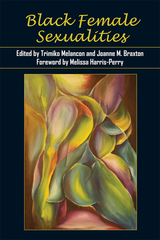
Black Female Sexualities
Melancon, Trimiko
Rutgers University Press, 2015
Western culture has long regarded black female sexuality with a strange mix of fascination and condemnation, associating it with everything from desirability, hypersexuality, and liberation to vulgarity, recklessness, and disease. Yet even as their bodies and sexualities have been the subject of countless public discourses, black women’s voices have been largely marginalized in these discussions. In this groundbreaking collection, feminist scholars from across the academy come together to correct this omission—illuminating black female sexual desires marked by agency and empowerment, as well as pleasure and pain, to reveal the ways black women regulate their sexual lives.
The twelve original essays in Black Female Sexualities reveal the diverse ways black women perceive, experience, and represent sexuality. The contributors highlight the range of tactics that black women use to express their sexual desires and identities. Yet they do not shy away from exploring the complex ways in which black women negotiate the more traumatic aspects of sexuality and grapple with the legacy of negative stereotypes.
Black Female Sexualities takes not only an interdisciplinary approach—drawing from critical race theory, sociology, and performance studies—but also an intergenerational one, in conversation with the foremothers of black feminist studies. In addition, it explores a diverse archive of representations, covering everything from blues to hip-hop, from Crash to Precious, from Sister Souljah to Edwidge Danticat. Revealing that black female sexuality is anything but a black-and-white issue, this collection demonstrates how to appreciate a whole spectrum of subjectivities, experiences, and desires.
[more]
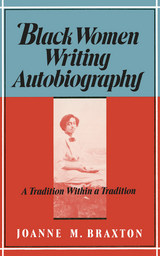
Black Women Writing Autobiography
A Tradition Within a Tradition
Joanne Braxton
Temple University Press, 1990
"In this illuminating study Joanne Braxton shows the continuity and tradition in the writing of Afra-American women. An important work for teachers and students of Literature, History, and Women's Studies."
--Gerda Lerner
"As black American women, we are born into a mystic sisterhood, and we live our lives within a magic circle, a realm of shared language, reference, and allusion within the veil of our blackness and our femaleness. We have been as invisible to the dominant culture as rain; we have been knowers, but we have not been known."
Joanne Braxton argues for a redefinition of the genre of black American autobiography to include the images of women as well as their memoirs, reminiscences, diaries, and journals--as a corrective to both black and feminist literary criticism. Beginning with slave narratives and concluding with modern autobiography, she deals with individual works as representing stages in a continuum and situates these works in the context of other writings by both black and white writers.
Braxton demonstrates that the criteria used to define the slave narrative genre are inadequate for analyzing Harriet "Linda Brent" Jacobs's pseudonymously published Incidents in the Life of a Slave Girl: Written by Herself (1861). She examines "sass" as a mode of women's discourse and a weapon of self-defense, and she introduces the "outraged mother" as a parallel to the articulate hero archetype. Not even emancipation authorized black women to define themselves or address an audience. Late-nineteenth-century accounts in the form of confessional spiritual autobiographies, travelogue/adventure stories, and slave memoirs enabled such women as Jarena Lee, Rebecca Cox Jackson, Elizabeth Keckley, Susie King Taylor, as well as Harriet Tubman and Sojourner Truth to tell their own extraordinary stories and to shed light on the thousands of lives obscured by illiteracy and sexual and racial oppression. In her diaries, Charlotte Forten Grimké, the gifted poet, epitomizes the problems faced by a well-educated, extremely articulate black woman attempting to find a public voice in America.
Moving into the twentieth century, Braxton analyzes the memoir of Ida B. Wells, journalist and anti-lynching activist, and the work of Zora Neale Hurston and Era Bell Thompson. They represent the first generation of black female autobiographers who did not continually come into contact with former slaves and who transcended the essential struggle for survival that occupied earlier writings. For the contemporary black woman autobiographer, the quest for personal fulfillment is the central theme. Braxton concludes with Maya Angelou's I Know Why the Caged Bird Sings (1996), which represents the black woman of the 1960s who has found the place to recreate the self in her own image--the place all the others had been searching for.
"Braxton's book is scrupulously researched. She has been creative in finding resources and courageous in analyzing and interpreting her finds. This is the word of a diligent mind. The material is mountainous, yet the book sings. Braxton is a poet. Thank goodness."
--Maya Angelou
"Joanne Braxton's essays on black women's autobiographies delineate and illuminate the personal and historical dimension of an important literary tradition. Emphasizing the distinct character of Afra-American women's experience and relations with each other, she ground their writing of their lives in the struggles and triumphs of the lives they actually led."
--Elizabeth Fox-Genovese
"In this compelling and lucid study examining the content, context, and continuum of black women autobiographers, Braxton clears the place for it in the curriculum: at the center of black and feminist studies."
--Paula Giddings
"This is the fullest and most sympathetic study of black American autobiographers I know. By paying close attention to private and public history, to social networks and literary kinships, to narrative structures and patterns of imagery, Braxton leads her readers to see the black woman 'at the center of her own [written] experiences.' At once scholarly and passionate, Braxton's critique will immediately secure her a place among the leading analysts of black American autobiography."
--Albert E. Stone
"A highly readable and original contribution to the important fields of Afro-American studies, feminist criticism, and autobiographical narrative."
--Elaine Showalter
"Rich in empathy and insight, Joanne M. Braxton's trailblazing study attends to both the textual and historical dimensions of a powerful literary inheritance. She brings to bear a keen sense of the departures and continuities of which any tradition consists; and an appreciation of the distinctive Afro-American dynamic between literary convention and a vernacular substrate. Braxton doesn't just read--she listens."
--Henry Louis Gates, Jr.
"Joanne Braxton makes a unique contribution to the scholarship of American autobiography. Her focus on the outraged mother as a figure of rebellion is a significant challenge to our conventional understanding of autobiographical acts."
--Hazel Carby
"This is the most inclusive and thoughtful literary history of black American women's autobiography in existence…It is not just a collection of essays; it is well knit together and displays multiple traditions as they evolved and are in the process of evolving still."
--William L. Andrews
"This book marks another milestone in the critical appraisal of American autobiographical writings. In tracing the evolution of a tradition of black women in autobiography in America, Braxton takes us on the first journey of this kind: the black American woman's search for a dignified, self-defining identity through the rejection of traditional female roles. This book sets the tone for future studies of black women's autobiographies."
--Nellie McKay
[more]
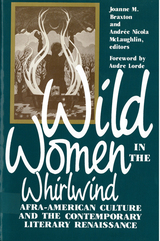
Wild Women in the Whirlwind
Afra-American Culture and the Contemporary Literary Renaissance
Edited by Joanne M. Braxton and Andree Nicola McLaughlin
Rutgers University Press, 1989
"Pays an impressive tribute to the new renaissance in African-American literature."
--New York Times Book Review
"The cultural and literary achievements of black American women are examined and celebrated in some 20 enjoyable, erudite essays by prominent scholars, critics, and activists."
--Publishers Weekly
This book is the first comprehensive collection of critical and theoretical essays to explore the literary and multi-cultural traditions of Black American women in many genres over a broad span of time. The essays explore cultural and literary experience in a wide context and offer a variety of critical theoretical constructs in which to view that experience. The editors have written excellent introductions providing both historical and comparative discussions of the contemporary literary renaissance. The book also includes a valuable bibliography of selected English-language works by Black women in the Americas from the 1970s to the present.
--New York Times Book Review
"The cultural and literary achievements of black American women are examined and celebrated in some 20 enjoyable, erudite essays by prominent scholars, critics, and activists."
--Publishers Weekly
This book is the first comprehensive collection of critical and theoretical essays to explore the literary and multi-cultural traditions of Black American women in many genres over a broad span of time. The essays explore cultural and literary experience in a wide context and offer a variety of critical theoretical constructs in which to view that experience. The editors have written excellent introductions providing both historical and comparative discussions of the contemporary literary renaissance. The book also includes a valuable bibliography of selected English-language works by Black women in the Americas from the 1970s to the present.
[more]
READERS
Browse our collection.
PUBLISHERS
See BiblioVault's publisher services.
STUDENT SERVICES
Files for college accessibility offices.
RECENTLY PUBLISHED




UChicago Accessibility Resources
home | accessibility | search | about | contact us
BiblioVault ® 2001 - 2026
The University of Chicago Press