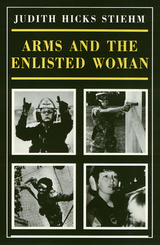
front cover of Arms And The Enlisted Woman
Arms And The Enlisted Woman
Judith Hicks Stiehm
Temple University Press, 1989
"This book is about America’s most unknown soldiers-enlisted women in the Army, Air Force, Navy, and Marines." Focusing on the decade from 1972 to 1982, Judith Stiehm uses personal narratives, interviews, policy statements, and other material to explore the experience of American women in the military—their reasons for enlisting, their roles, their self-image, and the way they are viewed by civilians. Although there are now more than 200,000 women in uniform, Stiehm asks why the policies concerning enlisted women "so often appear to fly in the face of both logic and evidence." Her analysis of the effects of change in military policy on women of different ranks and ages reveals how certain functional myths (e.g., "war is manly") are challenged by the presence of women. The result has been an uneasy accommodation. Arms and the Enlisted Woman includes a vivid first-person account by a female veteran of one woman’s experience in the Air Force. Honorably discharged as a Staff Sergeant after six years of working as an airplane mechanic, this woman describes the struggle to be taken seriously and treated equally, and to excel in a non-traditional field. She also relates the joys of seeing a job well done and being part of a cohesive team. Her mixed reaction to her military career epitomizes the difficulty with which enlisted women have been assimilated. Stiehm also analyzes the rapidly shifting military policies concerning women as well as the reasons for certain erroneous but persistent beliefs about them, and remarks, "One thing seems to be certain. To the professional military the enlisted woman is a raw nerve."
[more]

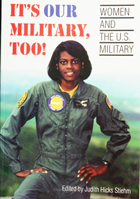
front cover of It's Our Military Too
It's Our Military Too
Women and the U.S Military
edited by Judith Hicks Stiehm
Temple University Press, 1996

In the last twenty-five years the U.S. military has seen the abolition of women's separate corps, the appointment of women generals, and an unprecedented increase in the ratio of women to men. Also, women are now permitted to serve on combat planes and ships. Despite these developments, most civilians know very little about women in the military.

This collection includes unusual accounts by women on active duty, retired officers, women who have worked for the armed forces in a civilian capacity, and civilian academics. The book offers insights on a variety of pressing issues including minority women, lesbians, combat, the role of gender in weapons design, and the changing mission of the military.

Through personal accounts and commentaries, this book dispels many of the myths about women and the military and explores the reasons for the persistence of misconceptions in the face of increased female participation. This comprehensive effort will be of interest to anyone who wants to know the truth about women in the armed forces and will be a wake-up call to women who feel that the military is irrelevant to them.


Contributors: Rhonda Cornum, Virginia Solms, Billie Mitchell, Connie L. Reeves, Brenda L. Moore, Nina Richman-Loo, Rachel Weber, Lucinda Joy Peach, M. C. Devilbiss, Carol Burke, Susan Jeffords, Miriam Cooke.
[more]

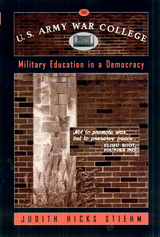
front cover of U.S. Army War College
U.S. Army War College
Military Education In A Democracy
Judith Hicks Stiehm
Temple University Press, 2002
We are all familiar with ROTC, West Point, and other institutions that train young men and women to be military officers. But few people know of the U.S. Army War College, where the Army's elite career officers go for advanced training in strategy, national security policy, and military-government policymaking. This book takes readers inside the U.S. Army War College to learn about the faculty, staff, administration, and curriculum.Established in 1901, the school's mission has evolved from teaching the skills of war to training officers to negotiate both the complex world of modern strategy and the civilian bureaucracy in Washington. More like a professional graduate program than an academic graduate school, much of the education takes the form of exercises and simulations.Judith Stiehm, who holds the U.S. Army Distinguished Civilian Service Medal, allows readers to judge whether the U.S. Army War College successfully prepares its students for their many roles. She is skeptical that instructors can fulfill this difficult task in an era where civilians expect our military to be invincible, to win without casualties, and to serve as peacekeepers.The Military answers to the people of the United States and it is our responsibility to know how it operates at all levels. This book is a good place to start.
[more]


Send via email Share on Facebook Share on Twitter