
 A SCHOLARLY BOOK REPOSITORY
Dean of the Harvard Medical School and School of Public Health in the 1920's and '30's,David Edsall was one of the leaders in a period of great change and progress in medicine. At the beginning of Edsall's career, a doctor's chief weapons were his informed mind and trained senses. By the end of it, the permanent alliance of the sciences and medicine had profoundly altered the doctor's practice and his education. It was a time of struggle, of conflict, and of enduring accomplishment.
Edsall was at the center of this revolutionary effort in three leading schools of medicine: the University of Pennsylvania, Washington University in St. Louis, and Harvard. He began his career in Pennsylvania as recording clerk to the famous Dr. William Pepper, Jr., at the same time making scientific contributions in metabolism through his work in the Pepper Laboratory of Clinical Medicine. By 1907 he had become Professor of Therapeutics and Pharmacology. In 1910 and '11, for one stormy year, he was the school's Professor of Medicine. This was a key year -in 1910 the publication of Abraham Flexner's Medical Education in the United States and Canada had led to the eradication of one quarter of U. S. medical schools and radical reform of many others.
From Pennsylvania Edsall went to St. Louis as Professor of Preventive Medicine, and his part in the reform of that medical school is both controversial and fascinating.
,Edsall's appointment in 1912 to a double post at Harvard and the Massachusetts General Hospital brought him to Boston -the field of his major contributions. This remarkable period was the day of such people as Harvard's Walter Cannon, Otto Folin, Harvey Cushing, Alice Hamilton, L. J. Henderson. It saw the founding of the School of Public Health, the major endowment of the Medical School. In his ten years at the hospital and his seventeen years as dean, as in his influence as a trustee of the Rockefeller Foundation, Edsall gave direction to many developments in American medicine which bear his mark to this day.
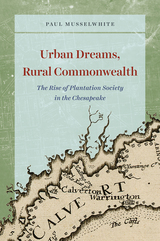
Paul Musselwhite details the unsuccessful urban development that defined the region from the seventeenth century through the Civil War, showing how places like Jamestown and Annapolis—despite their small size—were the products of ambitious and cutting-edge experiments in urbanization comparable to those in the largest port cities of the Atlantic world. These experiments, though, stoked ongoing debate about commerce, taxation, and self-government. Chesapeake planters responded to this debate by reinforcing the political, economic, and cultural authority of their private plantation estates, with profound consequences for the region’s laborers and the political ideology of the southern United States. As Musselwhite makes clear, the antebellum economy around this well-known waterway was built not in the absence of cities, but upon their aspirational wreckage.
READERS
Browse our collection.
PUBLISHERS
See BiblioVault's publisher services.
STUDENT SERVICES
Files for college accessibility offices.
RECENTLY PUBLISHED




UChicago Accessibility Resources
home | accessibility | search | about | contact us
BiblioVault ® 2001 - 2025
The University of Chicago Press