
 A SCHOLARLY BOOK REPOSITORY
Browse by Title
4 books by Williams, Learotha
4 books by Williams, Learotha
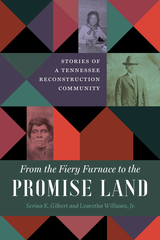
From the Fiery Furnace to the Promise Land
Stories of a Tennessee Reconstruction Community
Serina K. Gilbert and Learotha Williams Jr.
Vanderbilt University Press, 2025
The Promise Land community, a small village west of Nashville, Tennessee was founded after the Civil War by people who had been enslaved at the Cumberland Iron Furnace. These early settlers, who included United States Colored Troops veterans, were able to purchase land and establish Black‑owned businesses. This afforded the community a level of stability that defies conventional wisdom about the post‑Reconstruction‑era South.
In time the community encompassed approximately 1,000 acres with more than 50 homes, several stores, three churches, and an elementary school. But by the mid‑twentieth century, the community had dwindled to just a handful of families. Now all that remains physically is a church and the old school building. But in the hearts of the descendants of those families, Promise Land remains a vital and thriving community of friends, family, and, albeit virtual, neighbors who continue to support each other.
This is the story of this town told through the memories of the people who lived there. Serina Gilbert grew up in the community and is now one of the revered storytellers and story‑keepers of Promise Land. Along with historian Learotha Williams, she is sharing the history of a community that thrived and continues to thrive in the face of almost insurmountable obstacles.
In time the community encompassed approximately 1,000 acres with more than 50 homes, several stores, three churches, and an elementary school. But by the mid‑twentieth century, the community had dwindled to just a handful of families. Now all that remains physically is a church and the old school building. But in the hearts of the descendants of those families, Promise Land remains a vital and thriving community of friends, family, and, albeit virtual, neighbors who continue to support each other.
This is the story of this town told through the memories of the people who lived there. Serina Gilbert grew up in the community and is now one of the revered storytellers and story‑keepers of Promise Land. Along with historian Learotha Williams, she is sharing the history of a community that thrived and continues to thrive in the face of almost insurmountable obstacles.
[more]

I'll Take You There
Exploring Nashville's Social Justice Sites
Amie Thurber
Vanderbilt University Press, 2021
Before there were guidebooks, there were just guides—people in the community you could count on to show you around.
I'll Take You There is written by and with the people who most intimately know Nashville, foregrounding the struggles and achievements of people's movements toward social justice. The colloquial use of "I'll take you there" has long been a response to the call of a stranger: for recommendations of safe passage through unfamiliar territory, a decent meal and place to lay one's head, or perhaps a watering hole or juke joint.
In this book, more than one hundred Nashvillians "take us there," guiding us to places we might not otherwise encounter. Their collective entries bear witness to the ways that power has been used by social, political, and economic elites to tell or omit certain stories, while celebrating the power of counternarratives as a tool to resist injustice. Indeed, each entry is simultaneously a story about place, power, and the historic and ongoing struggle toward a more just city for all. The result is akin to the experience of asking for directions in an unfamiliar place and receiving a warm offer from a local to lead you on, accompanied by a tale or two.
I'll Take You There is written by and with the people who most intimately know Nashville, foregrounding the struggles and achievements of people's movements toward social justice. The colloquial use of "I'll take you there" has long been a response to the call of a stranger: for recommendations of safe passage through unfamiliar territory, a decent meal and place to lay one's head, or perhaps a watering hole or juke joint.
In this book, more than one hundred Nashvillians "take us there," guiding us to places we might not otherwise encounter. Their collective entries bear witness to the ways that power has been used by social, political, and economic elites to tell or omit certain stories, while celebrating the power of counternarratives as a tool to resist injustice. Indeed, each entry is simultaneously a story about place, power, and the historic and ongoing struggle toward a more just city for all. The result is akin to the experience of asking for directions in an unfamiliar place and receiving a warm offer from a local to lead you on, accompanied by a tale or two.
[more]

The Sculpture of William Edmondson
Tombstones, Garden Ornaments, and Stonework
Marin R. Sullivan
Vanderbilt University Press, 2021
Winner of the Mary Ellen LoPresti Publication Award, Art Libraries Society of North America (ARLIS/NA), 2022
William Edmondson (1874–1951) was the first African American sculptor to have a one-person exhibition at the Museum of Modern Art. Edmondson started sculpting in his late fifties, after the Nashville Women's Hospital, where he worked as a janitor, closed. During his life he was well known for his yard art, such as whimsical birdbaths and "critters" of real and imaginary provenance, and the grave markers he carved for African American families. His sculptures are now highly sought after by collectors.
The Sculpture of William Edmondson: Tombstones, Garden Ornaments, and Stonework is the first large-scale museum examination of artist William Edmondson's career in over twenty years. Organized by Cheekwood Curator-at-Large Marin R. Sullivan, the exhibition draws upon new scholarship and methodologies to contextualize Edmondson's sculpture, both within the histories of Nashville during the Interwar years and the art histories of modern art in the United States.
Edmondson has largely been confined to narratives that focus on his artistic discovery by white patrons in the 1930s, his work's formal resonance with so-called primitivism and direct carving techniques, and his place in the traditions of African American "outsider" art. This exhibition revisits Edmondson's work within these frameworks, but also seeks to reevaluate his sculpture on its own terms and as part of a comprehensive practice that included the creation of commercial objects rather than strictly fine art.
The exhibition's title references the sign that hung on the outside of Edmondson's studio, advertising what was for sale and on view to the public in his yard, including tombstones, birdbaths, and statuary meant to be used and intended for outdoor rather than gallery display.
William Edmondson (1874–1951) was the first African American sculptor to have a one-person exhibition at the Museum of Modern Art. Edmondson started sculpting in his late fifties, after the Nashville Women's Hospital, where he worked as a janitor, closed. During his life he was well known for his yard art, such as whimsical birdbaths and "critters" of real and imaginary provenance, and the grave markers he carved for African American families. His sculptures are now highly sought after by collectors.
The Sculpture of William Edmondson: Tombstones, Garden Ornaments, and Stonework is the first large-scale museum examination of artist William Edmondson's career in over twenty years. Organized by Cheekwood Curator-at-Large Marin R. Sullivan, the exhibition draws upon new scholarship and methodologies to contextualize Edmondson's sculpture, both within the histories of Nashville during the Interwar years and the art histories of modern art in the United States.
Edmondson has largely been confined to narratives that focus on his artistic discovery by white patrons in the 1930s, his work's formal resonance with so-called primitivism and direct carving techniques, and his place in the traditions of African American "outsider" art. This exhibition revisits Edmondson's work within these frameworks, but also seeks to reevaluate his sculpture on its own terms and as part of a comprehensive practice that included the creation of commercial objects rather than strictly fine art.
The exhibition's title references the sign that hung on the outside of Edmondson's studio, advertising what was for sale and on view to the public in his yard, including tombstones, birdbaths, and statuary meant to be used and intended for outdoor rather than gallery display.
[more]

Voyage of the Adventure
Retracing the Donelson Party's Journey to the Founding of Nashville
John Guider
Vanderbilt University Press, 2021
In the harsh winter of 1779, as the leader of a flotilla of settlers, John Donelson loaded his family and thirty slaves into a forty-foot flatboat at the present site of Kingsport, Tennessee. Their journey into the wilderness led to the founding of a settlement now known as Nashville—over one thousand river miles away. In the fall of 2016, photographer John Guider retraced the Donelson party’s journey in his hand-built 14½' motorless rowing sailboat while making a visual documentation of the river as it currently exists 240 years later.
This photo book contains more than 120 striking images from the course of the journey, allowing the reader to see how much has changed and how much has remained untouched in the two and a half centuries since Donelson first took to the water. Equally significant, the essays include long-ignored contemporary histories of both the Cherokee whom Donelson encountered and the slaves he brought with him, some of whom did not survive the journey.
Guider, a professional photographer, has created images of every point in the thousand-mile trip from a platform just a few feet above the waterline of three of Tennessee’s most notable rivers.
This photo book contains more than 120 striking images from the course of the journey, allowing the reader to see how much has changed and how much has remained untouched in the two and a half centuries since Donelson first took to the water. Equally significant, the essays include long-ignored contemporary histories of both the Cherokee whom Donelson encountered and the slaves he brought with him, some of whom did not survive the journey.
Guider, a professional photographer, has created images of every point in the thousand-mile trip from a platform just a few feet above the waterline of three of Tennessee’s most notable rivers.
[more]
READERS
Browse our collection.
PUBLISHERS
See BiblioVault's publisher services.
STUDENT SERVICES
Files for college accessibility offices.
RECENTLY PUBLISHED




UChicago Accessibility Resources
home | accessibility | search | about | contact us
BiblioVault ® 2001 - 2025
The University of Chicago Press