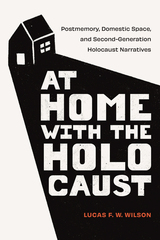
At Home with the Holocaust
Postmemory, Domestic Space, and Second-Generation Holocaust Narratives
Lucas F. W. Wilson
Rutgers University Press, 2025
At Home with the Holocaust examines the relationship between intergenerational trauma and domestic space, focusing on how Holocaust survivors’ homes became extensions of their traumatized psyches that their children “inhabited.” Analyzing second- and third-generation Holocaust literature—such as Art Spiegelman's Maus, Jonathan Safran Foer's Everything Is Illuminated, Sonia Pilcer's The Holocaust Kid, and Elizabeth Rosner's The Speed of Light—as well as oral histories of children of survivors, Lucas F. W. Wilson's study reveals how the material conditions of survivor-family homes, along with household practices and belongings, rendered these homes as spaces of traumatic transference. As survivors’ traumas became imbued in the very space of the domestic, their homes functioned as material archives of their Holocaust pasts, creating environments that, not uncommonly, second-handedly wounded their children. As survivor-family homes were imaginatively transformed by survivors’ children into the sites of their parents’ traumas, like concentration camps and ghettos, their homes catalyzed the transmission of these traumas.
[more]