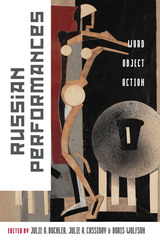
front cover of Russian Performances
Russian Performances
Word, Object, Action
Edited by Julie A. Buckler, Julie A. Cassiday, and Boris Wolfson
University of Wisconsin Press, 2018
Throughout its modern history, Russia has seen a succession of highly performative social acts that play out prominently in the public sphere. This innovative volume brings the fields of performance studies and Russian studies into dialog for the first time and shows that performance is a vital means for understanding Russia's culture from the reign of Peter the Great to the era of Putin. These twenty-seven essays encompass a diverse range of topics, from dance and classical music to live poetry and from viral video to public jubilees and political protest. As a whole they comprise an integrated, compelling intervention in Russian studies.

Challenging the primacy of the written word in this field, the volume fosters a larger intellectual community informed by theories and practices of performance from anthropology, art history, dance studies, film studies, cultural and social history, literary studies, musicology, political science, theater studies, and sociology.

[more]

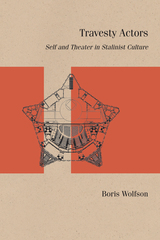
front cover of Travesty Actors
Travesty Actors
Self and Theater in Stalinist Culture
Boris Wolfson, edited by Simon Morrison
Northwestern University Press, 2026
Examining theatrical performance under Stalinist cultural mandates
 
Talk of Joseph Stalin’s “show trials,” the public prosecutions in Moscow’s Hall of Columns in the late 1930s, is so familiar as to obscure the relationship between actual shows—in the Soviet Union’s major theaters—and politics. Travesty Actors: Self and Theater in Stalinist Culture examines theatrical performance within the context of the Soviet cultural establishment’s fashioning of a “genuine Soviet person.” Boris Wolfson focuses on prominent and controversial plays by artists including Aleksandr Afinogenov, Mikhail Bulgakov, Yuri Olesha, and Natalia Sats and the efforts of theater companies, like the Moscow Arts Theater, the Meyerhold Theater, and the Central Children’s Theater, to adhere to this cultural mandate while grappling with repression, censorship, and conflicting interpretations of its aims. Drawing on archival materials, diaries and memoirs and eyewitness accounts, Wolfson greatly illuminates the achievements of Soviet theater during this harsh period and the cultural significance of artistic theories and practices for articulating and enacting ideological programs.
[more]


Send via email Share on Facebook Share on Twitter