
 A SCHOLARLY BOOK REPOSITORY

Finalist for the 2021 Siskiyou Prize for New Environmental Literature
As people come to understand more about animals’ inner lives—the intricacies of their thoughts and the emotions that are expressed every day by whales and cows, octopus and mice, even bees—we feel a growing compassion, a desire to better their lives. But how do we translate this compassion into helping other creatures, both those that are and are not our pets? Bringing together the latest science with heartfelt storytelling, Animals’ Best Friends reveals the opportunities we have in everyday life to help animals in our homes, in the wild, in zoos, and in science labs, as well as those considered to be food.
Barbara J. King, an expert on animal cognition and emotion, guides us on a journey both animal and deeply human. We meet cows living relaxed lives in an animal sanctuary—and cows with plastic portals in their sides at a university research station. We observe bison free-roaming at Yellowstone National Park and chimpanzees confined to zoos. We learn with King how to negotiate vegetarian preferences in omnivore restaurants. We experience the touch of a giant Pacific octopus tasting King’s skin with one of his long, neuron-rich arms. We reflect on animal testing as King shares her own experience as the survivor of a particularly nasty cancer. And in a moment all too familiar to many of us, we recover from a close encounter with two spiders in the home.
This is a book not of shaming and limitation, but of uplift and expansion. Throughout this journey, King makes no claims of personal perfection. Though an animal expert, she is just like the rest of us: on a journey still, learning each day how to be better, and do better, for animals. But as Animals’ Best Friends makes clear, challenging choices can bring deep rewards. By turning compassion into action on behalf of animals, we not only improve animals’ lives—we also immeasurably enrich our own.

Although not intended as a manual for landowners, Between Urban and Wild nonetheless offers useful and engaging perspectives on the realities of settling and living in a partially wild environment. Throughout her ongoing journey of being home, Jones’s close observations of the land and its native inhabitants are paired with the suggestion that even small landholders can act to protect the health of their properties. Her brief meditations capture and honor the subtleties of the natural world while illuminating the importance of working to safeguard it.
Probing the contradictions of a lifestyle that burdens the health of the land that she loves, Jones’s writing is permeated by her gentle, earnest conviction that living at the urban-wild interface requires us to set aside self-interest, consider compromise, and adjust our expectations and habits—to accommodate our surroundings rather than force them to accommodate us.
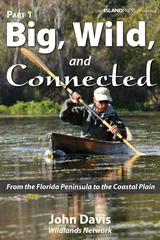
This E-ssential is a three-part series that covers John Davis's epic journey from Florida to Maine. In 2011, with support from the Wildlands Network, Davis traveled 7,600 miles in 10 months from Florida to Maine by foot, bicycle, skis, and canoe/kayak. His extensive travels were motivated by wanting to answer the question “Is it possible in the twenty-first century to identify and protect a continental-long wildlife corridor that could help to protect eastern nature into the future?”
John paints a vivid picture of the physical challenges of the trek, such as climbing the highest point in South Carolina with a heavily loaded bike and trying to consume the 8,000 calories per day he needed to fuel himself for the journey. As readers adventure with Davis, they will also share his evolving understanding of what it would take to implement an Eastern Wildway.
Eastern wildlife, both seen and unseen, from Florida panthers to North Carolina’s red wolves to the ghosts of cougars farther north, are the real focus of this adventure as John explores how such wildness can coexist with human development in the most populated regions of the United States. The science and conservation of large-scale connectivity are brought to life by his travels—offering unique insights into the challenges and opportunities for creating an Eastern Wildway. This is a must-read for enthusiasts of hiking narratives, as well as professionals and students interested in issues related to large-scale connectivity. Compelling photographs and other graphics complement John’s fascinating story.
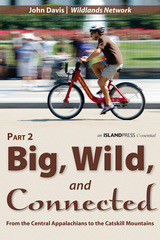
John paints a vivid picture of the physical challenges of the trek, such as climbing the highest point in South Carolina with a heavily loaded bike and trying to consume the 8,000 calories per day he needed to fuel himself for the journey. As readers adventure with Davis, they will also share his evolving understanding of what it would take to implement an Eastern Wildway.
Eastern wildlife, both seen and unseen, from Florida panthers to North Carolina’s red wolves to the ghosts of cougars farther north, are the real focus of this adventure as John explores how such wildness can coexist with human development in the most populated regions of the United States. The science and conservation of large-scale connectivity are brought to life by his travels—offering unique insights into the challenges and opportunities for creating an Eastern Wildway. This is a must-read for enthusiasts of hiking narratives, as well as professionals and students interested in issues related to large-scale connectivity. Compelling photographs and other graphics complement John’s fascinating story.
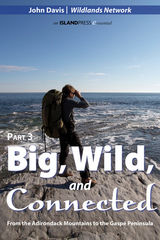
John paints a vivid picture of the physical challenges of the trek, such as climbing the highest point in South Carolina with a heavily loaded bike and trying to consume the 8,000 calories per day he needed to fuel himself for the journey. As readers adventure with Davis, they will also share his evolving understanding of what it would take to implement an Eastern Wildway.
Eastern wildlife, both seen and unseen, from Florida panthers to North Carolina’s red wolves to the ghosts of cougars farther north, are the real focus of this adventure as John explores how such wildness can coexist with human development in the most populated regions of the United States. The science and conservation of large-scale connectivity are brought to life by his travels—offering unique insights into the challenges and opportunities for creating an Eastern Wildway. This is a must-read for enthusiasts of hiking narratives, as well as professionals and students interested in issues related to large-scale connectivity. Compelling photographs and other graphics complement John’s fascinating story.
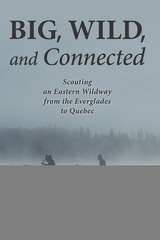
In Big, Wild, and Connected, we travel the Eastern Wildway with Davis, viscerally experiencing the challenges large carnivores, with their need for vast territories, face in an ongoing search for food, water, shelter, and mates. On his self-propelled journey, Davis explores the wetlands, forests, and peaks that are the last strongholds for wildlife in the East. This includes strategically important segments of disturbed landscapes, from longleaf pine savanna in the Florida Panhandle to road-latticed woods of Pennsylvania. Despite the challenges, Davis argues that creation of an Eastern Wildway is within our reach and would serve as a powerful symbol of our natural and cultural heritage.
Big, Wild, and Connected reveals Eastern landscapes through wild eyes, a reminder that, for the creatures with which we share the land, movement is as essential to life as air, water, and food. Davis’ journey shows that a big, wild, and connected network of untamed places is the surest way to ensure wildlife survival through the coming centuries.
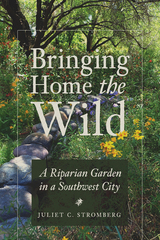
This book follows a two-decade journey in ecologically guided gardening on a four-acre irrigated parcel in Phoenix, Arizona, from the perspective of a retired botanist and her science historian partner. Through humor and playful use of language, Bringing Home the Wild not only introduces the plants who are feeding them, buffering the climate, and elevating their moods but also acknowledges the animals and fungi who are pollinating the plants and recycling the waste. Some of the plants featured are indigenous to the American Southwest, while others are part of the biocultural heritage of the cityscape. This book makes the case for valuing inclusive biodiversity and for respectful interactions with all wild creatures, regardless of their historical origin.
As author and partner learn to cohabit with the plants who feed them, calm them, entertain them, and protect them from the increasing heat, their desire to live sustainably, ethically, and close to the land becomes even stronger, revealing the importance of observing, appreciating, and learning from the ecosystems of which we are a part.
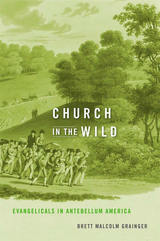
A religious studies scholar argues that in antebellum America, evangelicals, not Transcendentalists, connected ordinary Americans with their spiritual roots in the natural world.
We have long credited Emerson and his fellow Transcendentalists with revolutionizing religious life in America and introducing a new appreciation of nature. Breaking with Protestant orthodoxy, these New Englanders claimed that God could be found not in church but in forest, fields, and streams. Their spiritual nonconformity had thrilling implications but never traveled far beyond their circle. In this essential reconsideration of American faith in the years leading up to the Civil War, Brett Malcolm Grainger argues that it was not the Transcendentalists but the evangelical revivalists who transformed the everyday religious life of Americans and spiritualized the natural environment.
Evangelical Christianity won believers from the rural South to the industrial North: this was the true popular religion of the antebellum years. Revivalists went to the woods not to free themselves from the constraints of Christianity but to renew their ties to God. Evangelical Christianity provided a sense of enchantment for those alienated by a rapidly industrializing world. In forested camp meetings and riverside baptisms, in private contemplation and public water cures, in electrotherapy and mesmerism, American evangelicals communed with nature, God, and one another. A distinctive spirituality emerged pairing personal piety with a mystical relation to nature.
As Church in the Wild reveals, the revivalist attitude toward nature and the material world, which echoed that of Catholicism, spread like wildfire among Christians of all backgrounds during the years leading up to the Civil War.
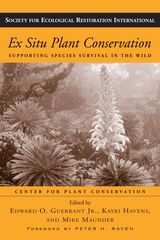
Faced with widespread and devastating loss of biodiversity in wild habitats, scientists have developed innovative strategies for studying and protecting targeted plant and animal species in "off-site" facilities such as botanic gardens and zoos. Such ex situ work is an increasingly important component of conservation and restoration efforts.
Ex Situ Plant Conservation, edited by Edward O. Guerrant Jr., Kayri Havens, and Mike Maunder, is the first book to address integrated plant conservation strategies and to examine the scientific, technical, and strategic bases of the ex situ approach. The book examines where and how ex situ investment can best support in situ conservation. Ex Situ Plant Conservation outlines the role, value, and limits of ex situ conservation as well as updating best management practices for the field, and is an invaluable resource for plant conservation practitioners at botanic gardens, zoos, and other conservation organizations; students and faculty in conservation biology and related fields; managers of protected areas and other public and private lands; and policymakers and members of the international community concerned with species conservation.
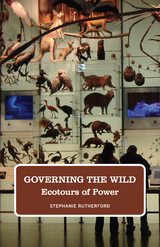
Take four emblematic American scenes: the Hall of Biodiversity at the American Museum of Natural History in New York; Disney’s Animal Kingdom theme park in Orlando; an ecotour of Yellowstone and Grand Teton National Parks; the film An Inconvenient Truth. Other than expressing a common interest in the environment, they seem quite dissimilar.
And yet, as Governing the Wild makes clear, these sites are all manifestations of green governmentality, each seeking to define and regulate our understanding, experience, and treatment of nature. Stephanie Rutherford shows how the museum presents a scientized assessment of global nature under threat; the Animal Kingdom demonstrates that a corporation can successfully organize a biopolitical project; the ecotour, operating as a school for a natural aesthetic sensibility, provides a visual grammar of pristine national nature; and the film offers a toehold on a moral way of encountering nature. But one very powerful force unites the disparate “truths” of nature produced through these sites, and that, Rutherford tells us, is their debt to nature’s commodification.
Rutherford’s analysis reveals how each site integrates nature, power, and profit to make the buying and selling of nature critical to our understanding and rescuing of it. The combination, she argues, renders other ways of encountering nature—particularly more radically environmental ways—unthinkable.
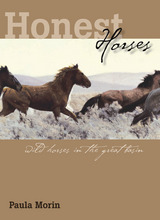
Horses have been part of the American West since the first Spanish explorers brought their European-bred steeds onto the new continent. Soon thereafter, some of these animals, lost or abandoned by their owners or captured by indigenous peoples, became the foundation of the great herds of mustangs (from the Spanish mesteño, stray) that still roam the West. These feral horses are inextricably intertwined with the culture, economy, and mythology of the West. The current situation of the mustangs as vigorous competitors for the scanty resources of the West’s drought-parched rangelands has put them at the center of passionate controversies about their purpose, place, and future on the open range. Photographer/oral historian Paula Morin has interviewed sixty-two people who know these horses best: ranchers, horse breeders and trainers, Native Americans, veterinarians, wild horse advocates, mustangers, range scientists, cowboy poets, western historians, wildlife experts, animal behaviorists, and agents of the federal Bureau of Land Management. The result is the most comprehensive, impartial examination yet of the history and impact of wild mustangs in the Great Basin. Morin elicits from her interviewees a range of expertise, insight, and candid opinion about the nature of horses, ranching, and the western environment. Honest Horses brings us the voices of authentic westerners, people who live intimately with horses and the land, who share their experiences and love of the mustangs, and who understand how precariously all life exists in Great Basin.
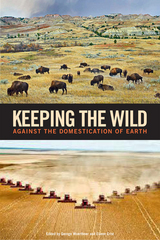
In Keeping the Wild, a group of prominent scientists, writers, and conservation activists responds to the Anthropocene-boosters who claim that wild nature is no more (or in any case not much worth caring about), that human-caused extinction is acceptable, and that “novel ecosystems” are an adequate replacement for natural landscapes. With rhetorical fists swinging, the book’s contributors argue that these “new environmentalists” embody the hubris of the managerial mindset and offer a conservation strategy that will fail to protect life in all its buzzing, blossoming diversity.
With essays from Eileen Crist, David Ehrenfeld, Dave Foreman, Lisi Krall, Harvey Locke, Curt Meine, Kathleen Dean Moore, Michael Soulé, Terry Tempest Williams and other leading thinkers, Keeping the Wild provides an introduction to this important debate, a critique of the Anthropocene boosters’ attack on traditional conservation, and unapologetic advocacy for wild nature.
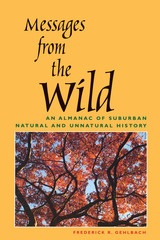
Seeking a closer connection with nature than the manicured lawns of suburbia, naturalist Fred Gehlbach and his family built a house on the edge of a wooded ravine in Central Texas in the mid-1960s. On daily walks over the hills, creek hollows, and fields of the ravine, Gehlbach has observed the cycles of weather and seasons, the annual migrations of birds, and the life cycles of animals and plants that also live in the ravine.
In this book, Gehlbach draws on thirty-five years of journal entries to present a composite, day-by-day almanac of the life cycles of this semiwild natural island in the midst of urban Texas. Recording such events as the hatching of Eastern screech owl chicks, the emergence of June bugs, and the first freeze of November, he reminds us of nature's daily, monthly, and annual cycles, from which humans are becoming ever more detached in our unnatural urban environments. The long span of the almanac also allows Gehlbach to track how local and even global developments have affected the ravine, from scars left by sewer construction to an increase in frost-free days probably linked to global warming.
This long-term record of natural cycles provides one of only two such baseline data sets for North America. At the same time, the book is an eloquent account of one keen observer's daily interactions with his wild and human neighbors and of the lessons in connectedness and the "play of life" that they teach.
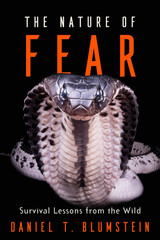
An Open Letters Review Best Book of the Year
A leading expert in animal behavior takes us into the wild to better understand and manage our fears.
Fear, honed by millions of years of natural selection, kept our ancestors alive. Whether by slithering away, curling up in a ball, or standing still in the presence of a predator, humans and other animals have evolved complex behaviors in order to survive the hazards the world presents. But, despite our evolutionary endurance, we still have much to learn about how to manage our response to danger.
For more than thirty years, Daniel Blumstein has been studying animals’ fear responses. His observations lead to a firm conclusion: fear preserves security, but at great cost. A foraging flock of birds expends valuable energy by quickly taking flight when a raptor appears. And though the birds might successfully escape, they leave their food source behind. Giant clams protect their valuable tissue by retracting their mantles and closing their shells when a shadow passes overhead, but then they are unable to photosynthesize, losing the capacity to grow. Among humans, fear is often an understandable and justifiable response to sources of threat, but it can exact a high toll on health and productivity.
Delving into the evolutionary origins and ecological contexts of fear across species, The Nature of Fear considers what we can learn from our fellow animals—from successes and failures. By observing how animals leverage alarm to their advantage, we can develop new strategies for facing risks without panic.

The complete resource on backcountry camping from a legendary wilderness expert.
In this classic guide, first published in the late 1950s, Rutstrum covers the key elements of a successful camping trip: the proper way to build a raft, chop down a tree, construct a campsite, cook over a campfire, find a way through the woods, and much more. Drawing upon his vast experience in all kinds of weather, Rutstrum provides essential knowledge for every camper, in a lightweight volume perfect for the backpack.
Gyorgyi Voros focuses on three governing metaphors in Stevens' poems—Nature as house, Nature as body, and Nature as self. She argues that Stevens' youthful wilderness experience yielded his primary subject—the relationship between human beings and nonhuman nature—and that it spurred his shift from a romantic to a phenomenological understanding of nature. Most important, it prompted him to reject his culture's narrow humanism in favor of a singular vision that in today's terms would he deemed ecological.
Pilgrims to the Wild is a survey of American writers who have responded to their encounters with the natural world. Ranging in its treatment from Thoreau’s important but neglected essay, 'Walking,' to the exuberant letters of the young artist Everett Ruess (who disappeared in the Escalante canyonlands), this is a broadly based exploration that brings to bear Eastern and Western classical philosophy, as well as contemporary critical theory, on a distinctive tradition of American Writing—those works concerned with the human relationship to the nonhuman world.
In addition to offering a fresh interpretation of classic authors such a Thoreau and Muir, this book introduces readers to the less widely known but equally fascinating writers Clarence King and Mary Austin.
Where and what is the place of the wild? Is the goal of preserving biodiversity across the landscape of North America compatible with contemporary Western culture?
Place of the Wild brings together original essays from an exceptional array of contemporary writers and activists to present in a single volume the most current thinking on the relationship between humans and wilderness. A common thread running through the volume is the conviction that everyone concerned with the natural world -- academics and activists, philosophers and poets -- must join forces to re-establish cultural narratives and shared visions that sustain life on this planet.
The contributors apply the insights of conservation biology to the importance of wilderness in the 21st century, raising questions and stimulating thought. The volume begins with a series of personal narratives that present portraits of wildlands and humans. Following those narratives are more-analytical discourses that examine conceptions and perceptions of the wild, and of the place of humanity in it. The concluding section features clear and resonant activist voices that consider the importance of wildlands, and what can be done to reconcile the needs of wilderness with the needs of human culture.
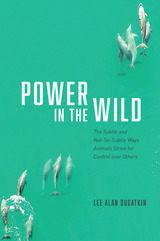
The quest for power in animals is so much richer, so much more nuanced than who wins what knock-down, drag-out fight. Indeed, power struggles among animals often look more like an opera than a boxing match. Tracing the path to power for over thirty different species on six continents, writer and behavioral ecologist Lee Alan Dugatkin takes us on a journey around the globe, shepherded by leading researchers who have discovered that in everything from hyenas to dolphins, bonobos to field mice, cichlid fish to cuttlefish, copperhead snakes to ravens, and meerkats to mongooses, power revolves around spying, deception, manipulation, forming and breaking up alliances, complex assessments of potential opponents, building social networks, and more. Power pervades every aspect of the social life of animals: what they eat, where they eat, where they live, whom they mate with, how many offspring they produce, whom they join forces with, and whom they work to depose. In some species, power can even change an animal’s sex. Nor are humans invulnerable to this magnificently intricate melodrama: Dugatkin’s tales of the researchers studying power in animals are full of unexpected pitfalls, twists and turns, serendipity, and the pure joy of scientific discovery.
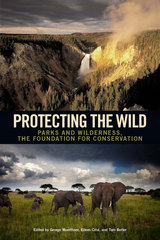
Protecting the Wild offers a spirited argument for the robust protection of the natural world. In it, experts from five continents reaffirm that parks, wilderness areas, and other reserves are an indispensable—albeit insufficient—means to sustain species, subspecies, key habitats, ecological processes, and evolutionary potential. Using case studies from around the globe, they present evidence that terrestrial and marine protected areas are crucial for biodiversity and human well-being alike, vital to countering anthropogenic extinctions and climate change.
A companion volume to Keeping the Wild: Against the Domestication of Earth, Protecting the Wild provides a necessary addition to the conversation about the future of conservation in the so-called Anthropocene, one that will be useful for academics, policymakers, and conservation practitioners at all levels, from local land trusts to international NGOs.
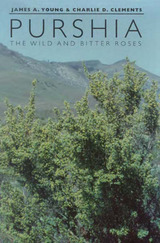
A useful and complete summary of all the scientific information available on one of the most significant plant species in the western and intermountain regions. Among the plant species of the great Basin rangeland, the Purshia—ancient members of the rose family evolved to survive the aridity and temperature extremes of this harsh region—are one of the most important. This book-length study of this key plant species provides a comprehensive examination of the biology and ecology of the species and region.
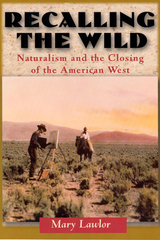
Ever since the first interactions between Europeans and Native Americans, the “West” has served as a site of complex geographical, social and cultural transformation. American literature is defined, in part, by the central symbols derived from these points of contact. By the end of the nineteenth century, the Western frontier was declared “closed,” a demise solidified by Frederick Jackson Turner’s influential essay “The Significance of the Frontier in American History (1893). At the same time, “naturalism” was popularized by the writings of Frank Norris, Stephen Crane, Jack London, Willa Cather, and the photographs of Edward Curtis. Though very different artists, they were united by their common attraction to the mythic American West.
As she investigates the interactions of representations of the West, Lawlor effortlessly melds literary studies, American studies, and history. She traces the cultural conception of the American West through its incarnations in the “westernism” of Daniel Boone and James Fenimore Cooper and the romanticism of the expansive frontier they helped formulate. Simultaneously, however, the influence of evolutionism and the styles of French naturalism began to challenge this romantic idiom. This naturalistic discourse constructed the West as a strictly material place, picturing a limited and often limiting geography that portrayed regional identity as the product of material “forces” rather than of individualistic enterprise.
With subtle, probing language, Lawlor explains how literary and artistic devices helped shape the idea of the American West and the changing landscape of the continent at the turn of the last century.
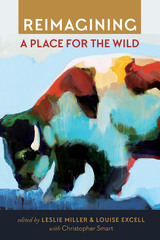
Reimagining a Place for the Wild contains a diverse collection of personal stories that describe encounters with the remaining wild creatures of the American West and critical essays that reveal wildlife’s essential place in western landscapes. Gleaned from historians, journalists, biologists, ranchers, artists, philosophers, teachers, and conservationists, these narratives expose the complex challenges faced by wild animals and those devoted to understanding them. Whether discussing keystone species like grizzly bears and gray wolves or microfauna swimming the thermal depths of geysers, these accounts reflect the authors’ expertise as well as their wonder and respect for wild nature. The writers do more than inform our sensibilities; their narratives examine both humanity’s conduct and its capacity for empathy toward other life. A selection of photos and paintings punctuates the volume.
This collection sprang from the Reimagine Western Landscapes Symposium held at the University of Utah’s Taft-Nicholson Environmental Humanities Education Center in Centennial Valley, Montana. These testaments join a chorus of voices seeking improved relations with the western wild in the twenty-first century.
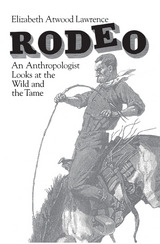
Based on extensive field work and drawing on comparative materials from other stock-tending societies, Rodeo is a major contribution to an understanding of the role of performance in society, the culturally constructed view of man's place in nature, and the structure and meaning of social relationships and their representations.
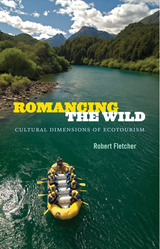
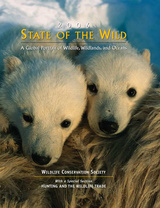
In wild places where nature thrives, humanity prospers; our well-being is inextricably linked with that of the planet's web of life. In fact, one could argue that the state of the world can be measured by the state of the wild.
But how do we gauge the state of earth's wildlife, wildlands, and oceans? State of the Wild is a new series that brings together some of the world's most renowned conservationists and writers-George Schaller, Alan Rabinowitz, Sylvia Earle, Rick Bass, Bill McKibben, Tom Lovejoy, and many others-to assess wildlife and wilderness, and to provide insights into how humans can become better stewards of the wild.
This new series combines evocative writings with a fascinating tour of news highlights and vital statistics from around the world. One-third of each volume will focus on a topic of particular concern to conservationists working to protect wildlife and our last wild places. This 2006 edition explores the impacts of hunting and the wildlife trade through a range of essays: Ted Kerasote traces the history of hunting in North America; Carl Safina, Eric Gilman, and Wallace J. Nichols quantify the toll taken by commercial fishing on seabirds, turtles, and other marine species; James Compton and Samuel K. H. Lee explore the global reach of the wildlife trade for traditional Asian medicine.
Contributors also examine other pivotal conservation issues, from the reasons why one in eight of the world's birds are endangered, to the impacts of global climate change, to the complexity of conserving seals, flamingos, zebras, and other wide-ranging species. The book's closing essay, "The Relative Wild," considers what exactly it means for a place to be "wild," where even the most remote corners of the planet have been altered by human activities.
Uniquely structured with magazine-like features up front, conservation news in the middle, and essay contributions from eminent authors and biologists throughout, this landmark series is an essential addition to any environmental bookshelf.
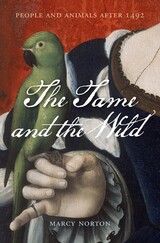
A dramatic new interpretation of the encounter between Europe and the Americas that reveals the crucial role of animals in the shaping of the modern world.
When the men and women of the island of Guanahani first made contact with Christopher Columbus and his crew on October 12, 1492, the cultural differences between the two groups were vaster than the oceans that had separated them. There is perhaps no better demonstration than the divide in their respective ways of relating to animals. In The Tame and the Wild, Marcy Norton tells a new history of the colonization of the Americas, one that places wildlife and livestock at the center of the story. She reveals that the encounters between European and Native American beliefs about animal life transformed societies on both sides of the Atlantic.
Europeans’ strategies and motives for conquest were inseparable from the horses that carried them in military campaigns and the dogs they deployed to terrorize Native peoples. Even more crucial were the sheep, cattle, pigs, and chickens whose flesh became food and whose skins became valuable commodities. Yet as central as the domestication of animals was to European plans in the Americas, Native peoples’ own practices around animals proved just as crucial in shaping the world after 1492. Cultures throughout the Caribbean, Amazonia, and Mexico were deeply invested in familiarization: the practice of capturing wild animals—not only parrots and monkeys but even tapir, deer, and manatee—and turning some of them into “companion species.” These taming practices not only influenced the way Indigenous people responded to human and nonhuman intruders but also transformed European culture itself, paving the way for both zoological science and the modern pet.
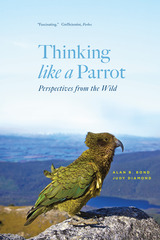
People form enduring emotional bonds with other animal species, such as dogs, cats, and horses. For the most part, these are domesticated animals, with one notable exception: many people form close and supportive relationships with parrots, even though these amusing and curious birds remain thoroughly wild creatures. What enables this unique group of animals to form social bonds with people, and what does this mean for their survival?
In Thinking like a Parrot, Alan B. Bond and Judy Diamond look beyond much of the standard work on captive parrots to the mischievous, inquisitive, and astonishingly vocal parrots of the wild. Focusing on the psychology and ecology of wild parrots, Bond and Diamond document their distinctive social behavior, sophisticated cognition, and extraordinary vocal abilities. Also included are short vignettes—field notes on the natural history and behavior of both rare and widely distributed species, from the neotropical crimson-fronted parakeet to New Zealand’s flightless, ground-dwelling kākāpō. This composite approach makes clear that the behavior of captive parrots is grounded in the birds’ wild ecology and evolution, revealing that parrots’ ability to bond with people is an evolutionary accident, a by-product of the intense sociality and flexible behavior that characterize their lives.
Despite their adaptability and intelligence, however, nearly all large parrot species are rare, threatened, or endangered. To successfully manage and restore these wild populations, Bond and Diamond argue, we must develop a fuller understanding of their biology and the complex set of ecological and behavioral traits that has led to their vulnerability. Spanning the global distribution of parrot species, Thinking like a Parrot is rich with surprising insights into parrot intelligence, flexibility, and—even in the face of threats—resilience.

“Why travel?” asks Tomas Espedal in Tramp, “Why not just stay at home, in your room, in your house, in the place you like better than any other, your own place. The familiar house, the requisite rooms in which we have gathered the things we need, a good bed, a desk, a whole pile of books. The windows giving on to the sea and the garden with its apple trees and holly hedge, a beautiful garden, growing wild.”
The first step in any trip or journey is always a footstep—the brave or curious act of putting one foot in front of the other and stepping out of the house onto the sidewalk below. Here, Espedal contemplates what this ambulatory mode of travel has meant for great artists and thinkers, including Rousseau, Kant, Hazlitt, Thoreau, Rimbaud, Whitman, Giacometti, and Robert Louis Stevenson. In the process, he confronts his own inability to write from a fixed abode and his refusal to banish the temptation to become permanently itinerant.
Lyrical and rebellious, immediate and sensuous, Tramp conveys Espedal’s own need to explore on foot—in places as diverse as Wales and Turkey—and offers us the excitement and adventure of being a companion on his fascinating and intriguing travels.
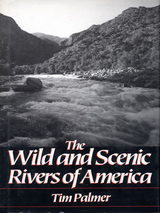
The National Wild and Scenic Rivers Act is one of the most important natural areas protection programs ever established at the federal level. It has resulted in the creation of the National Wild and Scenic Rivers System -- a rich American legacy that includes many of our finest waterways. This book is the definitive resource on the National Wild and Scenic Rivers System. Topics covered include:
- the importance of protecting river ecosystems
- state and local protection systems
- the history of the National Wild and Scenic Rivers System
- descriptions of each of the major rivers in the system
- how and why rivers are chosen for inclusion
- river management
- continuing threats to rivers
- what can be done to make the system more effective and more inclusive

In Wild and Wonderful, social anthropologist Vanessa Manceron investigates an understudied but indispensable scientific practice: getting to know and recognize the living worlds around us. Her research takes her to England, where a longstanding naturalist tradition brings together professionals, academics, and amateurs to study the world around them. Observing the natural world here is regarded not as a simple hobby, but as a necessary activity. This is participatory science, an itinerant brand of scholarship that immerses itself in a specific and delimited territory, meticulously documenting the species living there and how they develop and expand their domain or regress and disappear. Manceron leads us through woods and fields, showing us another way of looking, of paying attention to minute differences, sounds, and variations of color. Her book is both a contribution to the anthropology of science and an opportunity to take a fresh look at our relationship with nature, affording us a glimpse of another way of living and living with.
An indispensable resource for navigating the wild.
In the days before cell phones and global positioning systems, knowing how to find your own way in the wilderness was a vitally important skill. The Wilderness Route Finder, first published in 1967, was the popular resource for anyone venturing into the woods who wanted to find their way out again. Now this essential book is available once more in a handy paperback edition.
As more and more people seek to simplify their wilderness experiences and return to traditional camping methods, Rutstrum’s simple, straightforward, and dependable methods can be appreciated anew. Rutstrum focuses on the tried-and-true techniques that have served wilderness travelers for generations: how to use a map, a compass, a sextant, and the sun and stars. He explains why we sometimes get lost and what we should do when we are. This is a valuable traveling companion for anyone wishing to hunt, fish, explore, camp, or simply walk through unfamiliar territory.
Foreword: Whither World Wilderness? / Vance G. Martin
Introduction: Wilderness in the Rest of the World / David Rothenberg
How Can Four Trees Make a Jungle? / Pramod Parajuli
The Unpaintable West / Zeese Papanikolas
Restoring Wilderness or Reclaiming Forests? / Sahotra Sarkar
For Indian Wilderness / Philip Cafaro and Monish Verma
In the Dust of Kilimanjaro / David Western
Why Conservation in the Tropics Is Failing / John Terborgh
"Trouble in Paradise": An Exchange / David Western and John Terborgh
Zulu History / Ian Player
Bruno Manser and the Penan / William W. Bevis
Roads Where There Have Long Been Trails / Kathleen Harrison
Volcano Dreams / Tom Vanderbilt
Recycled Rain Forest Myths / Antonio Carlos Diegues
The Park of Ten Thousand Waterfalls / Dan Imhoff
Mapping the Wild / Edward A. Whitesell
Earth Jazz / Evan Eisenberg
They Trampled on Our Taboos / Damien Arabagali
READERS
Browse our collection.
PUBLISHERS
See BiblioVault's publisher services.
STUDENT SERVICES
Files for college accessibility offices.
RECENTLY PUBLISHED



UChicago Accessibility Resources
home | accessibility | search | about | contact us
BiblioVault ® 2001 - 2024
The University of Chicago Press